
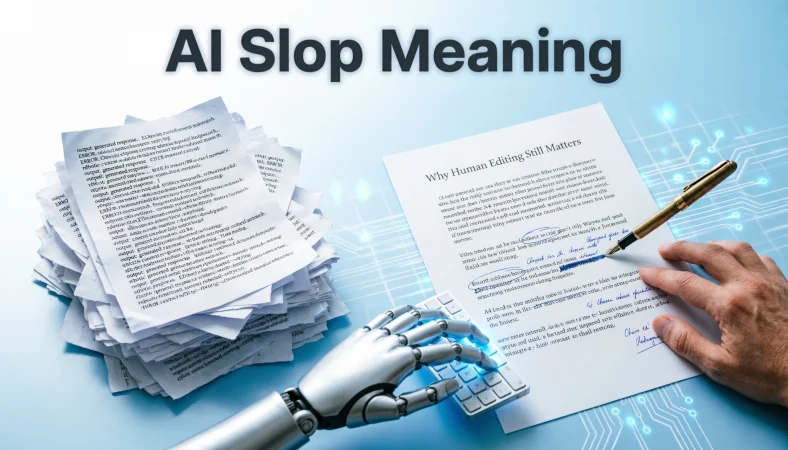
AI slop is a slang term used to describe low-quality, repetitive, or mass-produced content created using artificial intelligence tools, often lacking originality, depth, or human creativity.
Ever scrolled through social media and felt like you’re reading the same article, caption, or product review over and over again? That’s where the phrase “AI slop” enters the conversation.
As AI tools like OpenAI and platforms powered by advanced language models become mainstream, people have started noticing a flood of generic, automated content online. Some call it efficient. Others call it helpful. But critics? They call it AI slop.
In this in-depth guide, we’ll break down:
- What AI slop meaning really is
- Where the term came from
- How it’s used in real conversations
- Tone differences (funny, neutral, negative 😅)
- Comparison with related terms
- Professional alternatives
- FAQs people are actually searching
Let’s dive in.
What Does AI Slop Mean?
AI slop meaning:
A dismissive slang term referring to low-effort, generic, or overly automated content generated by artificial intelligence systems.
The word “slop” traditionally means something messy, unappetizing, or poorly prepared. When combined with “AI,” it implies content that feels rushed, repetitive, or machine-like rather than thoughtful and human-crafted.
It’s commonly used in online discussions, especially on platforms like:
- X (formerly Twitter)
- TikTok
- YouTube
Origin of the Term “AI Slop”
The phrase started gaining popularity around 2023–2025 as generative AI tools became widely accessible.
When AI writing tools, image generators, and video creators exploded in popularity, people noticed:
- Blog posts repeating similar structures
- AI-generated art flooding image platforms
- Fake news articles written by bots
- Mass-produced low-effort affiliate content
Online communities began calling this wave of generic content “AI slop.”
It mirrors older internet slang like:
- “Content farm garbage”
- “Clickbait junk”
- “SEO fluff”
But AI slop specifically targets content made with automated tools without meaningful human editing.
Why Is AI Slop So Popular as a Term?
The phrase went viral because:
1. AI Content Became Everywhere
From blog posts to product reviews to social captions, AI-generated content spread fast.
2. Quality Varied Wildly
Some AI outputs are excellent. Others feel robotic, repetitive, or shallow.
3. People Value Authenticity
Audiences increasingly prefer:
- Real stories
- Personal experiences
- Unique perspectives
When content lacks that human touch, critics label it “AI slop.”
How “AI Slop” Is Used in Real Conversations
The tone can vary depending on context.
1. Negative / Dismissive Tone 😒
“This article is just AI slop. No real insight at all.”
Meaning: The content feels generic and low effort.
2. Humorous / Sarcastic Tone 😂
“Another day, another pile of AI slop on my feed.”
Meaning: Playfully complaining about repetitive AI content.
3. Critical but Analytical Tone 🧐
“The web is increasingly filled with AI slop, which makes it harder to find high-quality information.”
Meaning: Concern about declining content quality.
Example Usage Table
| Context | Sentence Example | Tone | Meaning |
|---|---|---|---|
| Social Media | “Stop posting AI slop for engagement.” | Negative | Accusing someone of low-quality automated posts |
| Marketing Discussion | “Google is trying to reduce AI slop in search results.” | Neutral | Referring to mass AI content |
| Meme Culture | “Me writing AI slop at 3 AM for traffic 💀” | Humorous | Self-aware joke |
Is AI Slop Always Bad?
Not necessarily.
Here’s the nuance:
AI Content ≠ AI Slop
High-quality AI-assisted content:
- Is edited by humans
- Adds original insight
- Provides value
- Feels natural
AI slop:
- Feels repetitive
- Lacks depth
- Is posted in bulk
- Exists only to rank or monetize
The difference is effort and intention.
Comparison With Related Terms
Let’s compare AI slop meaning with similar phrases.
| Term | Meaning | Difference |
|---|---|---|
| AI-generated content | Any content made with AI tools | Neutral term |
| Content farm | Mass-produced low-quality articles | Pre-AI concept |
| Clickbait | Misleading headline for clicks | Focuses on headlines |
| Spam content | Unwanted promotional content | More aggressive |
| SEO fluff | Keyword-stuffed filler text | Ranking-focused |
AI slop overlaps with SEO fluff and content farms but specifically refers to AI-generated low-effort material.
Why People Criticize AI Slop
Critics argue it causes:
1. Search Engine Pollution
Search engines struggle when thousands of similar AI articles exist.
2. Loss of Originality
Human creativity feels drowned out.
3. Trust Issues
Readers question authenticity.
Platforms like Google have updated algorithms to prioritize helpful, people-first content.
Alternate Meanings of AI Slop
Currently, AI slop has one dominant meaning: low-quality AI-generated content.
However, in rare meme contexts, it can also mean:
- Excessive AI-generated images
- Fake AI music uploads
- Automated comment spam
But 95% of the time, it refers to low-effort written or visual content.
Professional Alternatives to “AI Slop”
If you’re writing in a formal context, avoid slang.
Instead of saying:
❌ “This website is full of AI slop.”
Say:
✅ “The website contains low-quality AI-generated content.”
✅ “The material appears to be automatically generated without editorial review.”
✅ “The content lacks originality and depth.”
Using professional phrasing improves credibility.
How to Avoid Creating AI Slop
If you use AI tools, here’s how to stay high-quality:
1. Add Personal Insight
Share real examples or experience.
2. Edit Aggressively
Rewrite robotic phrasing.
3. Add Unique Structure
Avoid repeating common templates.
4. Include Real Data
Support claims with research.
5. Focus on User Intent
Write for humans, not just algorithms.
Real-World Impact of AI Slop
The rise of AI slop has influenced:
- SEO strategies
- Journalism standards
- Content moderation policies
- Academic writing discussions
Some platforms now label AI-generated material. Others penalize low-value automated posts.
This shows the term reflects a broader shift in digital content culture.
Tone Breakdown: When to Use the Term
| Situation | Should You Use “AI Slop”? |
|---|---|
| Casual Twitter/X thread | Yes |
| Academic research paper | No |
| Marketing blog (informal) | Maybe |
| Corporate presentation | Avoid |
The phrase is internet slang, not formal terminology.
FAQs
1. What does AI slop mean in simple words?
It means low-quality content created by artificial intelligence tools that feels generic or repetitive.
2. Is AI slop the same as AI-generated content?
No. AI-generated content can be high quality. AI slop specifically refers to poor-quality output.
3. Why do people call content AI slop?
Because it feels mass-produced, shallow, or automated without human effort.
4. Is using AI always considered bad?
No. AI is a tool. The problem is low-effort use without editing or originality.
5. Where did the term AI slop originate?
It emerged in online communities during the rise of generative AI tools around 2023–2025.
6. Does Google penalize AI slop?
Google prioritizes helpful content. Low-quality automated material may perform poorly in search rankings.
7. Can AI slop apply to images and videos?
Yes. It can refer to repetitive AI-generated art, music, or short videos.
8. How can I avoid writing AI slop?
Add personal insights, edit carefully, provide value, and avoid mass-producing generic content.
Conclusion
The phrase “AI slop” captures a real cultural shift happening online.
As AI tools reshape content creation, people are learning to distinguish between:
✔ Helpful AI-assisted content
❌ Low-effort AI slop
The future isn’t about rejecting AI it’s about using it responsibly.
Creators who combine AI efficiency with human creativity will thrive. Those who rely purely on automation risk being labeled as producing AI slop.
If you create content, the lesson is simple:
Use AI as a tool, not a shortcut.
That’s how you stay valuable and avoid the “slop” label.
Discover More Related Articles:-
- What Does RIF Mean in HR? Definition, Examples & FAQs (2026)
- What Does OD Mean in Medical Terms? Overdose vs Right Eye Explained For 2026
- What Does Hearsay Mean in Court? Definition & Rules (2026)

Tom Holland is a language enthusiast at ValneTix.com passionate about unraveling the meanings behind words and phrases. His clear, insightful and engaging explanations help readers expand their vocabulary and communicate with confidence.