
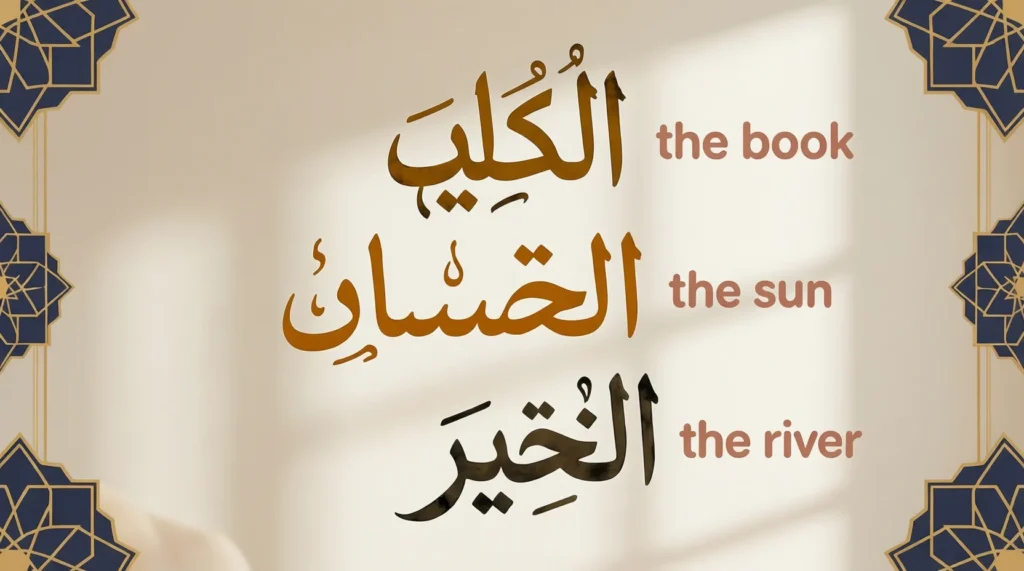
In Arabic, “al” (ال) means “the.” It is the definite article used before nouns to make them specific or definitesimilar to “the” in English. For example, kitāb means “a book,” while al-kitāb means “the book.”
If you’ve ever seen Arabic words like Al-Qur’an, Al-Jazeera, Al-Hamd, or names such as Al-Khalid, you may have wondered: What does “al” mean in Arabic, and why is it used so often?
The answer is simple on the surface it means “the” but the real story is richer and more fascinating. “Al” plays a central role in Arabic grammar, meaning, identity, and even global culture.
In this comprehensive guide, we’ll explore:
- The exact meaning of al in Arabic
- Its grammatical role and origin
- How it’s used in everyday speech, religion, media, and names
- Differences between sun letters and moon letters
- Common examples with tone and context
- Comparisons with similar terms
- FAQs people commonly search online
Let’s dive in.
What Does Al Mean in Arabic?
Al (ال) is the Arabic definite article, equivalent to the English word “the.”
It is attached directly to the noun it defines and never appears as a standalone word.
Basic Example:
- كتاب (kitāb) → a book
- الكتاب (al-kitāb) → the book
So whenever you see al at the beginning of an Arabic word, it’s usually signaling specificity, familiarity, or importance.
The Origin of Al in Arabic
The Arabic definite article ال (al) has been part of the language since Classical Arabic, dating back over 1,500 years.
Linguistic Roots:
- Arabic belongs to the Semitic language family (alongside Hebrew and Aramaic)
- Many Semitic languages use prefixes to mark definiteness
- Arabic standardized al- as its core definite marker
Unlike English, Arabic does not have an indefinite article (“a” or “an”). Instead:
- Indefiniteness = noun without al
- Definiteness = noun with al
This makes al extremely important in Arabic grammar and meaning.
How Al Is Used in Arabic Grammar
1. Making a Noun Definite
This is the most common use.
| Without Al | Meaning | With Al | Meaning |
|---|---|---|---|
| بيت (bayt) | a house | البيت (al-bayt) | the house |
| شمس (shams) | a sun | الشمس (ash-shams) | the sun |
| طالب (ṭālib) | a student | الطالب (aṭ-ṭālib) | the student |
2. Attached, Not Separate
Al is always attached to the noun no spaces.
✔ المدينة
✘ ال مدينة
3. Used with Nouns Only
- ❌ Not used with verbs
- ❌ Not used with most pronouns
- ✔ Used with common nouns, proper nouns, and adjectives used as nouns
Sun Letters vs. Moon Letters
One of the most fascinating aspects of al is how its pronunciation changes.
The Rule:
Arabic letters are divided into:
- Sun letters (حروف شمسية)
- Moon letters (حروف قمرية)
This affects whether the “l” sound in al is pronounced or absorbed.
Moon Letters 🌙 (The “L” Is Pronounced)
Example:
- القمر → al-qamar (the moon)
- الكتاب → al-kitāb
You clearly hear the “l” sound.
Sun Letters ☀️ (The “L” Is Silent)
The l sound disappears and merges with the next letter.
Example:
- الشمس → ash-shams (the sun)
- الطالب → aṭ-ṭālib (the student)
You write al, but you don’t pronounce the l.
Common Sun Letters:
ت، ث، د، ذ، ر، ز، س، ش، ص، ض، ط، ظ، ل، ن
Real-World Usage of Al
1. In Daily Conversation
Arabic speakers use al constantly—just like “the” in English.
- أين السيارة؟
Where is the car? - السيارة هناك
The car is there.
2. In Religion Islamic Context
Many Islamic terms begin with al because they refer to specific, absolute concepts.
| Term | Meaning |
|---|---|
| القرآن (Al-Qur’an) | The Qur’an |
| الحمد لله (Al-ḥamdu lillāh) | All praise is for God |
| الرحمن (Ar-Raḥmān) | The Most Merciful |
Here, al emphasizes uniqueness and completeness.
3. In Media & Global Brands
You’ve probably encountered al even if you don’t speak Arabic:
- Al Jazeera → The Island
- Al Arabiya → The Arabic (channel)
- Al Qaeda → The Base
4. In Arabic Names and Surnames
In names, al often indicates:
- Lineage
- Origin
- Tribe
- Profession
Examples:
- Al-Farabi → “from Farab”
- Al-Hakim → “the wise”
- Al-Ansari → “from the Helpers (Ansar)”
Tone and Context: How Al Feels in Use
While al itself is neutral, context changes tone.
Friendly / Neutral
- البيت جميل
The house is beautiful. 😊
Formal / Respectful
- الأستاذ حاضر
The professor is present.
Emphatic or Serious
- الحقيقة واضحة
The truth is clear.
The definite article adds weight, clarity, and authority.
Does Al Have Other Meanings in Arabic?
In Standard Arabic:
✅ No it strictly means “the.”
In Other Contexts:
- AL in English may mean:
- Artificial Intelligence (AI typo)
- Alabama (USA)
- Assembly Language
But these are not Arabic meanings.
Important note:
Arabic al (ال) is completely unrelated to English abbreviations like “AL” or “AI.”
Comparison: Al vs Similar Concepts
Al vs English “The”
| Feature | Arabic Al | English “The” |
|---|---|---|
| Attached to noun | Yes | No |
| Pronunciation changes | Yes (sun letters) | No |
| Written separately | No | Yes |
| Indefinite article | No | Yes (“a/an”) |
Al vs Hebrew “Ha-”
Hebrew uses ה (ha-) similarly:
- Arabic: الكتاب
- Hebrew: הספר (ha-sefer)
Both mark definiteness, showing shared Semitic roots.
Polite or Professional Alternatives to Al
In Arabic, al has no direct replacement. However, definiteness can also be conveyed through:
- Possession
- كتابي (my book)
- Proper nouns
- محمد (Muhammad)
- Contextual clarity
Still, al remains the most precise and formal method.
Labeled Example Table
| Arabic Word | Transliteration | Meaning | Tone |
|---|---|---|---|
| الكتاب | al-kitāb | the book | Neutral |
| الشمس | ash-shams | the sun | Neutral |
| الحق | al-ḥaqq | the truth | Serious |
| الأستاذ | al-ustādh | the teacher | Respectful |
| القرآن | al-Qur’an | the Qur’an | Sacred |
Common Mistakes Learners Make with Al
- ❌ Saying al as a separate word
- ❌ Forgetting sun letter pronunciation
- ❌ Using al with proper names unnecessarily
- ❌ Translating it literally in every context
Tip: Focus on meaning and sound, not just spelling.
Conclusion
To sum it up:
- Al (ال) means “the” in Arabic
- It is essential to grammar, meaning, and expression
- It appears in daily speech, religion, names, and media
- Pronunciation changes depending on sun or moon letters
- It adds clarity, emphasis, and authority to words
If you’re learning Arabic or simply curious about the language, understanding al is one of the best first steps you can take.
FAQs
What does al mean in Arabic?
It means “the” and is used to make nouns definite.
Is al always pronounced the same?
No. With sun letters, the l sound is silent.
Why do so many Arabic names start with al?
It often indicates origin, title, profession, or lineage.
Is al the same as “AI”?
No. Arabic al (ال) has nothing to do with Artificial Intelligence (AI).
Does Arabic have “a” or “an”?
No. Indefiniteness is shown by not using al.
Can al change meaning?
No. Its meaning stays “the,” but context adds nuance.
Is al used in spoken Arabic?
Yes, though pronunciation may be shortened in dialects.
Why is al important in Arabic?
Because it defines clarity, specificity, and meaning in sentences.

Tom Holland is a language enthusiast at ValneTix.com passionate about unraveling the meanings behind words and phrases. His clear, insightful and engaging explanations help readers expand their vocabulary and communicate with confidence.