Last Updated on February 19, 2026
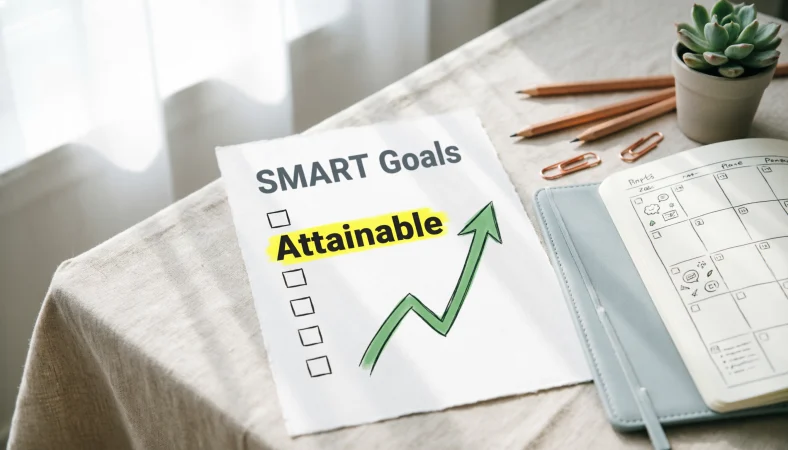
In SMART goals, “attainable” means that a goal is realistic and achievable given your current resources, skills, time, and circumstances.
An attainable goal challenges you but remains possible with effort and planning.
Setting goals feels exciting until they quietly fade away. Maybe you’ve promised yourself you’ll double your income in a month, learn a new language in two weeks, or wake up at 5 a.m. every day forever. The motivation is real, but the results? Often not.
That’s exactly why the SMART goals framework exists and why the word attainable plays such a critical role in turning ambition into actual achievement.
If you’ve ever asked, “What does attainable mean in SMART goals?”, you’re in the right place. This guide breaks it all down in plain English, with real-life examples, comparisons, tables, and practical advice you can actually use.
🎯 Why “Attainable” Is the Make-or-Break Part of SMART Goals
SMART goals are designed to help people succeed—not feel discouraged. While ambition is important, unrealistic goals often lead to burnout, frustration, and quitting altogether.
The “A” in SMART ensures your goal:
- Pushes you forward
- Respects real-world limits
- Keeps motivation alive
- Encourages steady progress
In short, attainable goals build confidence instead of crushing it.
🔤 What Does SMART Stand For?
Before zooming in on “attainable,” let’s place it in context.
SMART goals are:
| Letter | Meaning | Purpose |
| S | Specific | Clear and focused |
| M | Measurable | Trackable progress |
| A | Attainable | Realistic and achievable |
| R | Relevant | Meaningful and aligned |
| T | Time-bound | Deadline-driven |
Each letter supports the others—but attainable is often where people struggle most.
🧠 What Does “Attainable” Mean in SMART Goals?
Simple Definition
In the context of SMART goals, attainable means “possible with effort.”
It asks:
- Can this realistically be done?
- Do I have (or can I get) the resources?
- Is the timeline reasonable?
- Does this align with my current situation?
Important Distinction
Attainable does not mean:
- Easy
- Comfortable
- Guaranteed
It means achievable with commitment, planning, and growth.
🕰️ Origin of the Term “Attainable” in SMART Goals
Where Did SMART Goals Come From?
The SMART framework is commonly traced back to management and performance theory in the 1980s, especially workplace goal-setting systems.
While different versions exist, “Attainable” (sometimes called “Achievable”) became a core element as organizations realized:
Goals that sound impressive but can’t be reached don’t improve performance—they hurt it.
Why “Attainable” Became Essential
Research in motivation and psychology consistently shows that:
- Realistic goals increase follow-through
- Achievable challenges boost confidence
- Small wins create momentum
That’s why “attainable” stuck as a foundational principle.
🌍 Popularity and Real-World Usage of “Attainable” in SMART Goals
You’ll find the term attainable used widely across:
- Education
- Business management
- Personal development
- Fitness and health coaching
- Career planning
- Project management
- HR performance reviews
It appears in:
- Goal-setting worksheets
- Employee evaluations
- Productivity books
- Coaching sessions
- Academic planning guides
In every case, the message is the same: a goal must be possible to be powerful.
🧩 Attainable vs Unrealistic Goals
Unrealistic Goals Often Lead To:
- Procrastination
- Anxiety
- Low self-esteem
- Giving up entirely
Attainable Goals Lead To:
- Consistent progress
- Motivation
- Skill development
- Long-term success
The difference isn’t ambition—it’s alignment with reality.
🧾 Example Table: Attainable vs Unattainable Goals
| Goal | Attainable? | Why |
| Run a 5K in 3 months | ✅ Yes | Reasonable timeline |
| Run a marathon next week (no training) | ❌ No | Unrealistic prep |
| Save $500 in 2 months | ✅ Yes | Manageable target |
| Save $50,000 in 30 days | ❌ No | Resource mismatch |
| Read 1 book per month | ✅ Yes | Fits daily routine |
| Read 100 books in a month | ❌ No | Time constraint |
🧠 How to Tell If a Goal Is Truly Attainable
Ask yourself these five questions:
- Do I have the necessary skills?
- Do I have the time required?
- Do I have access to resources or support?
- Is the timeline realistic?
- Have others in similar situations done this?
If most answers are “yes” or “with effort,” your goal is likely attainable.
✨ Examples of “Attainable” Goals With Context
Friendly / Encouraging Tone
“I’ll increase my daily steps from 4,000 to 6,000 over the next month 🚶♀️”
Neutral / Professional Tone
“The team will reduce response time by 10% within the next quarter.”
Overly Ambitious (Not Attainable)
“I’ll master three new programming languages in one week.”
Adjusted to Be Attainable
“I’ll complete an introductory course in one programming language this month.”
🔄 Attainable vs Related SMART Goal Terms
Attainable vs Achievable
These terms are often used interchangeably.
| Term | Meaning |
| Attainable | Realistic given current conditions |
| Achievable | Possible to accomplish |
In practice, both mean the same thing in SMART goals.
Attainable vs Realistic
Some SMART variations use “Realistic” instead of Attainable.
- Attainable: Can it be done?
- Realistic: Does it make sense in your life right now?
Both aim to ground goals in reality.
Attainable vs Relevant
- Attainable: Is it possible?
- Relevant: Is it worth pursuing?
A goal can be attainable but not relevant—and still fail.
🔁 Alternate Meanings of “Attainable”
Outside SMART goals, attainable simply means:
- Reachable
- Possible to achieve
- Within limits
For example:
- “An attainable level of success”
- “Attainable housing goals”
In SMART goals, the meaning is more structured and intentional.
🧑💼 Polite or Professional Alternatives to “Attainable”
In formal writing or business settings, you might see:
- Achievable
- Feasible
- Realistic
- Practical
- Within reach
All convey similar ideas, but “attainable” remains the standard in SMART goals.
⚠️ Common Mistakes People Make With Attainable Goals
1. Confusing Attainable With Easy
Attainable goals can still be challenging.
2. Underestimating Time
Many goals fail due to unrealistic timelines.
3. Ignoring Resources
Money, energy, tools, and support matter.
4. Comparing to Others
What’s attainable for someone else may not be attainable for you—yet.
🛠️ How to Make a Goal More Attainable
If your goal feels overwhelming, try these adjustments:
- Break it into smaller steps
- Extend the deadline
- Reduce the scope
- Increase support or resources
- Focus on progress, not perfection
Small changes can turn a failing goal into a winning one.
🧾 Example Table: Turning a Goal Into an Attainable SMART Goal
| Original Goal | Problem | Attainable Version |
| Lose 30 lbs in 1 month | Too extreme | Lose 8 lbs in 2 months |
| Learn fluent Spanish in 30 days | Unrealistic | Complete beginner Spanish course |
| Start a business this week | Too broad | Write a business plan in 30 days |
| Save $10,000 in 2 months | Resource gap | Save $2,000 in 6 months |
💡 Usage Tips for Writing Attainable SMART Goals
- Use realistic numbers
- Match goals to your current level
- Allow room for setbacks
- Review and adjust regularly
- Celebrate small wins 🎉
Attainable goals aren’t static—they evolve as you grow.
FAQs
1. What does attainable mean in SMART goals?
It means the goal is realistic and achievable given your resources and situation.
2. Is attainable the same as achievable?
Yes, they’re often used interchangeably.
3. Why is attainable important in goal setting?
Because unrealistic goals reduce motivation and success.
4. Can a goal be too attainable?
Yes if it’s too easy, it may not challenge or inspire growth.
5. How do I know if my goal is attainable?
Assess time, skills, resources, and constraints.
6. What happens if a goal isn’t attainable?
It often leads to frustration, stress, or quitting.
7. Should attainable goals still be challenging?
Absolutely attainable doesn’t mean effortless.
8. Can an unattainable goal become attainable later?
Yes, as skills, resources, and circumstances change.
Conclusion
In SMART goals, attainable means setting goals that stretch you without setting you up to fail. It’s about respecting reality while still aiming higher than where you are now.
- Attainable = realistic but challenging
- It balances ambition with practicality
- It boosts motivation and follow-through
- It adapts as your skills and resources grow
The most successful goals aren’t the boldest ones they’re the ones you can actually achieve.

James Colton is a language researcher and content writer who loves exploring the deeper meanings behind everyday words. With a background in linguistics, he breaks down complex terms into simple, clear explanations that anyone can understand.