
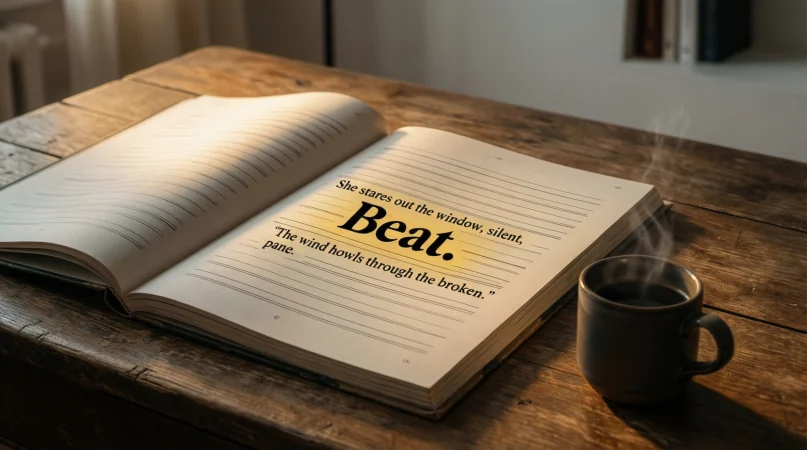
In a script, a “beat” is a brief pause or moment of silence that signals a shift in emotion, thought, or action, allowing the character or audience to process what just happened before moving on.
Screenwriters use beats to control rhythm, emphasize subtext, and guide actors without over directing them. This article breaks down everything you need to know from origin and usage to examples, comparisons, and professional alternatives so you can confidently read, write, or analyze scripts like a pro.
If you’ve ever read a screenplay and seen the word “Beat.” sitting on its own line, you probably paused and wondered what does beat mean in a script, exactly?
It looks simple, almost casual, but in professional screenwriting, beat is a powerful storytelling tool that shapes pacing, emotion, and performance.
What Does “Beat” Mean in a Script?
In screenwriting, a beat represents a moment of transition. It’s not a full pause like “(pause)” and not a long silence either it’s subtle, intentional, and emotionally meaningful.
A beat can indicate:
- A character thinking
- An emotional reaction
- A shift in power or tone
- A moment of realization
- A change in intent
Unlike dialogue or action, a beat often exists to let what was just said or done land.
Why Beats Matter in Scripts
Beats help:
- Actors understand emotional timing
- Directors visualize scene rhythm
- Readers feel natural pacing
- Scenes breathe instead of rushing
Without beats, dialogue can feel robotic or rushed—even if the words are good.
Origin of “Beat” in Screenwriting
The term “beat” comes from theater and acting, not just film.
Theatrical Roots
- In stage acting, a beat refers to a unit of action or intention
- Actors break scenes into emotional beats to track character goals
Transition into Film & TV
- Screenwriters adopted the term to communicate timing without micromanaging
- It became popular in modern Hollywood scripts for its simplicity and flexibility
Today, beat is widely accepted in:
- Hollywood screenplays
- TV scripts
- Indie films
- Streaming platform originals
How Is “Beat” Written in a Script?
A beat is usually written as a standalone line or inserted into action.
Standard Formatting Examples
JOHN
I didn’t tell her.

Beat.

She already knew.
Or within action:
Sarah looks at him. Beat. Then she smiles.
Simple. Clean. Effective.
What a Beat Is — and What It Is NOT
Let’s clear up confusion quickly.
✅ A Beat IS:
- A brief pause
- Emotionally meaningful
- Open to interpretation by the actor
- A storytelling tool
❌ A Beat Is NOT:
- A long silence
- A stage direction overload
- A replacement for dialogue
- A technical camera instruction
Real-World Usage: Why Writers Use Beats
Professional writers use beats to:
- Avoid writing “on-the-nose” dialogue
- Show emotion instead of explaining it
- Let subtext do the work
A well-placed beat can say more than a paragraph of dialogue.
Examples of “Beat” in Scripts
Below are practical examples showing how beats work in different emotional contexts.
Friendly / Light Tone Example 😊
LUCAS
You ate the last slice?

Beat.

EMMA
…Maybe.
Why it works:
The beat creates comedic timing and anticipation.
Neutral / Thoughtful Tone Example
MAYA
Do you trust me?

Beat.

ALEX
I want to.
Why it works:
The beat shows hesitation and emotional complexity.
Negative / Dismissive Tone Example 😬
DAN
I thought you cared.

Beat.

RACHEL
I used to.
Why it works:
The beat sharpens the emotional impact of the response.
Labeled Example Table: How Beats Function
| Situation | How Beat Is Used | Effect on Scene |
|---|---|---|
| Emotional reveal | Beat before response | Builds tension |
| Comedy | Beat before punchline | Improves timing |
| Conflict | Beat after insult | Lets emotion land |
| Decision moment | Beat before action | Shows internal struggle |
| Power shift | Beat before reply | Signals control change |
Beat vs Similar Script Terms
Many writers confuse beat with other script terms. Here’s a clear comparison.
Beat vs Pause vs Silence
| Term | Meaning | Duration | Usage |
|---|---|---|---|
| Beat | Emotional or mental shift | Very brief | Subtext |
| Pause | Noticeable stop | Short–medium | Dialogue timing |
| Silence | No sound at all | Longer | Mood or tension |
Beat vs Action Line
- Beat: Emotional moment
- Action line: Physical movement or description
Example:
He clenches his fists. (action)
Beat. (emotion)
Beat vs Reaction Shot
- Beat = written instruction
- Reaction shot = directorial choice
Writers suggest beats; directors decide shots.
Alternate Meanings of “Beat”
Outside of scripts, beat can mean:
- Musical rhythm (“catch the beat”)
- News coverage (“crime beat”)
- Defeating someone (“we beat them”)
- Police patrol area (“on the beat”)
👉 But in screenwriting, “beat” almost always refers to timing or emotion.
Should You Use “Beat” in Professional Scripts?
Yes—but sparingly.
Best Practices
- Use beats when emotion matters
- Avoid stacking multiple beats close together
- Trust actors to interpret
Common Mistakes
- Overusing beats every few lines
- Using beats instead of writing strong dialogue
- Treating beats as camera directions
Professional or Polite Alternatives to “Beat”
Sometimes writers prefer variety or subtlety.
Alternative Script Directions
- A moment.
- He hesitates.
- She considers this.
- A brief pause.
- Time passes.
Each alternative slightly changes tone and interpretation.
How Actors Interpret Beats
Actors often:
- Translate beats into facial expressions
- Adjust breathing or posture
- Use beats to change intention
That’s why beats are powerful—they invite performance rather than dictate it.
How Beats Affect Pacing & Storytelling
Beats:
- Slow scenes down when needed
- Prevent emotional overload
- Create realism in dialogue
- Help scenes feel lived-in
Fast dialogue + no beats = unnatural speech.
FAQs
1. What does “beat” mean in a screenplay?
A beat is a short pause indicating an emotional or mental shift before continuing dialogue or action.
2. How long is a beat in a script?
Usually just a second or two—long enough to register emotion, not long enough to stop momentum.
3. Is “beat” a direction for actors or directors?
Primarily for actors, but directors also use beats to guide pacing.
4. Can you overuse beats in a script?
Yes. Too many beats can slow pacing and feel amateurish.
5. Are beats necessary in every script?
No, but they’re useful in emotional, dramatic, or comedic moments.
6. What’s the difference between a beat and a pause?
A beat is emotional; a pause is more literal and timing-based.
7. Do professional screenwriters use beats?
Absolutely. Many top Hollywood scripts include beats sparingly and strategically.
8. Should beginners use beats?
Yes but carefully. Focus on strong storytelling first, then add beats where they enhance emotion.
Conclusion
It’s a small word with big impact.
- A beat is a brief emotional pause
- It helps control pacing, tone, and subtext
- Used well, it elevates dialogue and performance
- Overused, it can weaken a script
👉 If removing a beat doesn’t change the scene, you probably don’t need it.
👉 If removing it kills the emotion keep it.
Mastering beats is one of the quiet skills that separates good scripts from great ones.

Tom Holland is a language enthusiast at ValneTix.com passionate about unraveling the meanings behind words and phrases. His clear, insightful and engaging explanations help readers expand their vocabulary and communicate with confidence.