

Last Updated on February 19, 2026
In Hebrew, “Christ” corresponds to the word Mashiach (מָשִׁיחַ), which means “the anointed one.”
The English word Christ comes from the Greek Christos, a translation of the Hebrew Mashiach, referring to someone chosen and anointed by God for a special role or mission.
What does “Christ” mean in Hebrew and why does this ancient word still matter today?
Whether you’ve encountered it in religious texts, historical discussions, or everyday conversation, the term Christ carries deep linguistic, cultural, and spiritual significance. Yet many people are surprised to learn that “Christ” is not originally a Hebrew word at all it’s a translation rooted in Hebrew tradition.
In this in-depth guide, we’ll unpack the Hebrew meaning behind “Christ,” explore its origins, usage, tone, and real-world implications, and compare it with related terms like Messiah. By the end, you’ll have a clear, confident understanding of what the word truly means and why context matters so much when using it.
Understanding the Core Meaning of “Christ”
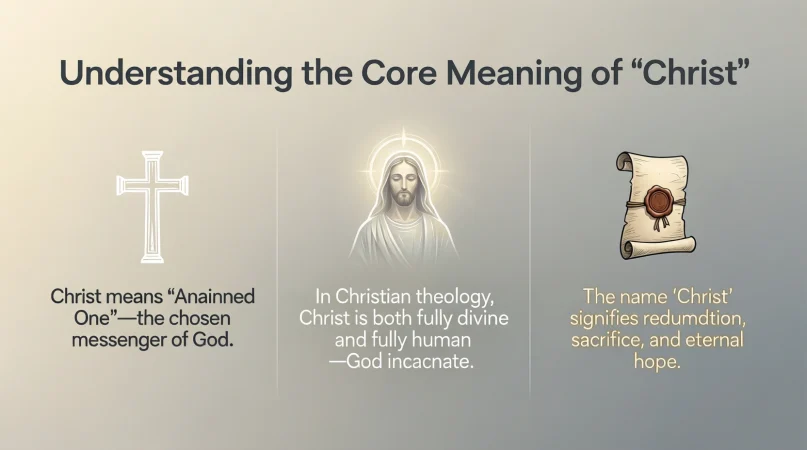
At its heart, Christ is a title, not a surname. It describes a role, status, or calling specifically someone who has been anointed.
Key Meaning Breakdown
- Hebrew word: Mashiach (מָשִׁיחַ)
- Literal meaning: Anointed one
- Greek translation: Christos (Χριστός)
- English form: Christ
In ancient times, anointing with oil symbolized divine selection and authority. Kings, priests, and sometimes prophets were anointed to mark their appointment by God.
Origin of the Word “Christ”
1. The Hebrew Root: Mashach
The Hebrew word Mashiach comes from the verb mashach, meaning:
- To anoint
- To smear or apply oil
This act had religious, political, and ceremonial significance in ancient Israel.
2. Transition into Greek
When Hebrew scriptures were translated into Greek (the Septuagint), Mashiach became:
- Christos — meaning “anointed”
3. Entry into English
Later, Christos moved through Latin (Christus) and into English as Christ.
📌 Important takeaway:
The meaning did not change—only the language did.
What Did “Mashiach” Mean in Ancient Hebrew Context?

In the Hebrew Bible (Tanakh), Mashiach was not limited to one future figure.
Common Uses in Hebrew Scripture
- Kings (e.g., Saul, David)
- High priests
- Occasionally prophets
These individuals were anointed as a sign of God’s authority resting upon them.
Was “Mashiach” Always a Savior Figure?
Not originally. In early Hebrew usage:
- It meant chosen leader
- It was practical and political
- It did not automatically imply divinity
The idea of a future, ultimate Messiah developed later in Jewish thought.
How “Christ” Is Used in Christianity
In Christianity, Christ becomes a unique and central title.
- Jesus is referred to as Jesus Christ, meaning Jesus the Anointed One
- Christians believe Jesus fulfills the messianic prophecies of Hebrew scripture
- Over time, Christ became closely identified with Jesus himself
💡 Fun fact:
Early followers often said “Jesus is the Christ”, not Jesus Christ as a name.
Tone and Context: How the Word “Christ” Is Perceived
The tone of the word Christ can vary widely depending on context, audience, and intent.
1. Religious or Respectful Tone
- Used in prayer, theology, or scripture
- Carries reverence and seriousness
Example:
“Christ is central to Christian theology.”
2. Neutral or Academic Tone
- Used in historical, linguistic, or comparative religion contexts
Example:
“The term Christ derives from the Hebrew Mashiach.”
3. Negative or Dismissive Tone (Caution ⚠️)
- Sometimes used casually or as an exclamation
- Can offend in religious settings
Example:
“Christ!” (used as an expression of frustration)
👉 Usage tip:
When speaking publicly or professionally, it’s best to use the term with respect and intention.
Examples of “Christ” in Context
Labeled Example Table
| Context Type | Example Sentence | Tone |
|---|---|---|
| Religious | “Christ is the fulfillment of God’s promise.” | Reverent |
| Academic | “Christ is the Greek equivalent of Mashiach.” | Neutral |
| Historical | “Messianic expectations shaped views of Christ.” | Informative |
| Casual | “Oh Christ, I forgot my keys.” | Dismissive / Informal |
Christ vs. Messiah: What’s the Difference?
These two terms are often used interchangeably but there’s nuance worth understanding.
Comparison Table
| Term | Language | Meaning | Common Usage |
|---|---|---|---|
| Mashiach | Hebrew | Anointed one | Jewish tradition |
| Messiah | English | Anointed one | Jewish & general use |
| Christ | Greek/English | Anointed one | Christian theology |
Key Differences
- Messiah is more neutral and widely used
- Christ is strongly associated with Jesus and Christianity
- Jewish tradition typically avoids using Christ for theological reasons
Popularity and Real-World Usage Today
Where You’ll See the Word “Christ”
- Religious texts and sermons
- Academic writing on theology
- Art, music, and literature
- Common expressions in English
Search Popularity
Questions like:
- “What does Christ mean in Hebrew?”
- “Is Christ a name or title?”
- “Difference between Christ and Messiah”
…are searched thousands of times each month, showing ongoing global interest.
Alternate Meanings of “Christ”
While primarily religious, Christ can appear in:
- Idiomatic expressions (often informal)
- Cultural references in film or literature
⚠️ These uses usually do not reflect the original Hebrew meaning and may be considered inappropriate in formal contexts.
Polite or Professional Alternatives
If you want to avoid religious sensitivity or sound more neutral, consider these options:
- Messiah (academic or interfaith contexts)
- Anointed one (explanatory writing)
- Messianic figure (historical analysis)
FAQs
1. What does Christ literally mean in Hebrew?
It corresponds to Mashiach, meaning the anointed one.
2. Is Christ a Hebrew word?
No. Christ is Greek; the Hebrew word is Mashiach.
3. Why is Jesus called Christ?
Because Christians believe Jesus is the anointed Messiah foretold in scripture.
4. Do Jews use the word Christ?
Generally no. Jewish tradition uses Mashiach or Messiah instead.
5. Is Christ a name or a title?
It is a title, not a personal name.
6. Are Messiah and Christ the same?
Linguistically yes; theologically, interpretations differ.
7. What does anointing symbolize?
Divine selection, authority, and purpose.
8. Can Christ be used outside religion?
Yes, but context matters casual use may be offensive to some.
Conclusion
- Christ means “the anointed one”
- Its Hebrew root is Mashiach (מָשִׁיחַ)
- The word traveled from Hebrew → Greek → English
- It’s a title, not a surname
- Context and tone matter greatly when using it
Whether you’re studying theology, writing academically, or just curious about word origins, understanding the Hebrew meaning of Christ adds clarity and cultural depth.

Sophia Lane is a passionate wordsmith and lifestyle writer who covers everything from Spanish phrases to biblical terms. She believes that understanding language helps people connect better with the world around them