
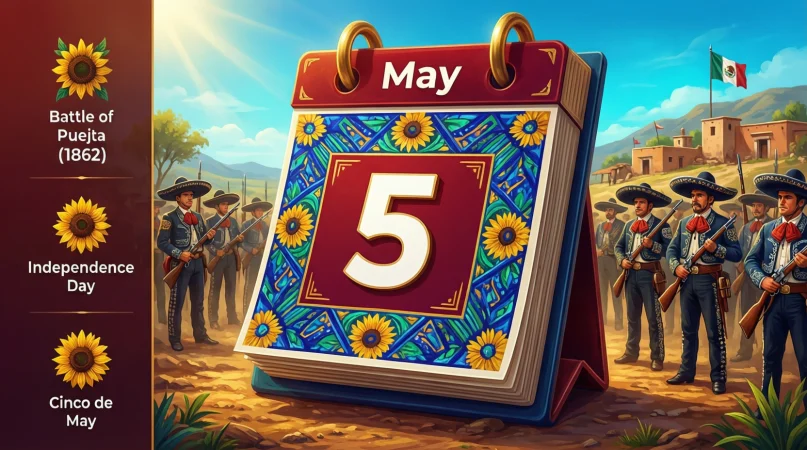
Cinco de Mayo means “Fifth of May” in English.
It refers to May 5, a date that commemorates Mexico’s victory over the French army at the Battle of Puebla in 1862.
Cinco de Mayo is one of those phrases many people recognize instantly but fewer fully understand. You’ve probably seen it on party banners, restaurant promotions, or social media posts filled with tacos, music, and colorful decorations. But what does Cinco de Mayo actually mean in English, and why is it important?
Let’s break it down clearly, simply, and accurately no fluff, no myths, just real meaning, history, and modern usage.
What Does Cinco de Mayo Mean Literally?
In plain English translation:
- Cinco = Five
- de = of
- Mayo = May
👉 Cinco de Mayo = Fifth of May
That’s the literal meaning. But the cultural meaning goes much deeper than just a calendar date.
Quick Breakdown Table
| Spanish Term | English Meaning | Explanation |
|---|---|---|
| Cinco | Five | Number |
| de | Of | Connector |
| Mayo | May | Month |
| Cinco de Mayo | Fifth of May | Historical date |
Origin of Cinco de Mayo
The Historical Background
Cinco de Mayo marks a real historical event, not a generic holiday.
On May 5, 1862, the Mexican army outnumbered and under resourced defeated the powerful French forces at the Battle of Puebla.
This victory was significant because:
- France had one of the strongest militaries in the world
- Mexico was facing political and financial instability
- The win became a symbol of resistance and national pride
Key Facts About the Battle of Puebla
- Date: May 5, 1862
- Location: Puebla, Mexico
- Opponents: Mexico vs. France
- Outcome: Mexican victory against overwhelming odds
💡 Important: Cinco de Mayo is not Mexico’s Independence Day.
Is Cinco de Mayo Mexico’s Independence Day?
This is one of the biggest misconceptions online.
| Event | Date | Meaning |
|---|---|---|
| Cinco de Mayo | May 5 | Battle of Puebla victory |
| Mexican Independence Day | September 16 | Independence from Spain |
🇲🇽 Mexican Independence Day celebrates freedom from Spanish rule, while Cinco de Mayo celebrates a military victory against France.
Why Is Cinco de Mayo So Popular—Especially in the U.S.?
Interestingly, Cinco de Mayo is celebrated more in the United States than in Mexico.
In Mexico
- Observed mainly in Puebla
- Government offices may mark it
- Not a national public holiday
In the United States
- Widely celebrated as a cultural festival
- Popular in Mexican-American communities
- Often associated with:
- Mexican heritage
- Food and drink
- Music and community events
🎉 Over time, it became a broader celebration of Mexican culture, not just a historical event.
Real-World Usage of “Cinco de Mayo”
The phrase is typically used in a neutral or celebratory tone, though it can sometimes be misused or oversimplified.
Common Contexts
- Cultural festivals
- Restaurant promotions
- Educational discussions
- Social media captions
Examples of “Cinco de Mayo” in Sentences
Friendly / Celebratory Tone
- “We’re hosting a Cinco de Mayo party with music and food 🎉”
- “Happy Cinco de Mayo! Let’s learn some Mexican history today.”
Neutral / Informational Tone
- “Cinco de Mayo commemorates the Battle of Puebla in 1862.”
- “The holiday is observed differently in Mexico and the U.S.”
Dismissive or Misused Tone
- “Cinco de Mayo is just an excuse to drink.”
⚠️ This minimizes its historical significance and can be culturally insensitive.
Does Cinco de Mayo Have Alternate Meanings?
Short answer: No.
- It always refers to May 5
- It always connects to the Battle of Puebla
- It does not mean:
- Mexican Independence Day
- A general Mexican holiday
- A religious celebration
Any alternate interpretation usually comes from misunderstanding or marketing, not language.
Cinco de Mayo vs Similar Terms
Let’s compare it with related phrases people often confuse.
Comparison Table
| Term | Meaning | Same as Cinco de Mayo? |
|---|---|---|
| Cinco de Mayo | Fifth of May | — |
| Mexican Independence Day | Sept 16 | ❌ No |
| Día de los Muertos | Day of the Dead | ❌ No |
| Fiesta Mexicana | Mexican party | ❌ No |
| Battle of Puebla | Historical event | ✅ Related |
Tone & Usage Tips
If you’re using “Cinco de Mayo” in writing or conversation, here are a few respectful tips:
Do
- Acknowledge its historical meaning
- Use it in educational or cultural contexts
- Celebrate Mexican heritage thoughtfully
Avoid
- Treating it as only a drinking holiday
- Confusing it with Independence Day
- Using stereotypes
✅ Professional alternative phrasing:
- “Cinco de Mayo commemorates Mexican resilience and history.”
How Is Cinco de Mayo Celebrated Today?
Common Celebrations Include
- Parades and reenactments (especially in Puebla)
- Cultural festivals
- Traditional Mexican music
- Educational events in schools
🌮 Food and festivities are common, but they are not the core meaning of the day.
Conclusion
- Cinco de Mayo means “Fifth of May” in English
- It commemorates a Mexican military victory, not independence
- It’s often misunderstood but historically significant
- Celebrated more widely in the U.S. than in Mexico
- Best used with cultural awareness and respect
Understanding the true meaning of Cinco de Mayo helps move beyond clichés and honors the history behind the celebration.
FAQs
What does Cinco de Mayo mean in English?
It means “Fifth of May.”
Is Cinco de Mayo a national holiday in Mexico?
No. It’s mainly observed in Puebla.
Why do Americans celebrate Cinco de Mayo more than Mexicans?
It evolved into a broader celebration of Mexican-American culture in the U.S.
Is Cinco de Mayo the same as Mexican Independence Day?
No. Independence Day is September 16.
What happened on Cinco de Mayo?
Mexico defeated France at the Battle of Puebla in 1862.
Is it okay to celebrate Cinco de Mayo if you’re not Mexican?
Yes when done respectfully and with cultural awareness.
Does Cinco de Mayo have religious meaning?
No. It is a historical and cultural observance.
Why is Cinco de Mayo important today?
It symbolizes resilience, national pride, and cultural identity.
Discover More Related Articles:-
- What Does ELL Mean in School? Definition, Examples & FAQs (2026)
- What Does TE Mean in Football? Tight End Explained (2026 Guide)

Michael Jordan is a writer at ValneTix.com who explains word meanings in a clear and easy to understand style, helping readers expand their vocabulary and language skills.