
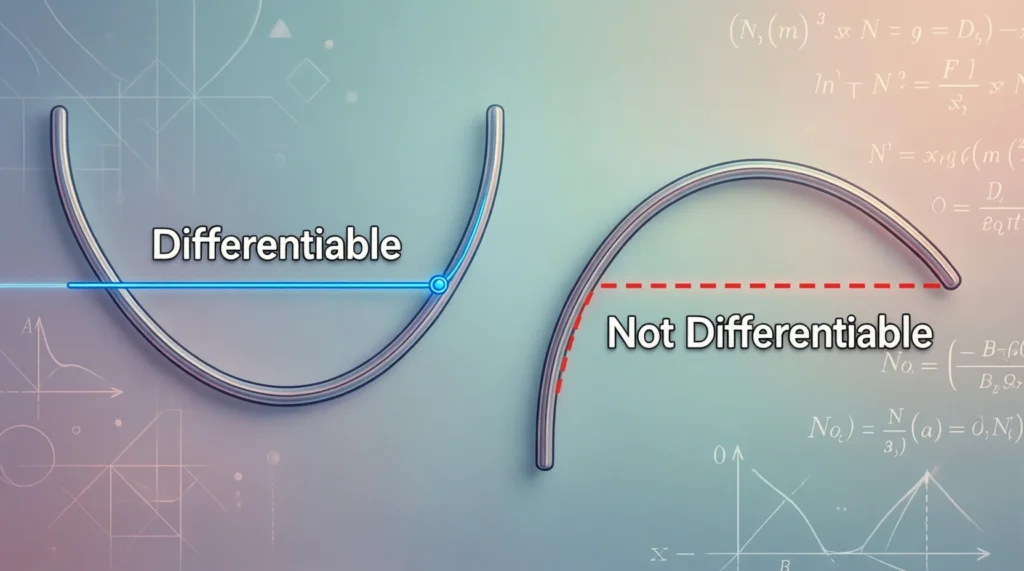
In calculus, differentiable means that a function has a derivative at a given point, meaning its rate of change exists there and the graph is smooth at that point without any sharp corners, breaks, or cusps.
If you’ve ever heard someone say “the function isn’t differentiable there” and felt your brain quietly panic don’t worry, you’re not alone 😅. The word differentiable sounds intimidating, but at its core, it describes something very intuitive: smooth change.
In calculus, differentiability is the bridge between formulas and motion. It tells us whether we can measure speed, slope, growth, or sensitivity at a specific point. From physics and engineering to economics, machine learning, and even medical imaging differentiability quietly runs the modern world.
This guide breaks the concept down step by step in clear, friendly language, with practical examples, comparisons, tables, FAQs, and real-world context so you don’t just memorize the term, you understand it.
What Does Differentiable Mean in Calculus?
A function is differentiable at a point if:
- You can draw a single, well-defined tangent line at that point
- The derivative exists at that point
- The graph is smooth there no corners, jumps, or vertical spikes
In simple terms:
Differentiable = smooth enough to measure change
If a function suddenly turns sharply or breaks, calculus says: “Nope can’t differentiate that here.”
Mathematical Definition
A function f(x) is differentiable at x = a if this limit exists:h→0limhf(a+h)−f(a)
This limit is the derivative, often written as f′(a).
If the limit:
- Exists → function is differentiable
- Does not exist → function is not differentiable
Origin and Evolution of the Term “Differentiable”
The word differentiable comes from:
- Latin differentia → “difference”
- Developed during the 17th century calculus revolution
- Popularized by Isaac Newton and Gottfried Wilhelm Leibniz
Originally, differentiation described how quantities differ or change relative to one another—especially in motion and physics.
Why It Became So Important
Differentiability allows mathematicians and scientists to:
- Predict motion
- Optimize systems
- Model natural processes
- Measure sensitivity and change
Why Differentiability Is So Important in Calculus
Here’s what differentiability allows us to do:
- 📈 Find slopes of curves
- 🚗 Measure velocity and acceleration
- 💰 Optimize profit, cost, and efficiency
- 🤖 Train machine learning models
- 🧠 Analyze signals and images
Without differentiability, calculus simply doesn’t work.
Differentiable vs Continuous
Many students think:
“If a function is continuous, it must be differentiable.”
❌ That’s not always true.
Key Rule to Remember:
Differentiable ⇒ Continuous
Continuous ≠ Differentiable
Comparison Table: Continuous vs Differentiable
| Feature | Continuous | Differentiable |
|---|---|---|
| Graph has breaks? | ❌ No | ❌ No |
| Graph has corners? | ✅ Maybe | ❌ No |
| Derivative exists? | ❌ Not required | ✅ Yes |
| Smooth curve? | ❌ Not always | ✅ Always |
When a Function Is NOT Differentiable
A function fails to be differentiable when the graph has:
1. Sharp Corners (Cusps)
Example:
f(x)=∣x∣-10-8-6-4-2246810246810
At x = 0, the left slope ≠ right slope → not differentiable.
2. Vertical Tangents
Example:
f(x)=3x-10-8-6-4-2246810-10-5510
The slope becomes infinite at x = 0.
3. Discontinuities
Any jump or break automatically kills differentiability 💥
Graphical Intuition: What Differentiable “Looks Like”
Think visually:
- Smooth curve → differentiable
- Sharp “V” shape → not differentiable
- Sudden jump → not differentiable
If you can gently place a ruler at a point and it touches the curve smoothly, chances are it’s differentiable there.
Examples of Differentiable Functions
Neutral / Academic Tone
- f(x)=x2 is differentiable for all real numbers.
- Polynomial functions are always differentiable.
Friendly / Casual Explanation 🙂
- “This curve is super smooth no weird turns so yeah, it’s differentiable everywhere.”
Slightly Dismissive / Corrective Tone
- “No, that function isn’t differentiable at zero. Look at the corner it breaks the rules.”
Labeled Example Table: Differentiability at a Point
| Function | Point | Differentiable? | Reason |
|---|---|---|---|
| x2 | x = 1 | ✅ Yes | Smooth curve |
| ( | x | ) | x = 0 |
| x1 | x = 0 | ❌ No | Undefined |
| sinx | all x | ✅ Yes | Smooth wave |
Differentiable vs Derivative vs Smooth
Let’s clear this up quickly:
| Term | Meaning |
|---|---|
| Differentiable | Derivative exists |
| Derivative | Numerical value of rate of change |
| Smooth | Informal term meaning differentiable |
🔑 Differentiable is the condition. Derivative is the result.
Real-World Usage of Differentiability
Differentiability isn’t just classroom theory—it’s everywhere:
Physics
- Velocity = derivative of position
- Acceleration = derivative of velocity
Economics
- Marginal cost and marginal profit rely on differentiability
Machine Learning 🤖
- Gradient descent requires differentiable loss functions
Medicine
- Smooth imaging models help analyze MRI and CT scans
Alternate Meanings of “Differentiable”
Outside calculus, differentiable may mean:
- Distinguishable
- Able to tell apart
However, in mathematics, the meaning is strict and technical—always related to derivatives.
Polite or Professional Alternatives
If you want to sound less technical, you can say:
- “The function is smooth at that point”
- “The slope is well-defined here”
- “We can calculate the rate of change”
These are often used in teaching or presentations.
Common Misconceptions About Differentiability
- ❌ “All continuous functions are differentiable”
- ❌ “Differentiable means the function is simple”
- ❌ “If the graph looks okay, it must be differentiable”
Always check corners, breaks, and vertical tangents.
Conclusion
- Differentiable means a derivative exists
- Smooth curves = differentiable curves
- Corners, breaks, and vertical tangents break differentiability
- Differentiability powers calculus, physics, economics, and AI
- Always check visually and mathematically
🎯 Pro Tip:
If you’re ever unsure, sketch the graph. Your eyes often catch what formulas hide.
FAQs
What does differentiable mean in simple words?
It means a function changes smoothly and has a well-defined slope at a point.
Is differentiable the same as continuous?
No. Differentiable functions are continuous, but not all continuous functions are differentiable.
Can a function be differentiable at one point but not another?
Yes. For example, ∣x∣ is differentiable everywhere except at x = 0.
Why is differentiability important?
It allows us to calculate rates of change, slopes, and optimize real-world systems.
Are all polynomials differentiable?
Yes. Polynomials are differentiable for all real numbers.
Is a function with a corner differentiable?
No. Corners mean the derivative does not exist.
How do I check if a function is differentiable?
Check continuity first, then see if left-hand and right-hand derivatives match.
Does differentiable always mean smooth?
In calculus, yes smoothness is a practical way to visualize differentiability.

Madison Lee is a skilled writer at ValneTix.com dedicated to making word meanings clear, relatable and actionable. She empowers readers to understand language deeply and use words with confidence in daily life.