
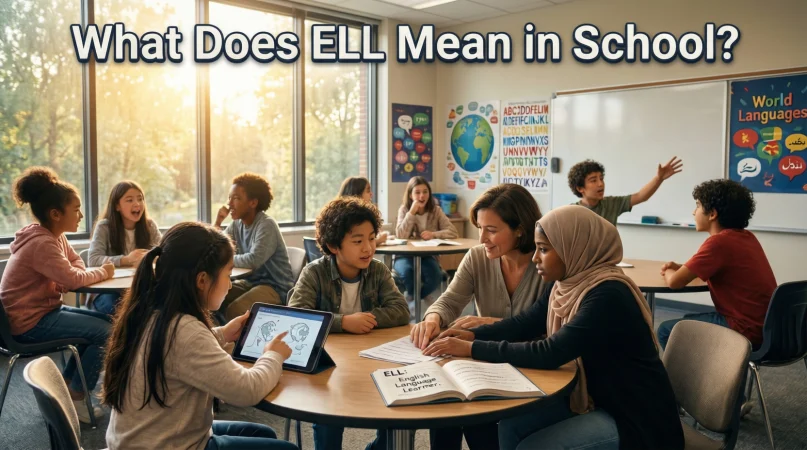
ELL stands for English Language Learner.
In school, it refers to a student who is learning English in addition to their native language and may need additional instructional support to succeed academically in English based classrooms.
ELL is a term you’ll often hear in schools, parent meetings, education policies, and classroom discussions but what does it really mean, and why is it so important in today’s education system?
Whether you’re a parent, student, teacher, or simply curious, this in depth guide will explain what ELL means in school, how it’s used, where it comes from, and how it compares to similar terms. By the end, you’ll have a clear, confident understanding of ELL and how it affects real students every day.
Understanding ELL in Simple Terms
An ELL student is someone who:
- Speaks a first language other than English at home
- Is still developing proficiency in English
- Receives specialized instruction or support to help them learn academic English
ELL is not a measure of intelligence or ability. It only describes a student’s current level of English language proficiency.
Why the Term ELL Matters in Schools
Schools use the term ELL to:
- Identify students who need language support
- Provide fair access to education
- Design instructional programs tailored to language learners
- Ensure compliance with education laws and policies
In many countries especially the U.S., UK, Canada, and Australia ELL programs help create inclusive classrooms where students from different linguistic backgrounds can thrive.
Origin and History of the Term ELL
Where Did “ELL” Come From?
The term English Language Learner emerged in education policy during the late 20th century as schools became more linguistically diverse due to:
- Immigration
- Globalization
- Refugee resettlement
- Multilingual households
Before ELL, schools often used older terms like:
- LEP (Limited English Proficient)
- ESL (English as a Second Language)
Over time, ELL became preferred because it is more respectful and learner-focused.
How ELL Is Used in Real School Settings
Common Places You’ll See the Term ELL
- Student report cards
- School enrollment forms
- Parent-teacher conferences
- Education laws and funding programs
- Classroom lesson plans
Typical Usage Examples
- “This class includes several ELL students.”
- “The school provides additional reading support for ELL learners.”
- “ELL services are available for qualifying students.”
What Does Being an ELL Student Mean Academically?
ELL students may receive:
- Extra time on tests
- Modified assignments
- Small-group instruction
- Bilingual support
- Visual aids and simplified instructions
👉 Important: ELL students learn the same academic content as other students—the difference is how it’s taught.
Example Sentences with Tone Variations
| Sentence | Tone | Context |
|---|---|---|
| “She’s an ELL student and is improving her reading skills quickly.” | Friendly | Encouraging classroom comment |
| “ELL learners require differentiated instruction.” | Neutral | Professional or academic setting |
| “He’s just ELL, so lower the expectations.” | ❌ Negative | Incorrect and dismissive usage |
🔴 Note: ELL should never be used to imply lower intelligence or potential.
ELL vs ESL vs EAL: What’s the Difference?
Understanding related terms can prevent confusion.
Comparison Table
| Term | Full Form | Meaning | Common Usage |
|---|---|---|---|
| ELL | English Language Learner | Student learning English | Schools & policies |
| ESL | English as a Second Language | Program or class | Instructional settings |
| EAL | English as an Additional Language | English added to other languages | UK, Australia |
| LEP | Limited English Proficient | Outdated term | Avoided today |
👉 Key Difference:
- ELL describes the student
- ESL describes the program or instruction
Is ELL the Same as Bilingual?
Not exactly.
- A bilingual student may already be fluent in two languages
- An ELL student is still learning English
Some ELL students eventually become bilingual, but the terms are not interchangeable.
Alternate Meanings of ELL
While ELL usually means English Language Learner in education, it can have other meanings in different contexts:
- ELL (Architecture): An L-shaped extension of a building
- Ell (Measurement): An old unit of length
- ELL (Acronym): Organization-specific abbreviations
📌 Context matters in schools, ELL almost always refers to students learning English.
Polite and Professional Alternatives to ELL
Some educators prefer more inclusive language, such as:
- Multilingual learner (MLL)
- Emergent bilingual
- Language learner
These alternatives emphasize growth and strengths, not limitations.
Benefits of ELL Programs
ELL programs help students:
- Build academic vocabulary
- Improve reading and writing
- Participate confidently in class
- Succeed in standardized testing
- Integrate socially and culturally
They also benefit schools by creating diverse, inclusive learning environments.
Common Misconceptions About ELL Students
❌ Myth: ELL students are behind academically
✅ Fact: Many excel in math, science, or problem-solving
❌ Myth: ELL means poor language skills overall
✅ Fact: ELL students are often fluent in another language
❌ Myth: ELL support lowers standards
✅ Fact: It provides equitable access, not easier work
Practical Tips for Parents and Teachers
- Encourage reading in both languages
- Celebrate cultural and linguistic diversity
- Focus on progress, not perfection
- Use visuals, gestures, and examples
- Be patient—language acquisition takes time
Conclusion
ELL means English Language Learner, a student who is developing English proficiency while learning academic subjects. It is a supportive, educational term, not a label of ability or intelligence.
- ELL focuses on language, not intelligence
- It promotes equity and inclusion
- ELL students bring valuable cultural and linguistic strengths
Understanding what ELL means helps parents, teachers, and students build stronger, more inclusive schools.
FAQs
What does ELL stand for in education?
ELL stands for English Language Learner, a student learning English in addition to their native language.
Is ELL a special education category?
No. ELL is not special education. It focuses only on language development.
How do schools identify ELL students?
Through home language surveys, language assessments, and proficiency tests.
How long does a student remain classified as ELL?
Until they demonstrate sufficient English proficiency based on school or state criteria.
Can native English speakers be ELL?
Rarely, but in some cases (such as interrupted education), assessments may apply.
Is ELL used worldwide?
Yes, though some countries prefer terms like EAL or MLL.
Do ELL students take the same exams as others?
Yes, often with accommodations like extra time or simplified instructions.
Is the term ELL considered respectful?
Yes, though many educators now prefer multilingual learner for inclusivity.

Olivia Brooks is a skilled writer at ValneTix.com dedicated to making word meanings simple, practical and relatable. Her clear explanations empower readers to use language effectively and confidently.