
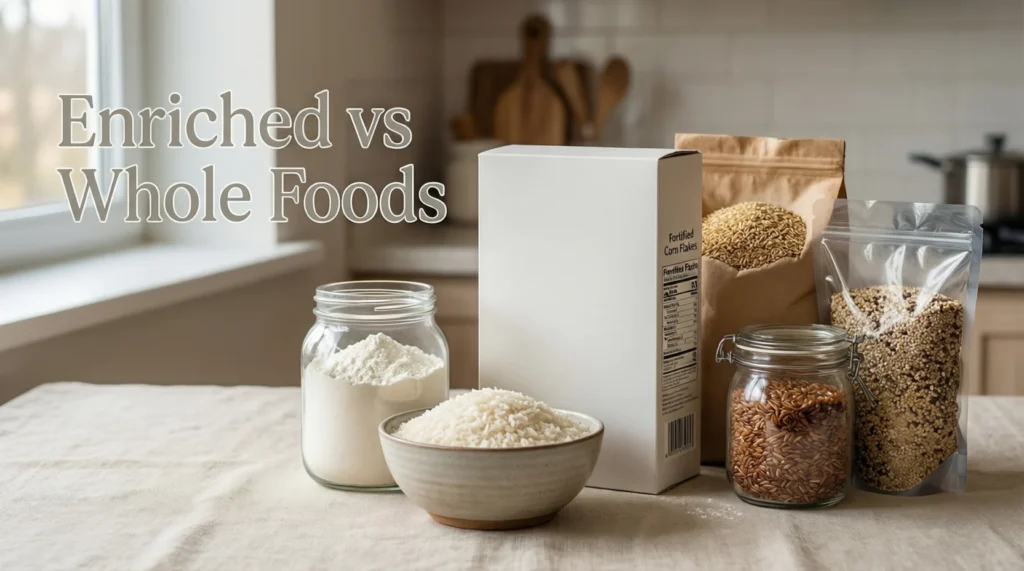
Enriched food refers to food products in which nutrients usually vitamins and minerals are added back after being lost during processing, restoring them to levels similar to the original food.
Ever noticed the word “enriched” on food labels and wondered what it actually means for your health? From enriched flour to enriched rice and cereals, this term shows up everywhere in grocery stores but it’s often misunderstood. Some people assume it means “healthier,” while others think it’s just marketing language.
In this in depth guide, we’ll break down what enriched means in food, why it exists, how it’s used, and how it compares to similar terms like fortified or whole grain. By the end, you’ll know exactly how to read food labels with confidence and make smarter choices for your diet.
Understanding “Enriched” in Simple Terms
When food is processed, refined, or milled, it often loses natural nutrients. Enrichment is the process of adding some of those nutrients back in.
👉 Key point: Enriched foods are not necessarily better than whole foods—they are often restored foods.
For example:
- Whole wheat → refined flour (nutrients removed)
- Refined flour → enriched flour (nutrients added back)
Origin of the Term “Enriched” in Food
The concept of enriched foods dates back to the early 20th century, particularly during the 1930s–1940s.
Why enrichment became popular:
- Widespread nutrient deficiencies (especially B vitamins and iron)
- Increase in refined grains during industrial food production
- Public health concerns like pellagra and anemia
Historical milestone:
In the 1940s, the U.S. government encouraged enrichment of flour and bread to combat vitamin deficiencies. This practice later spread worldwide and remains common today.
Why Are Foods Enriched?
Food enrichment serves several important roles:
- ✅ Prevent nutrient deficiencies
- ✅ Improve population-wide nutrition
- ✅ Restore nutrients lost during processing
- ✅ Support public health (especially in staple foods)
Commonly enriched nutrients include:
- Iron
- Folic acid (vitamin B9)
- Thiamin (vitamin B1)
- Riboflavin (vitamin B2)
- Niacin (vitamin B3)
Real-World Usage of “Enriched”
You’ll most often see the word enriched on:
- Flour and bread
- Rice
- Pasta
- Breakfast cereals
- Milk alternatives
- Baby foods
Label example:
Ingredients: Enriched wheat flour (wheat flour, niacin, reduced iron, thiamin mononitrate, riboflavin, folic acid)
That long list in parentheses? Those are the nutrients added back in.
Labeled Example Table: Enriched Foods in Daily Life
| Food Item | Why It’s Enriched | Nutrients Added |
|---|---|---|
| Enriched flour | Nutrients lost during milling | Iron, B vitamins |
| Enriched rice | Polished rice lacks vitamins | Iron, folic acid |
| Enriched cereal | Improve nutrition profile | Vitamins A, D, B-complex |
| Enriched pasta | Restore refined grain nutrients | Iron, niacin |
Examples of “Enriched” Used in Context
Friendly / Informative Tone 🙂
- “This cereal is enriched with iron and B vitamins to support daily nutrition.”
- “Enriched rice helps replace nutrients lost during polishing.”
Neutral / Technical Tone
- “The product contains enriched wheat flour as defined by food labeling regulations.”
Slightly Critical / Dismissive Tone ⚠️
- “It’s enriched, but it’s still made from refined grains not whole food.”
- “Enrichment doesn’t fully replace the benefits of whole grains.”
Enriched vs. Fortified vs. Whole Grain Important Comparison
Many people confuse these terms, but they are not the same.
Comparison Table
| Term | Meaning | Example |
|---|---|---|
| Enriched | Nutrients added back after processing | Enriched flour |
| Fortified | Nutrients added that weren’t originally present | Milk with vitamin D |
| Whole grain | All natural grain parts remain intact | Whole wheat bread |
Quick takeaway:
- Enriched = restored
- Fortified = enhanced
- Whole grain = untouched
Is Enriched Food Healthy?
The answer depends on context.
Benefits of enriched foods:
- Helps prevent vitamin deficiencies
- Improves nutrition in staple foods
- Beneficial for children, pregnant women, and elderly populations
Limitations:
- Doesn’t fully replicate natural nutrient balance
- Often lacks fiber found in whole foods
- Can create a “health halo” effect
👉 Best practice: Enriched foods are helpful, but whole foods should still be prioritized.
Alternate Meanings of “Enriched”
Outside of food, enriched can mean:
- Emotionally enriched – more fulfilling or meaningful
- Educationally enriched – enhanced learning environment
- Enriched experience – improved or expanded version of something
However, in food labeling, enriched has a strict nutritional definition.
Polite or Professional Alternatives to “Enriched”
Depending on the context, alternatives include:
- Nutrient-restored
- Nutrient-added
- Vitamin-enhanced
- Improved nutritional profile
These are often used in professional writing or marketing copy.
How to Identify Enriched Foods on Labels
Here’s how to spot enriched foods easily:
- 🔍 Look for the word “enriched” in the ingredient list
- 🔍 Check for added vitamins like iron or folic acid
- 🔍 Compare with whole-grain versions when possible
Pro tip: If “whole” appears before the grain name (e.g., whole wheat), enrichment is usually unnecessary.
Conclusion
So, what does enriched mean in food?
It means nutrients lost during processing have been thoughtfully added back to help maintain nutritional value.
- ✔ Enriched foods are useful, especially where whole foods aren’t available
- ✔ They help prevent nutrient deficiencies on a large scale
- ✔ Whole foods and whole grains remain the gold standard
Understanding enrichment empowers you to read labels smarter not fear them.
FAQs
What does enriched mean in food labels?
It means nutrients lost during processing have been added back to the food.
Is enriched food better than whole food?
No. Whole foods naturally retain fiber and nutrients that enrichment can’t fully replace.
Is enriched the same as fortified?
No. Enriched restores nutrients; fortified adds new ones.
Why is flour enriched?
Because refining removes B vitamins and iron, which are then added back.
Is enriched rice healthy?
It’s healthier than plain white rice but less nutritious than brown rice.
Are enriched foods safe to eat daily?
Yes, they are regulated and safe when consumed as part of a balanced diet.
Does enriched mean artificial?
Not exactly. Added nutrients may be synthetic but mimic natural vitamins.
Should I avoid enriched foods?
No, but balance them with whole and minimally processed foods.

Michael Jordan is a writer at ValneTix.com who explains word meanings in a clear and easy to understand style, helping readers expand their vocabulary and language skills.