
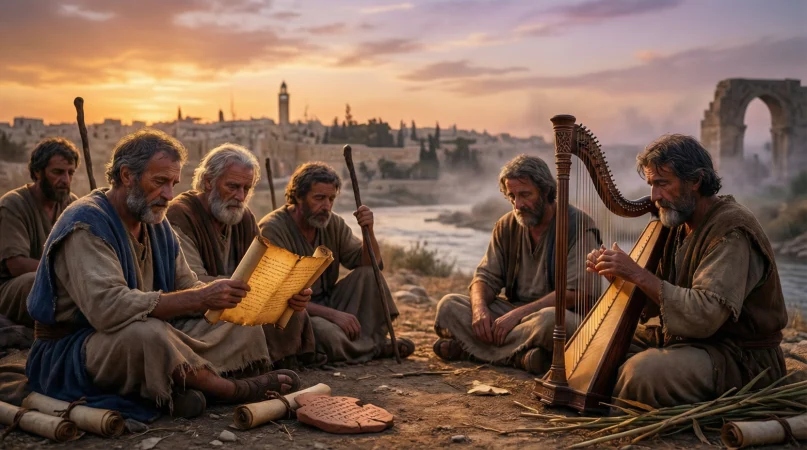
In the Bible, exile means the forced removal of God’s people from their homeland as a consequence of disobedience, resulting in separation from the land, the temple, and a sense of God’s presence yet often followed by promises of repentance, restoration, and return.
Exile is one of the most emotionally powerful and theologically rich concepts in the Bible. It’s not just about people being forced out of their homeland it’s about loss, judgment, repentance, identity, and ultimately, hope. From the fall of Jerusalem to the promises of restoration, exile shapes much of the Bible’s story and message.
Why Exile Matters in the Bible
Exile is not a minor theme it’s a central storyline that helps explain:
- Why Israel lost its land
- How God responds to disobedience
- How repentance leads to restoration
- Why hope remains even in judgment
In short, exile explains both God’s justice and God’s mercy.
Origin of the Word “Exile” Biblical & Linguistic Roots
Hebrew Origins (Old Testament)
In the Hebrew Bible, exile is commonly expressed through words like:
- גָּלוּת (Galut) – captivity or banishment
- גָּלָה (Galah) – to uncover, remove, or deport
These words often describe being stripped from one’s land and protection.
Greek Origins (New Testament & Septuagint)
In Greek texts, exile is connected to terms such as:
- αἰχμαλωσία (aichmalōsia) – captivity
- παροικία (paroikia) – living as a foreigner or sojourner
These emphasize alienation and displacement, not just geography.
What Exile Meant Spiritually in the Bible
Exile was more than physical relocation. Biblically, it symbolized:
- ❌ Separation from God’s blessings
- ❌ Loss of national identity
- ❌ Absence from the temple (God’s dwelling place)
- ❌ Consequences of covenant unfaithfulness
But—importantly—it also represented:
- ✅ A call to repentance
- ✅ A refining period
- ✅ A setup for future restoration
Major Biblical Exiles Explained
1. The Assyrian Exile (722 BC)
- Affected the Northern Kingdom of Israel
- Assyria captured Samaria
- Israelites were scattered and assimilated
📖 “The king of Assyria carried Israel away into Assyria…” (2 Kings 17:6)
👉 This exile emphasized total loss and dispersion.
2. The Babylonian Exile (586 BC)
The most famous and theologically significant exile.
Key events:
- Jerusalem destroyed
- Solomon’s Temple burned
- Judah taken to Babylon
📖 “By the rivers of Babylon, there we sat down and wept…” (Psalm 137:1)
This exile lasted 70 years and deeply shaped Jewish faith, scripture, and worship.
3. The Return from Exile
Under Persian rule (King Cyrus):
- Jews were allowed to return
- The temple was rebuilt
- Jerusalem was restored
📖 “The Lord stirred up the spirit of Cyrus…” (Ezra 1:1)
Exile ends not in despair—but renewal.
Why Did Exile Happen According to the Bible?
The Bible is very clear about the cause.
Primary Reasons:
- Idolatry
- Injustice
- Breaking God’s covenant
- Ignoring prophetic warnings
Biblical Explanation:
“You have not listened to my words… therefore I will send for all the tribes of the north.” (Jeremiah 25:8–9)
Exile was discipline, not abandonment.
Examples of Exile in the Bible
📘 Example Table: Exile Usage in Scripture
| Verse | Context | Tone |
|---|---|---|
| Psalm 137:1 | Mourning in Babylon | Sad / Lamenting |
| Jeremiah 29:11 | God’s promise in exile | Hopeful |
| Daniel 1:1–6 | Life in Babylon | Neutral / Reflective |
| Lamentations 1:3 | Judah’s suffering | Negative / Grieving |
| Ezra 1:3 | Return to Jerusalem | Joyful |
Tone-Based Examples
Neutral:
“Daniel lived faithfully while in exile.”
Emotional:
“Israel wept in exile, longing for Zion 😔”
Hopeful:
“Even in exile, God had plans for their future ✨”
Exile as a Metaphor in the Bible
Beyond historical events, exile is also symbolic.
Spiritual Metaphors:
- Humanity’s separation from God (Genesis 3)
- Believers as “foreigners” in the world
- Life away from God’s original design
📖 “We are strangers and exiles on the earth.” (Hebrews 11:13)
This idea strongly influences Christian theology.
Exile in the New Testament Briefly Explained
While there is no national exile like Babylon, the concept remains.
Key Ideas:
- Christians as spiritual exiles
- Earth is not the final home
- Hope lies in God’s kingdom
📖 “Dear friends, I urge you, as foreigners and exiles…” (1 Peter 2:11)
Comparison: Exile vs Related Biblical Terms
| Term | Meaning | Difference from Exile |
|---|---|---|
| Captivity | Being imprisoned | Exile includes displacement |
| Diaspora | Scattered people | Often voluntary or long-term |
| Banishment | Legal punishment | Less spiritual meaning |
| Sojourner | Temporary resident | Not forced like exile |
Alternate Meanings of Exile Outside the Bible
In modern usage, exile can mean:
- Political banishment
- Social exclusion
- Self-imposed separation
But in the Bible, exile is divinely permitted and purpose-driven.
Polite or Professional Alternatives to “Exile”
Depending on context, alternatives include:
- Forced relocation
- Captivity
- Displacement
- Period of separation
- Foreign residence
These are often used in academic or interfaith discussions.
Real-World Usage Influenced by the Bible
Biblical exile influences:
- Literature and poetry
- Political language
- Sermons and theology
- Modern metaphors for alienation
Example:
“He felt like he was living in exile from his purpose.”
FAQs
1. What is exile in simple biblical terms?
Exile is when God’s people were forced to live outside their homeland due to disobedience.
2. How long did the Babylonian exile last?
About 70 years, as prophesied by Jeremiah.
3. Was exile a punishment or a test?
Both punishment for sin and a test that refined faith.
4. Did God abandon Israel during exile?
No. God remained present and promised restoration.
5. What books of the Bible focus on exile?
Jeremiah, Ezekiel, Daniel, Lamentations, Ezra, Nehemiah.
6. What does exile symbolize spiritually?
Separation from God, longing for restoration, and hope.
7. Is exile still relevant today?
Yes spiritually and metaphorically in faith discussions.
8. How did exile shape Jewish faith?
It strengthened scripture study, prayer, and identity.
Conclusion
In the Bible, exile represents both judgment and hope. It shows the consequences of disobedience, but also God’s faithfulness in restoring His people. Exile is not the end of the story it’s a season meant to transform hearts, renew faith, and lead back to God’s promises.

Michael Jordan is a writer at ValneTix.com who explains word meanings in a clear and easy to understand style, helping readers expand their vocabulary and language skills.