Last Updated on February 19, 2026
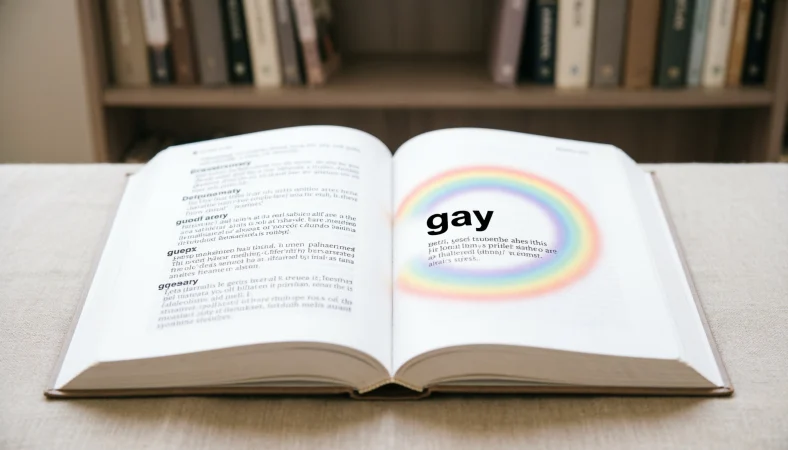
According to modern dictionaries, “gay” primarily means a person who is romantically or sexually attracted to people of the same sex, especially men.
Historically, the word also meant happy, joyful, lively, or carefree, a meaning that still appears in dictionaries as a secondary or dated definition.
Words evolve. Few English words show that evolution as clearly and as publicly as the word “gay.” If you’ve ever looked it up or heard different people use it in very different ways, you might wonder: What does “gay” actually mean in the dictionary? And why does it seem to carry both historical and modern meanings at the same time?
This article gives a clear, respectful, and comprehensive answer. We’ll explore the dictionary definition of “gay,” its origins, how its meaning has changed over time, how it’s used today, and why context and tone matter so much. Whether you’re a student, writer, educator, or simply curious, this guide is designed to be informative, balanced, and easy to understand.
Why People Still Search for “What Does Gay Mean in the Dictionary”
This question remains common because:
- The word has multiple meanings
- Its definition has changed over time
- It appears in literature, history, and modern conversation
- Misunderstanding can lead to confusion or offense
Looking at the dictionary helps clarify what the word officially means, not just how it’s casually used.
📘 Modern Dictionary Definitions of “Gay”
Most reputable English dictionaries (such as Merriam-Webster, Oxford, and Cambridge) list two main definitions, usually in this order:
1. Primary (Modern) Definition
Gay (adjective): sexually or romantically attracted to people of one’s own sex.
This is the most widely used and socially relevant meaning today.
2. Secondary (Historical or Descriptive) Definition
Gay (adjective): happy, cheerful, lively, or full of lighthearted pleasure.
This meaning is often marked as:
- dated
- historical
- literary
🧠 The Origin and Etymology of the Word “Gay”
Early Roots
The word gay comes from:
- Old French: gai (joyful, lighthearted)
- Possibly from Germanic roots meaning bright or lively
When it entered English in the Middle Ages, gay had no connection to sexuality at all.
📜 Historical Meaning of “Gay” (Before the 20th Century)
For centuries, gay was commonly used to describe:
- Happiness
- Bright colors
- Cheerful behavior
- Festive occasions
Examples from Older English
- “A gay song”
- “Gay attire”
- “A gay and merry crowd”
Classic literature often uses gay this way, which is why the definition still appears in dictionaries today.
🔄 How the Meaning of “Gay” Changed Over Time
Late 19th to Early 20th Century
The word began to take on coded meanings, especially in urban slang, referring indirectly to:
- Nontraditional lifestyles
- Sexual freedom
- Same-sex attraction (often subtly)
Mid-20th Century
The LGBTQ+ community increasingly reclaimed “gay” as a self-descriptive term.
Late 20th Century to Today
“Gay” became:
- A widely accepted identity term
- A standard dictionary definition
- A neutral or positive descriptor when used respectfully
🌍 Popularity and Real-World Usage Today
Today, gay is used most often to:
- Describe sexual orientation
- Refer to individuals or communities
- Appear in legal, medical, and academic contexts
It is commonly used in:
- News articles
- Educational materials
- Personal identification
- Advocacy and rights discussions
🗣️ Examples of “Gay” Used in Context
Neutral / Informational Tone
“He identifies as gay.”
Friendly / Affirming Tone
“She’s gay and proud of who she is 🌈”
Historical / Literary Tone
“The garden was bright and gay in the spring.”
Negative or Dismissive Tone (Outdated and Discouraged)
“That’s so gay.”
⚠️ This usage is widely considered offensive and inappropriate today.
📊 Example Table: Meanings of “Gay” by Context
| Context | Meaning |
| Modern conversation | Same-sex attraction |
| Identity description | Sexual orientation |
| Historical literature | Happy or cheerful |
| Slang (outdated) | Offensive misuse |
🔄 Comparison With Related Terms
Gay vs Lesbian
- Gay: Often refers to men, but can be inclusive
- Lesbian: Refers specifically to women attracted to women
Gay vs Homosexual
- Gay: Socially common and conversational
- Homosexual: Clinical or formal, less commonly used in casual speech
Gay vs Queer
- Gay: Specific sexual orientation
- Queer: Broader umbrella term (reclaimed by many, but not all)
🔁 Alternate Meanings of “Gay”
Dictionaries may still list:
- Happy
- Lighthearted
- Brightly colored
However, these meanings are now:
- Rare in everyday speech
- Mostly literary or historical
- Potentially confusing without context
🧑💼 Polite and Professional Usage Tips
When using the word gay:
- Use it factually and respectfully
- Avoid jokes or stereotypes
- Don’t use it as a negative descriptor
- Let individuals self-identify
In professional writing:
- Use gay when relevant and accurate
- Avoid unnecessary labeling
⚠️ Common Misunderstandings About the Word “Gay”
Myth 1: “Gay only means happy”
❌ Historically true, but not the primary meaning today.
Myth 2: Using “gay” is always offensive
❌ It’s neutral or positive when used correctly.
Myth 3: Dictionaries promote one meaning over others unfairly
❌ Dictionaries reflect actual language usage, not opinions.
🛠️ Practical Usage Tips for Writers and Speakers
- Check context carefully
- Avoid outdated slang
- Be aware of your audience
- Use inclusive language when appropriate
If you’re quoting older texts, clarify historical meaning to avoid confusion.
📋 Example Table: Appropriate vs Inappropriate Usage
| Usage | Appropriate? |
| “He is gay.” | ✅ Yes |
| “Gay rights movement” | ✅ Yes |
| “That test was gay.” | ❌ No |
| “A gay mood” (modern speech) | ⚠️ Rare |
FAQs
1. What does gay mean in the dictionary today?
It primarily means same-sex attraction.
2. Does gay still mean happy?
Yes, but it’s considered historical or literary.
3. Is gay a formal word?
It’s acceptable in both formal and informal contexts.
4. Is “gay” offensive?
Not when used respectfully and accurately.
5. Why did the meaning change?
Language evolves with culture and social identity.
6. Can gay refer to women?
Yes, though “lesbian” is more specific.
7. Is gay the same as queer?
No queer is broader.
8. Should I avoid using gay?
No just use it thoughtfully.
Conclusion
So, what does gay mean in the dictionary?
It means:
- Primarily: A sexual orientation involving same-sex attraction
- Secondarily: A historical term meaning happy or lively
Understanding both meanings and when each applies helps us communicate clearly, respectfully, and accurately.
- Dictionaries reflect real usage
- Context defines meaning
- Respect matters more than intent
- Language evolves and that’s normal

Ethan Ware is a digital writer and internet culture enthusiast who stays on top of the latest slang, trends and viral phrases. He specializes in making modern language easy to understand for readers of all ages.