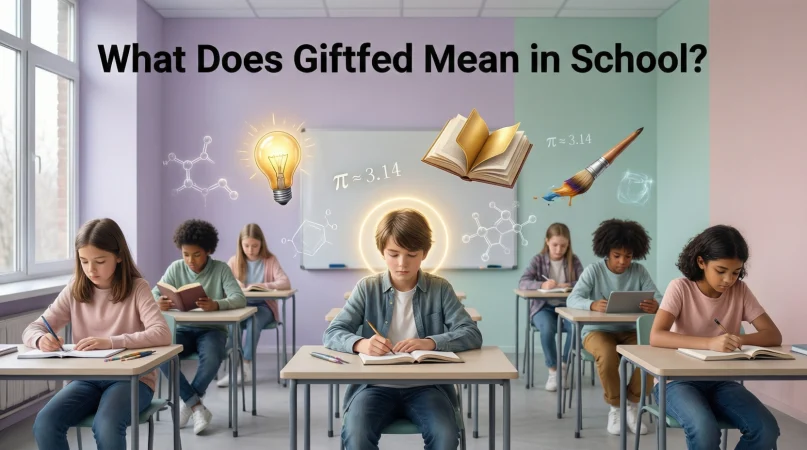
In school, “gifted” means a student who demonstrates exceptionally high ability or potential in one or more areas such as intelligence, academics, creativity, leadership, or the arts well above the average for their age group.
Gifted students often need specialized instruction, enrichment, or acceleration to stay engaged and reach their full potential.
You’ve probably heard a teacher say, “This child is gifted,” or seen a school offer a “gifted and talented program.” But what does gifted mean in school, really? Does it mean a child is smarter than everyone else? Does it guarantee success? And how is giftedness actually identified?
The term gifted carries a lot of weight for parents, students, and educators alike. It can bring pride, pressure, confusion, or even controversy. Some people associate it only with high IQ scores, while others think of creative or artistic brilliance. In reality, giftedness in school is broader, more nuanced, and more complex than most people realize.
This guide breaks it all down clearly and practically, so whether you’re a parent, student, teacher, or just curious, you’ll walk away with a solid understanding of what gifted truly means in an educational setting.
What Does Gifted Mean in School?
In schools, gifted refers to students who:
- Learn faster than their peers
- Understand complex ideas at an early age
- Show advanced reasoning, problem-solving, or creativity
- Need more challenging material than the standard curriculum
Gifted students are not just “good at school.” They often think differently, ask deeper questions, and make unusual connections between ideas.
👉 Key idea: Giftedness is about potential and ability, not just grades.
How Schools Officially Define “Gifted”
Most schools follow definitions influenced by educational psychologists and government education departments.
A widely used definition is based on the U.S. Department of Education, which states that gifted students are those who demonstrate high performance capability in areas such as:
- Intellectual ability
- Specific academic subjects (math, reading, science)
- Creativity or creative thinking
- Leadership ability
- Visual or performing arts
Other countries use similar frameworks, even if the wording differs.
Origin and History of the Term “Gifted” in Education
The concept of gifted education is not new.
Early History
- In the early 1900s, psychologists began studying intelligence and exceptional ability.
- Lewis Terman, a pioneer in IQ testing, helped popularize the idea that some children have significantly higher intellectual capacity.
Mid-20th Century
- After World War II and during the Space Race, schools focused more on identifying high-ability students to support scientific and technological advancement.
Modern View
Today, giftedness is seen as:
- Multi-dimensional (not just IQ)
- Influenced by environment, opportunity, and support
- Present across all cultures, backgrounds, and income levels
How Common Is Giftedness in Schools?
Gifted students typically make up:
- 5–10% of the student population (depending on criteria)
- Some programs limit eligibility to the top 2–3%
Because definitions vary, a child may be labeled gifted in one school but not another.
How Are Gifted Students Identified?
Identification is usually a multi-step process, not a single test.
Common Identification Methods
- IQ or cognitive ability tests
- Standardized academic assessments
- Teacher observations and recommendations
- Classroom performance and work samples
- Creativity or problem-solving tasks
Important Note
A child can be gifted without being a straight-A student. Some gifted learners may:
- Get bored easily
- Underperform academically
- Struggle with motivation or behavior
Types of Giftedness in School
Giftedness is not one-size-fits-all. Students may be gifted in different ways.
Common Types of Gifted Students
| Type of Giftedness | Description |
|---|---|
| Intellectually Gifted | High reasoning, memory, and abstract thinking |
| Academically Gifted | Exceptional performance in specific subjects |
| Creatively Gifted | Original ideas, imagination, artistic talent |
| Leadership Gifted | Influences peers, strong communication skills |
| Twice-Exceptional (2e) | Gifted but also has a learning disability (e.g., ADHD, dyslexia) |
Gifted Programs: What Happens After Identification?
Once identified, gifted students may receive special educational support, such as:
- Enrichment activities
- Advanced or accelerated classes
- Pull-out programs (weekly or monthly sessions)
- Grade skipping (less common)
- Independent projects or mentorships
The goal is not to label, but to meet learning needs.
Real-World Usage of “Gifted” in School Settings
You’ll often hear the word used in contexts like:
- “She’s in the gifted program.”
- “Gifted students need more challenging material.”
- “He was identified as gifted in second grade.”
In professional settings, the term is usually neutral and educational, not boastful.
Examples of “Gifted” Used in Different Tones
Friendly / Positive Tone
- “My daughter is gifted in math and loves problem-solving.” 😊
- “The gifted class explores advanced science topics.”
Neutral / Informational Tone
- “Gifted students are assessed using multiple criteria.”
- “The school offers services for gifted learners.”
Negative or Dismissive Tone (Less Appropriate)
- “He thinks he’s gifted, but he’s just arrogant.”
- “Gifted kids get special treatment.”
⚠️ Tip: In education, gifted should be used respectfully and professionally.
Common Myths About Gifted Students
Let’s clear up some misconceptions.
❌ Myth 1: Gifted kids don’t need help
✔️ Truth: They often need more support, not less.
❌ Myth 2: Gifted means high grades
✔️ Truth: Some gifted students struggle academically.
❌ Myth 3: Gifted students are good at everything
✔️ Truth: Many are gifted in only one or two areas.
❌ Myth 4: Giftedness guarantees success
✔️ Truth: Without support, gifted students can underachieve.
Gifted vs. Talented vs. Advanced: What’s the Difference?
Comparison Table
| Term | Meaning in School | Key Difference |
|---|---|---|
| Gifted | High potential or ability | Focuses on capacity |
| Talented | Demonstrated skill | Often performance-based |
| Advanced | Ahead academically | May be due to practice |
| High-Achieving | Strong grades | Not always gifted |
Alternate Meanings of “Gifted”
Outside education, gifted can mean:
- Given as a gift
- “She gifted him a book.”
- Naturally talented (general use)
- “He’s gifted musically.”
In schools, however, the term has a specific educational meaning.
Polite and Professional Alternatives to “Gifted”
In some contexts, educators prefer softer or broader terms:
- High-ability learner
- Advanced learner
- Students with exceptional abilities
- Learners requiring enrichment
These terms can reduce pressure or stigma while conveying the same idea.
Does Being Gifted Affect a Child Emotionally?
Yes—sometimes.
Gifted students may experience:
- Perfectionism
- Sensitivity or emotional intensity
- Social challenges
- Anxiety or fear of failure
That’s why social-emotional support is just as important as academic challenge.
Conclusion
It means recognizing students who think, learn, or create at an unusually advanced level and providing them with the right environment to grow. Giftedness is not about superiority; it’s about difference, potential, and responsibility.
When understood correctly, the term ‘gifted’ becomes less about pressure and more about opportunity, helping students thrive, stay curious, and develop into confident, capable learners.
FAQs
What does gifted mean in school simple definition?
It means a student has significantly higher ability or potential compared to peers and may need advanced learning opportunities.
Is gifted the same as having a high IQ?
Not always. IQ is one factor, but creativity, leadership, and talent also count.
Can a child be gifted but struggle in school?
Yes. Many gifted students underperform due to boredom, anxiety, or learning differences.
At what age can a child be identified as gifted?
Some as early as preschool, but identification often becomes clearer in elementary school.
Do all schools have gifted programs?
No. Availability depends on funding, policies, and location.
Is giftedness permanent?
Abilities can change over time. Support and environment play a big role.
Are gifted programs elitist?
They’re meant to meet learning needs, not create superiority.
Can gifted students have learning disabilities?
Yes. These students are called twice-exceptional (2e).

Michael Jordan is a writer at ValneTix.com who explains word meanings in a clear and easy to understand style, helping readers expand their vocabulary and language skills.