
Last Updated on February 19, 2026
Hearsay in court means a statement made outside the courtroom that is presented as evidence to prove the truth of what it claims, without the speaker being present to testify.
In simple terms:
👉 Someone is repeating what another person said, instead of that person testifying directly.
Ever heard a lawyer object with “That’s hearsay!” and wondered what just happened?
Hearsay is one of the most misunderstood yet most powerful concepts in courtroom law. It can decide whether a statement is allowed as evidence or completely thrown out.
This guide breaks it all down in plain, human language no law degree required.
Why Hearsay Matters So Much in Court
Hearsay isn’t just a technical legal word it directly affects fairness and truth in trials.
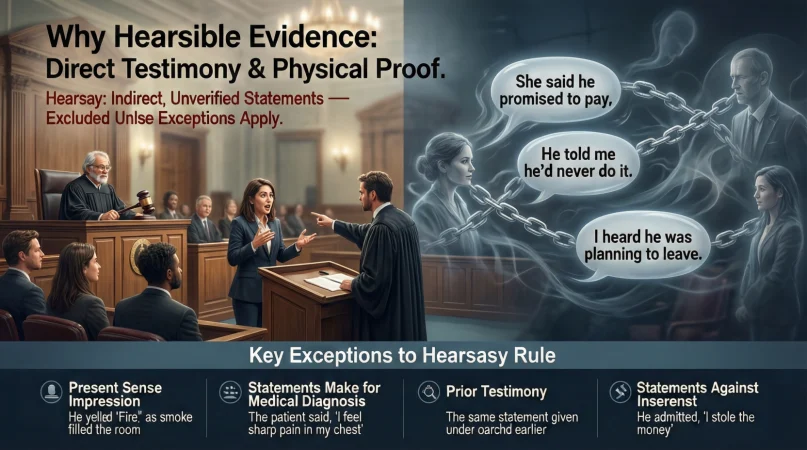
Courts generally do not allow hearsay because:
- The original speaker is not under oath
- The speaker cannot be cross-examined
- The statement’s accuracy can’t be tested
- It increases the risk of rumors, exaggerations, or lies
That’s why judges and lawyers take hearsay very seriously.
Understanding Hearsay in Simple Words
Let’s say this happens in court:
Witness: “My neighbor told me the defendant stole the car.”
This is hearsay because:
- The neighbor is not in court
- The statement is used to prove the defendant stole the car
- The defense can’t question the neighbor
✅ Result: Likely excluded as hearsay.
But if the neighbor comes to court and testifies directly, it’s not hearsay anymore.
Origin and History of the Term “Hearsay”
Where Does the Word Come From?
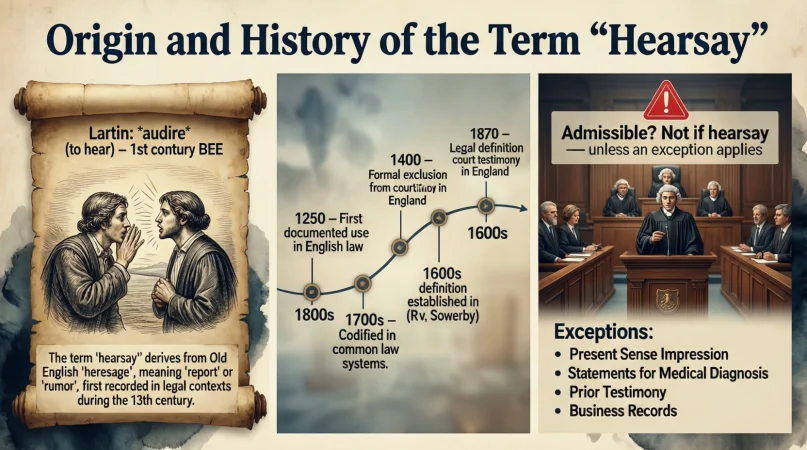
The word hearsay comes from:
- Old English “heren” (to hear)
- Combined with “say”
Literally meaning: “what someone heard someone else say.”
Legal History
- Hearsay rules developed in English common law
- Adopted by courts in:
- United States
- United Kingdom
- Canada
- Australia
- Many Commonwealth countries
- United States
- Modern rules are codified (e.g., Federal Rules of Evidence in the U.S.)
Real-World Usage of Hearsay
In Courtrooms
- Lawyers object: “Objection, hearsay.”
- Judges rule whether the statement is admissible
- Can determine whether evidence is accepted or rejected
Outside Court (Everyday Language)
People often misuse the term casually:
“That’s just hearsay — I don’t believe it.”
In everyday speech, hearsay means rumor or unverified information, not the strict legal definition.
Legal Definition vs Everyday Meaning
| Context | Meaning of Hearsay |
| Legal (Court) | An out-of-court statement offered to prove truth |
| Everyday Use | Gossip, rumor, secondhand info |
| Formal Accuracy | Very strict |
| Casual Speech | Loosely used |
Common Examples of Hearsay in Court
Neutral Example
“The cashier said the suspect ran away.”
📌 Tone: Neutral
📌 Status: Hearsay (cashier not testifying)
Friendly / Casual Example
“My friend told me he saw the accident.”
📌 Tone: Friendly
📌 Status: Hearsay unless friend testifies
Negative / Dismissive Example
“That’s just hearsay — no proof at all.”
📌 Tone: Dismissive 😒
📌 Usage: Common in debates and arguments
Labeled Example Table: Hearsay vs Not Hearsay
| Statement | Hearsay? | Why |
| “I heard John stole the phone.” | ✅ Yes | Repeating someone else’s claim |
| “I saw John steal the phone.” | ❌ No | Firsthand observation |
| “The report says the fire started at midnight.” | ✅ Usually | Report writer not testifying |
| “The defendant confessed to me.” | ⚠️ Depends | May be an exception |
Is All Hearsay Automatically Illegal? ❌ No.
This is where things get interesting.
Hearsay Rule
Courts generally exclude hearsay unless an exception applies.
Why Exceptions Exist
Because some statements are considered reliable enough, even if made outside court.
Common Exceptions to the Hearsay Rule
Here are some widely recognized hearsay exceptions:
1. Excited Utterance
A statement made during or right after a shocking event.
“He just stabbed me!” 😱
2. Present Sense Impression
Describing something as it’s happening.
“He’s running out the door right now.”
3. Business Records
Regularly kept business documents.
Bank statements, medical records
4. Dying Declaration
Statements made when someone believes death is imminent.
Common in homicide cases
5. Admission by a Party Opponent
If the defendant’s own words are used against them.
“Yes, I did it.”
Hearsay vs Related Legal Terms
Hearsay vs Direct Evidence
| Feature | Hearsay | Direct Evidence |
| Source | Secondhand | Firsthand |
| Allowed? | Usually no | Yes |
| Example | “Someone told me…” | “I saw…” |
Hearsay vs Circumstantial Evidence
| Aspect | Hearsay | Circumstantial |
| Based on | Statements | Facts & inference |
| Reliability | Questioned | Often allowed |
| Example | Rumor | Fingerprints |
Hearsay vs Testimony
| Term | Meaning |
| Hearsay | Out-of-court statement |
| Testimony | Sworn statement in court |
Alternate Meanings of “Hearsay”
Outside legal settings, hearsay can mean:
- Gossip
- Rumors
- Office talk
- Social media claims
⚠️ But only the legal definition applies in court.
Polite or Professional Alternatives to “Hearsay”
If you want to sound more professional, try:
- “Unverified information”
- “Secondhand report”
- “Uncorroborated claim”
- “Informal account”
- “Indirect evidence”
Usage Tips: How to Use “Hearsay” Correctly
✅ Correct:
“That statement may be hearsay and inadmissible.”
❌ Incorrect:
“Hearsay means a lie.” (Not always true!)
💡 Tip:
Hearsay is about how information is presented, not whether it’s true.
FAQs
1. What is hearsay in simple terms?
Hearsay is when someone repeats what another person said instead of that person testifying in court.
2. Is hearsay always illegal in court?
No. Hearsay is generally excluded, but many legal exceptions exist.
3. Why is hearsay not allowed?
Because the original speaker can’t be cross-examined, making it less reliable.
4. Can hearsay ever be used as evidence?
Yes, if it fits an exception like business records or excited utterances.
5. Is a police report considered hearsay?
Often yes, unless the officer testifies or an exception applies.
6. What happens if hearsay is allowed by mistake?
It may lead to appeals or mistrials if it affected the verdict.
7. Is hearsay the same in all countries?
The concept is similar, but rules vary by legal system.
8. Can text messages be hearsay?
Yes — unless the sender testifies or an exception applies.
Conclusion
Hearsay is one of the cornerstones of evidence law and understanding it helps you:
- Follow court cases more clearly
- Avoid misinformation
- Speak more accurately in legal discussions
- Hearsay = out-of-court statement
- Usually not allowed
- Many important exceptions
- Not the same as a lie
- Misused often in everyday speech
If you hear “Objection, hearsay!” now, you’ll know exactly what it means and why it matters.

James Colton is a language researcher and content writer who loves exploring the deeper meanings behind everyday words. With a background in linguistics, he breaks down complex terms into simple, clear explanations that anyone can understand.