
Last Updated on March 9, 2026
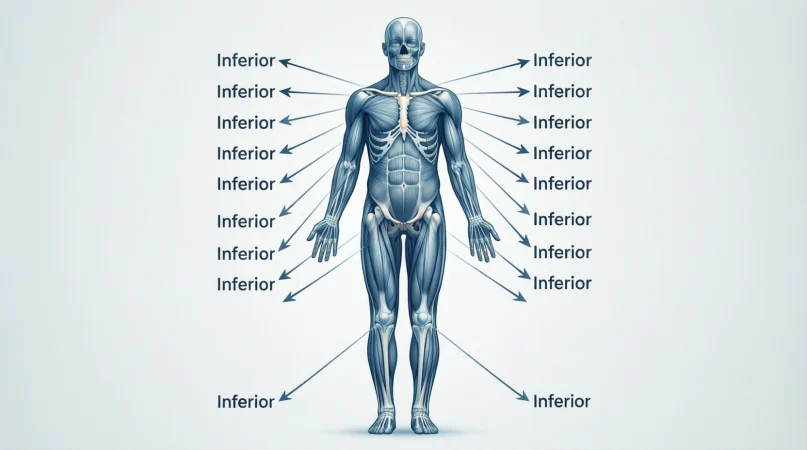
In anatomy, inferiormeans located below or toward the lower part of the body in relation to another structure.
It is a standard directional term used by healthcare professionals to describe precise locations of organs, bones, muscles, and other anatomical features.
If you’ve ever looked at a medical diagram, read a radiology report, or studied basic human anatomy, you’ve probably come across the word inferior. At first glance, it might sound judgmental or negative after all, in everyday language, inferior often means “worse” or “lower quality.” 😬
But in anatomy, inferior has nothing to do with value or importance. Instead, it’s a neutral, technical term that helps doctors, students, and medical professionals communicate clearly and accurately about the human body.
Understanding what inferior means in anatomy can:
- Help you read medical reports with confidence
- Make anatomy classes much easier
- Prevent confusion with everyday meanings
- Improve communication in healthcare settings
Let’s break it down step by step clearly, practically, and without the jargon overload.
What Does Inferior Mean in Anatomy?
In anatomical terminology, inferior describes a structure that is situated below another structure or closer to the feet when the body is in the standard anatomical position.
Anatomical Position Reminder
The anatomical position is the reference posture used in anatomy:
- Standing upright
- Facing forward
- Arms at the sides
- Palms facing forward
- Feet flat and pointing forward
All directional terms—including inferior—are based on this position.
Simple Definition
- Inferior = below / lower than
- Opposite term: Superior = above / higher than
📌 Example:
The stomach is inferior to the heart.
Origin and History of the Term “Inferior”
The word inferior comes from Latin:
- Latin root: inferior
- Meaning: “lower,” “beneath,” or “below”
This term entered anatomical language centuries ago, when early anatomists used Latin to ensure consistency across countries and languages. Because Latin is a “dead language” (it doesn’t change), it remains ideal for precise scientific naming.
Why Anatomy Still Uses Latin
- Avoids ambiguity
- Universally understood in medicine
- Prevents regional language confusion
- Keeps terminology consistent over time
How “Inferior” Is Used in Real-World Anatomy
In anatomy and medicine, inferior is used to describe the relative position of one structure compared to another.
Common Contexts Where You’ll See “Inferior”
- Anatomy textbooks
- Radiology reports (X-rays, MRIs, CT scans)
- Surgical notes
- Medical school exams
- Physical therapy documentation
Important Rule
👉 Inferior is always comparative.
It only makes sense when comparing two structures.
❌ Incorrect: “The liver is inferior.”
✅ Correct: “The liver is inferior to the lungs.”
Examples of Inferior in Anatomical Context
Friendly Learning Examples
- The mouth is inferior to the nose 🙂
- The knees are inferior to the hips
- The pelvis is inferior to the abdomen
Clinical or Neutral Tone Examples
- The mass is located inferior to the diaphragm.
- Pain radiates inferiorly toward the pelvis.
- The inferior border of the lung is visible on imaging.
Potentially Confusing (But Not Negative)
- The inferior vena cava carries blood to the heart.
- Inferior muscles of the neck assist in movement.
💡 Key Tip:
In anatomy, inferior never implies weakness, poor function, or lower importance—only position.
Inferior vs. Superior: A Crucial Comparison
These two terms are often taught together because they describe opposite directions.
| Term | Meaning in Anatomy | Direction |
| Inferior | Below or toward the feet | Downward |
| Superior | Above or toward the head | Upward |
Example Pair
- The lungs are superior to the liver
- The liver is inferior to the lungs
Inferior Compared to Other Directional Terms
Anatomy uses many directional terms, and inferior works alongside them.
Comparison Table: Inferior and Related Terms
| Term | Meaning | Example |
| Inferior | Below | The bladder is inferior to the intestines |
| Superior | Above | The brain is superior to the spinal cord |
| Anterior | Front | The chest is anterior to the spine |
| Posterior | Back | The spine is posterior to the sternum |
| Medial | Toward the midline | The nose is medial to the eyes |
| Lateral | Away from midline | The arms are lateral to the chest |
Common Anatomical Structures Using “Inferior”
Some anatomical names include inferior directly in their official terminology.
Examples
- Inferior vena cava – large vein carrying blood from the lower body to the heart
- Inferior turbinate – structure in the nasal cavity
- Inferior oblique muscle – eye movement muscle
- Inferior angle of the scapula – lower tip of the shoulder blade
These names are fixed anatomical labels—not descriptive opinions.
Inferior in Medical Imaging and Reports
Radiologists frequently use inferior to describe location on scans.
📄 Example from a radiology report:
“A lesion is identified inferior to the right kidney.”
This helps surgeons and physicians pinpoint exact locations without ambiguity.
Alternate Meanings of “Inferior”
Outside of anatomy, inferior can have very different meanings.
Everyday Language Meaning
- Lower quality
- Worse in comparison
- Subordinate or lesser
📌 Example:
“This product is inferior to the original.”
⚠️ Important:
This meaning does not apply in anatomical or medical contexts.
Professional and Polite Alternatives (Non-Anatomical Contexts)
If you’re writing professionally and want to avoid sounding harsh, consider alternatives:
| Instead of “Inferior” | Try This |
| Inferior quality | Less effective |
| Inferior option | Alternative option |
| Inferior performance | Below expectations |
In anatomy, however, inferior is always appropriate and neutral.
Usage Tips for Students and Professionals
✔ Always use inferior in relation to another structure
✔ Base descriptions on anatomical position
✔ Don’t confuse with “lower quality”
✔ Pair with superior for clarity
✔ Practice using diagrams and labeling exercises
FAQs
1. What does inferior mean in anatomy in simple terms?
It means below or lower than another body part when the body is in anatomical position.
2. Is inferior the same as bottom?
Not exactly. Inferior is a relative term, while “bottom” is informal and less precise.
3. What is the opposite of inferior in anatomy?
The opposite term is superior, meaning above or toward the head.
4. Does inferior mean less important?
No. In anatomy, it only describes location, not importance or function.
5. Can inferior be used to describe organs?
Yes. Many organs are described as inferior or superior relative to others.
6. What does inferior mean in a medical report?
It indicates that a structure is located below another structure.
7. Is inferior used in surgery?
Yes. Surgeons rely on directional terms like inferior for accuracy and safety.
8. Why does anatomy use words like inferior and superior?
To maintain precision, clarity, and universal understanding across medicine.
Conclusion
Understanding what inferior means in anatomy unlocks clearer communication and better comprehension of medical language.
- Inferior means below or toward the feet
- It’s a neutral, positional term
- Based on anatomical position
- Commonly paired with superior
- Widely used in anatomy, imaging, and clinical practice
Whether you’re a student, healthcare professional, or curious learner, mastering terms like inferior makes anatomy far less intimidating and a lot more logical. 🧠✨

Ryan Holloway is an experienced content strategist with a deep interest in etymology and word origins. He enjoys digging into the history behind words and presenting them in a straightforward, engaging way.