
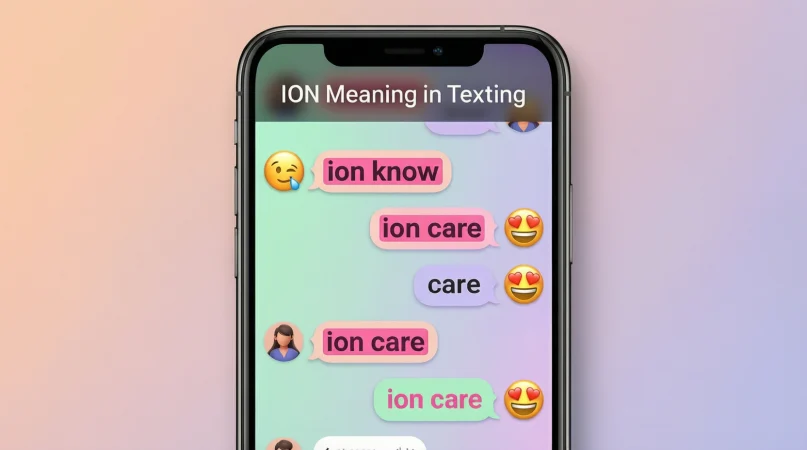
Ion in texting is a slang abbreviation for “I don’t”, commonly used in casual digital conversations.
It’s informal, conversational, and often associated with relaxed, playful, or dismissive tones depending on context.
Ever seen someone text “ion care” or “ion know” and wondered if they forgot half the sentence? You’re not alone. The slang term “ion” is everywhere on social media, texts, and casual online chats and its meaning isn’t always obvious if you’re new to internet slang.
This guide breaks it all down clearly and conversationally, so by the end, you’ll know exactly what “ion” means in texting, how people use it, when it sounds friendly vs dismissive, and what to say instead in more polite or professional situations.
What Does “Ion” Mean in Texting?
In texting and online chat, “ion” = “I don’t.”
It’s a phonetic spelling based on how “I don’t” sounds when spoken quickly, especially in casual speech. Instead of typing two words, people shorten it to one.
Simple Breakdown
- I don’t → spoken fast → “I’ don” → ion
- Used mostly in casual, informal communication
- Very common on:
- TikTok
- Twitter (X)
- Instagram comments
- Snapchat
- Text messages between friends
Quick Examples
- “Ion know what he talking about.”
- “Ion care fr.”
- “Ion wanna go.”
The Origin of “Ion” in Slang
Linguistic Roots
“Ion” comes from spoken English, not traditional grammar. It reflects how people naturally compress words when talking fast.
This usage has strong roots in:
- African American Vernacular English (AAVE)
- Casual urban speech
- Internet and social media culture
Important note: While “ion” is widely used online, it originated from specific speech communities. Using it casually is fine, but awareness and respectful usage matter.
Rise in Popularity
“Ion” became mainstream due to:
- Viral tweets and memes
- TikTok captions and comments
- Influencers and creators using casual speech online
Over time, it spread beyond specific communities into general internet slang.
How “Ion” Is Used in Real Conversations
“Ion” almost always replaces “I don’t”, but the tone depends on context.
Common Sentence Structures
- Ion + verb
- Ion know
- Ion care
- Ion like
- Ion think
- Ion + wanna
- Ion wanna talk
- Ion wanna argue
Tone Matters: Friendly vs Dismissive Usage
“Ion” can sound very different depending on how it’s used.
Friendly / Casual Tone 😊
Used jokingly or playfully among friends.
Examples:
- “Ion even remember 😭”
- “Ion know bro, maybe later.”
- “Ion mind if you come.”
Vibe: relaxed, conversational, friendly
Neutral / Informational Tone 😐
Used simply as shorthand, without strong emotion.
Examples:
- “Ion have the details yet.”
- “Ion think the update dropped.”
Vibe: casual but not emotional
Negative or Dismissive Tone 😒
When paired with short replies or blunt wording, it can sound rude.
Examples:
- “Ion care.”
- “Ion asked.”
- “Ion got time.”
Vibe: dismissive, uninterested, sometimes disrespectful
Example Table: “Ion” in Different Contexts
| Text Message | Meaning | Tone |
|---|---|---|
| “Ion know 🤷♂️” | I don’t know | Casual |
| “Ion care fr” | I don’t care, seriously | Dismissive |
| “Ion mind helping” | I don’t mind helping | Friendly |
| “Ion wanna talk rn” | I don’t want to talk right now | Neutral |
| “Ion asked tho” | I didn’t ask | Rude / Defensive |
Is “Ion” Grammatically Correct?
Short answer: No—but that’s okay.
“Ion” is:
- ❌ Not grammatically correct
- ❌ Not suitable for formal writing
- ✅ Perfectly normal in casual texting
Where “Ion” Is Acceptable
- Text messages
- Social media posts
- Online chats
- Comments and DMs
Where You Should Avoid It
- Emails
- School assignments
- Work messages
- Professional communication
Polite and Professional Alternatives to “Ion”
If you’re texting someone you don’t know well—or writing professionally—here are better options.
Casual but Polite
- “I don’t think so”
- “I’m not sure”
- “I don’t mind”
- “I don’t really want to”
Professional Alternatives
| Slang | Professional Version |
|---|---|
| Ion know | I’m not certain |
| Ion care | It’s not a priority |
| Ion wanna | I would prefer not to |
| Ion think | I don’t believe |
Comparison: “Ion” vs Similar Slang Terms
“Ion” isn’t the only shortcut people use. Here’s how it compares to similar slang.
Ion vs I Don’t
| Feature | Ion | I Don’t |
|---|---|---|
| Formal | ❌ No | ✅ Yes |
| Casual texting | ✅ Yes | ✅ Yes |
| Professional use | ❌ No | ✅ Yes |
| Tone flexibility | High | Neutral |
Ion vs Idk
- Ion know = I don’t know (casual, conversational)
- IDK = I don’t know (neutral, widely accepted)
IDK is safer in mixed or semi-professional chats.
Ion vs Don’t
- “Don’t” is still standard English
- “Ion” is more relaxed and stylistic
Alternate Meanings of “Ion”
Outside of texting slang, ion has other meanings but context makes it obvious.
1. Science (Chemistry & Physics)
An ion is a charged atom or molecule.
- Example: “Sodium ion”
- Completely unrelated to texting slang
2. Acronym Usage (Rare)
Sometimes “ION” appears as an acronym, but this is uncommon in casual chat.
In texting, 99% of the time, “ion” means “I don’t.”
When Should You Avoid Using “Ion”?
Avoid using “ion” if:
- You’re speaking to elders
- You’re writing professionally
- You want to sound respectful or serious
- The conversation is sensitive or emotional
Using “ion” in the wrong setting can come off as careless or dismissive.
Usage Tips: Sound Natural, Not Rude
✔ Use emojis to soften tone
✔ Use full sentences if clarity matters
✔ Match the other person’s communication style
❌ Don’t use it in arguments unless you want to sound blunt
❌ Don’t use it in formal writing—ever
FAQs
1. What does “ion” mean in texting?
“Ion” means “I don’t.” It’s casual slang used in informal conversations.
2. Is “ion” rude?
Not always. It can sound rude if used bluntly (like “ion care”), but with context or emojis, it can be friendly.
3. Is “ion” the same as “IDK”?
Not exactly. “Ion know” means “I don’t know,” while IDK is a more neutral abbreviation.
4. Can I use “ion” in school or work?
No. It’s considered informal slang and should be avoided in professional or academic settings.
5. Where did “ion” slang come from?
It originated from spoken English and AAVE influences, later spreading through social media.
6. Does “ion” always mean “I don’t”?
In texting slang, yes. In science, “ion” has a completely different meaning.
7. Is “ion” common on TikTok?
Very common. It’s frequently used in captions, comments, and memes.
8. How do I respond if someone texts me “ion care”?
That depends on tone. It could mean they’re joking or that they’re genuinely uninterested. Context is key.
Conclusion
- Ion = I don’t
- It’s casual, informal, and conversational
- Tone depends heavily on context
- Avoid it in professional or formal communication
- When used right, it sounds natural and modern
If you’re texting friends or scrolling social media, you’ll see “ion” everywhere and now, you’ll know exactly what it means and how to use it confidently.

Olivia Brooks is a skilled writer at ValneTix.com dedicated to making word meanings simple, practical and relatable. Her clear explanations empower readers to use language effectively and confidently.