
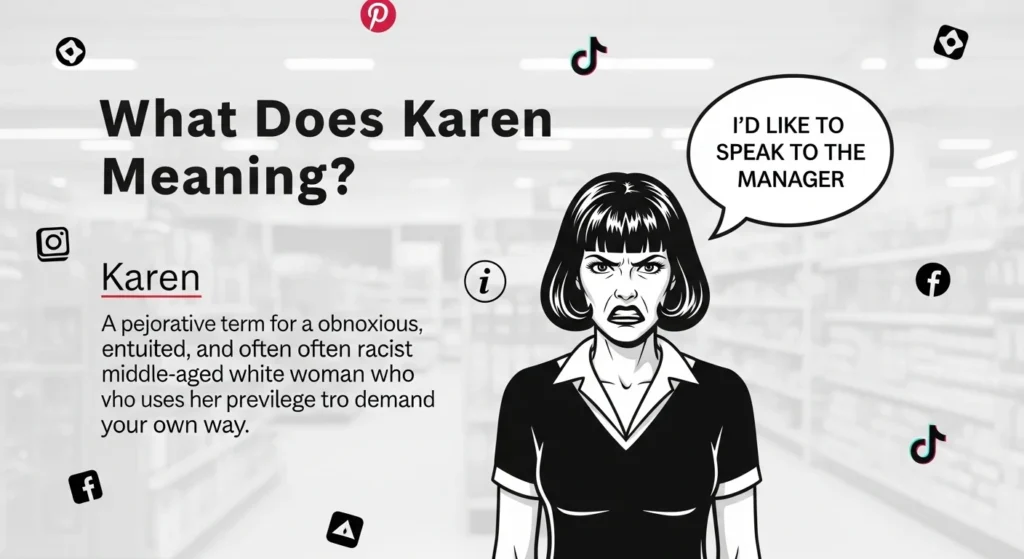
“Karen” is a slang term used to describe a person typically a middle aged white woman who is perceived as entitled, demanding, or overly critical, especially in public situations where they ask to “speak to the manager.”
Over time, the meaning has expanded to describe anyone displaying entitled, unreasonable, or privilege driven behavior, regardless of gender.
Have you ever seen a viral video of someone loudly demanding special treatment in a store, restaurant, or public place? Chances are, someone in the comments called them a “Karen.”
But what does Karen meaning really involve? Is it just a meme? A joke? Or something more complex?
In this in-depth guide, we’ll break down:
- The true meaning of “Karen”
- Where it originated
- Why it became so popular online
- Real-life examples and tone differences
- Comparisons with similar slang
- Professional alternatives
- FAQs people are searching for
Let’s dive in 👇
What Does Karen Meaning in Slang?
In modern slang, “Karen” refers to a person who behaves in an entitled, demanding, or self-important way, often in public settings.
Key Traits Associated With a “Karen”:
- Demands to “speak to the manager”
- Overreacts to minor inconveniences
- Displays racial or social privilege
- Assumes rules don’t apply to them
- Acts condescending toward workers
Originally, the term mostly described white middle-aged women, but today it is used more broadly.
Origin of the Term “Karen”
The slang meaning didn’t appear overnight. It evolved over time through internet culture and memes.
1️⃣ Early Meme Culture
The “Karen haircut” meme (the angled bob hairstyle) became popular in the 2000s and 2010s, symbolizing a stereotype of suburban entitlement.
2️⃣ Reddit & Online Forums
On platforms like Reddit, the term gained traction as shorthand for people behaving in frustrating or entitled ways.
3️⃣ Viral Social Media Videos
The term exploded during 2020 when videos of individuals calling police over minor issues went viral. At that point, “Karen” became associated with:
- Racial profiling
- Public confrontations
- Abuse of privilege
It became both a meme and a social commentary term.
Why Did “Karen” Become So Popular?
The rise of smartphone cameras + social media played a huge role.
People began recording public outbursts. When those videos went viral, internet users needed a label and “Karen” stuck.
Reasons for Popularity:
- Easy to understand stereotype
- Meme-friendly
- Reflects social frustrations
- Fits into short-form content (TikTok, Twitter, Instagram)
It became part of modern internet slang.
Real-Life Usage of “Karen” (With Tone Examples)
The meaning can shift depending on tone and context.
📊 Example Table: Tone & Context
| Situation | Example Sentence | Tone |
|---|---|---|
| Restaurant complaint | “She asked for the manager three times over a small mistake. Total Karen.” | Negative |
| Joke among friends | “Don’t be a Karen, it’s just five minutes late 😂” | Playful |
| Social media caption | “Another Karen caught on camera arguing with staff.” | Critical |
| Serious accusation | “Calling the police over nothing is Karen behavior.” | Strongly Negative |
Is “Karen” Always Negative?
Yes in slang usage, it’s generally negative or dismissive.
It implies:
- Lack of self-awareness
- Entitlement
- Overreaction
However, sometimes it’s used jokingly among friends in a light tone.
Example:
“Okay okay, I won’t complain. I don’t want to be a Karen 😅”
In this case, it’s playful—not harsh.
Does “Karen” Only Refer to Women?
Originally, yes. But now the usage has expanded.
Modern Variations Include:
- Male version: “Ken”
- General usage: Anyone acting entitled
- Behavior-focused: “That’s Karen behavior”
The focus has shifted more toward behavior than gender, though controversy remains.
Is the Term Offensive?
This is where it gets complex.
Critics Say:
- It stereotypes women.
- It can be misogynistic.
- It dismisses legitimate complaints.
Supporters Say:
- It calls out abusive entitlement.
- It highlights privilege.
- It exposes discriminatory behavior.
Like many slang terms, its impact depends on context and intent.
Comparison With Similar Slang Terms
Here’s how “Karen” compares to other internet slang:
| Term | Meaning | Difference From Karen |
|---|---|---|
| Snowflake | Easily offended person | Focuses on sensitivity |
| Boomer | Outdated or old-fashioned mindset | Age-based, not entitlement |
| Diva | Dramatic, high-maintenance person | Can be glamorous |
| Entitled | Believes they deserve special treatment | Broader term |
“Karen” specifically combines entitlement + public confrontation + privilege stereotype.
Alternate Meanings of Karen
Outside slang, Karen is simply a traditional first name.
It became popular in the U.S. during the 1950s and 1960s.
There is also:
- The Karen ethnic group in Myanmar
- Karen language (spoken in Southeast Asia)
So context matters.
How to Use “Karen” Carefully
If you’re writing professionally or creating content, consider:
⚠️ Avoid Using It When:
- Discussing serious workplace complaints
- Addressing customer service issues formally
- Speaking in professional environments
✅ Better Alternatives:
- “Entitled behavior”
- “Demanding customer”
- “Unreasonable complaint”
- “Overly confrontational”
- “Privilege-driven reaction”
Using alternatives maintains professionalism.
Examples of Karen Meaning in Sentences
Negative Usage
- “She refused to leave the store and demanded a refund without proof. Total Karen move.”
Playful Usage
- “I almost complained about the WiFi but didn’t want to sound like a Karen 😂”
Social Commentary
- “The video showed classic Karen behavior—calling authorities over a minor issue.”
Social Media and the “Karen” Meme
Platforms like TikTok, Twitter, and YouTube accelerated the spread.
Hashtags like:
- #Karen
- #KarenAlert
- #KarenMoment
Made it searchable and meme-ready.
It became a cultural shorthand.
Professional & Polite Alternatives
Instead of labeling someone a Karen, try:
- “The customer was dissatisfied.”
- “The individual reacted strongly.”
- “There was an escalation.”
- “The complaint was handled improperly.”
This keeps tone respectful.
FAQs
1. What does Karen mean in slang?
It refers to a person perceived as entitled, demanding, or overly confrontational, especially in public settings.
2. Why is someone called a Karen?
Usually because they’re acting unreasonable, demanding special treatment, or misusing authority.
3. Is Karen an insult?
Yes, it’s generally considered a negative or mocking term.
4. Does Karen only apply to white women?
Originally yes, but modern usage focuses more on behavior than identity.
5. What is the male version of Karen?
Some people use “Ken,” but it’s less common.
6. When did Karen become popular?
It became widely popular around 2018–2020 during viral social media videos.
7. Is it wrong to call someone a Karen?
It can be offensive depending on context. Use caution.
8. What are better words than Karen?
Entitled, confrontational, unreasonable, demanding.
Conclusion
So, what does Karen meaning come down to?
At its core, it describes entitled or confrontational public behavior, especially when someone abuses perceived privilege.
However:
- It’s not just a joke.
- It can be controversial.
- It can feel insulting.
- Context matters deeply.
If you’re using it casually, understand the tone.
If you’re writing professionally, choose alternatives.
Language evolves quickly and “Karen” is a perfect example of how internet culture shapes modern slang.
Discover More Related Articles:-
- What Does WYG Mean in Text? Definition, Examples & Usage Guide For 2026
- What Does Attainable Mean in SMART Goals? Definition, Examples & Tips For 2026

Tom Holland is a language enthusiast at ValneTix.com passionate about unraveling the meanings behind words and phrases. His clear, insightful and engaging explanations help readers expand their vocabulary and communicate with confidence.