
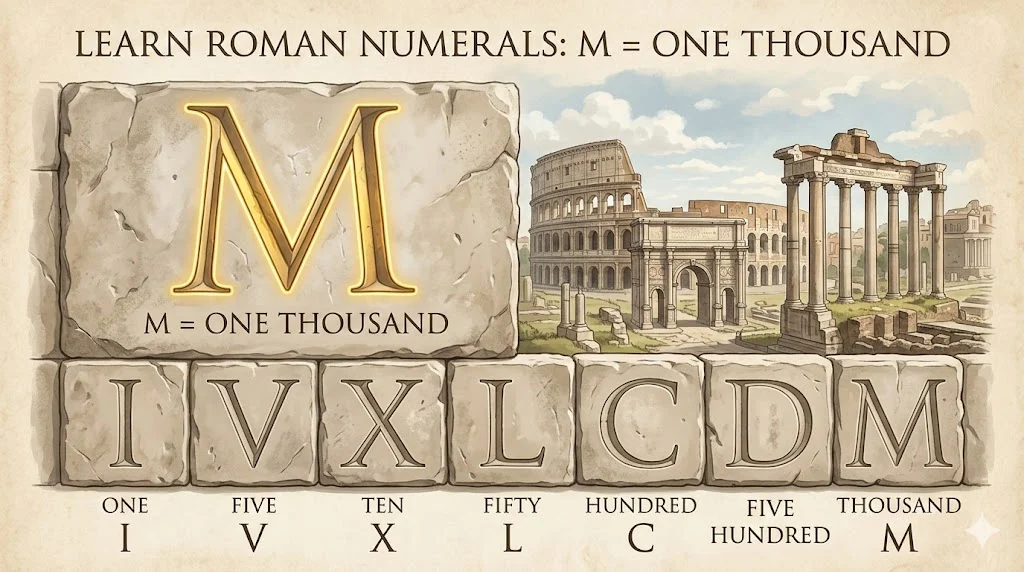
M in Roman numerals represents the number 1000.
It comes from the Latin word mille, which means thousand. In Roman numeral notation, M is used to represent values starting from 1000 and can be repeated to form larger numbers.
Examples:
| Roman Numeral | Number |
|---|---|
| M | 1000 |
| MM | 2000 |
| MMM | 3000 |
Roman numerals are commonly used in book chapters, movie titles, clocks, and historical dates.
Roman numerals are everywhere once you start noticing them on clocks, book chapters, movie release years, building cornerstones, and even Super Bowl logos. Among all these symbols, “M” stands out as one of the most powerful and intriguing. It represents a large number, appears frequently in dates, and carries a long historical legacy.
But what does M mean in Roman numerals, exactly? Why was this letter chosen, and how is it still used today?
This in-depth guide breaks it all down in a clear, friendly, and practical way whether you’re a student, history lover, designer, or just curious.
Why Roman Numerals (and M) Still Matter Today
Even though we rely on Arabic numerals (1, 2, 3…) in daily life, Roman numerals remain culturally and historically important. The symbol M often signals:
- Importance
- Grandeur
- Timelessness
- Tradition
Seeing M immediately tells us we’re dealing with something large, formal, or historically significant.
The Origin of M in Roman Numerals
Where Did Roman Numerals Come From?
Roman numerals originated in ancient Rome, around the 6th to 7th century BCE. They were developed for:
- Trade
- Record-keeping
- Military organization
- Architecture
The system uses combinations of letters from the Latin alphabet.
Why Does M Represent 1,000?
The letter M comes from the Latin word:
“Mille” — meaning one thousand
Over time, Mille was shortened to M for efficiency in writing and carving.
Historical Evolution of 1,000 in Roman Numerals
| Period | Symbol Used | Explanation |
| Early Rome | ↀ | Early symbol for 1,000 |
| Later Rome | CIƆ | Stylized form |
| Classical Latin | M | Simplified and standardized |
The modern M = 1,000 is the most widely recognized form today.
Roman Numeral Basics (Quick Refresher)
Before diving deeper into M, here’s a quick overview of common Roman numerals:
| Roman Numeral | Value |
| I | 1 |
| V | 5 |
| X | 10 |
| L | 50 |
| C | 100 |
| D | 500 |
| M | 1,000 |
How M Is Used in Roman Numerals
1. As a Standalone Number
- M = 1,000
Simple, clear, and powerful.
2. Repeated to Show Larger Numbers
Roman numerals rely on repetition:
- MM = 2,000
- MMM = 3,000
Traditionally, Roman numerals don’t repeat a symbol more than three times, which limits how large numbers are written.
3. Combined with Other Numerals
Examples:
- MC = 1,100
- MD = 1,500
- MCM = 1,900
- MMXXIV = 2024
Example Table: Numbers Using M
| Roman Numeral | Arabic Number | Explanation |
| M | 1,000 | Base value |
| MI | 1,001 | M + I |
| MC | 1,100 | M + C |
| MD | 1,500 | M + D |
| MCM | 1,900 | 1,000 + (1,000 − 100) |
| MM | 2,000 | M repeated |
| MMXXIV | 2024 | Modern year example |
How Subtraction Works with M
Roman numerals sometimes use subtractive notation to avoid repetition.
Key Rule
A smaller numeral placed before a larger one is subtracted.
Examples:
- CM = 900 (1,000 − 100)
- MCM = 1,900
- CMXC = 990
This system makes Roman numerals more compact and elegant.
Real-World Usage of M in Roman Numerals
1. Dates and Years
Roman numerals are often used for years on:
- Movies (© MMXXIV)
- Book publication pages
- Monuments
- Churches and historic buildings
Example:
Built in MDCCLXXVI → Built in 1776
2. Clock Faces
Many analog clocks use Roman numerals up to XII, but the tradition stems from the same system that includes M for larger values.
3. Events and Titles
- Super Bowl LVIII
- World War II
- Henry VIII
Though M isn’t always visible here, it’s part of the same numbering tradition.
4. Copyright and Film Credits
Movies often display years like:
- © MMXXIII
This adds a formal, classic tone 🎬
Tone and Context: What M Communicates
Using Roman numerals—especially M—adds a specific tone:
| Context | Tone |
| Historical | Formal, authoritative |
| Design/Branding | Classic, premium |
| Education | Scholarly |
| Pop culture | Timeless, iconic |
Comparison: M vs Other Roman Numerals
M vs D (500)
| Feature | M | D |
| Value | 1,000 | 500 |
| Frequency | Very common | Less common |
| Visual impact | Strong | Moderate |
M vs C (100)
M is used for:
- Large-scale dating
- Major milestones
C is used for:
- Smaller increments
- Everyday numbering
Alternate Meanings of “M” (Outside Roman Numerals)
To avoid confusion, it’s helpful to know that M can mean different things in other contexts:
| Context | Meaning |
| Measurements | Meter |
| Finance | Million |
| Science | Molar |
| Music | Major |
| Texting | Male |
⚠️ Important: Only in Roman numerals does M = 1,000.
Professional Alternatives to Roman Numerals
While Roman numerals look elegant, Arabic numerals are preferred when:
- Precision matters
- Data is complex
- Clarity is critical
Professional alternatives include:
- 1,000 instead of M
- 2024 instead of MMXXIV
Common Mistakes with M in Roman Numerals
❌ Writing MMMM for 4,000
✔ Using MV̄ or modern notation instead
❌ Confusing M with “million”
✔ Remembering Roman numerals don’t represent millions without special markings
Tips for Reading Roman Numerals with M
- Read left to right
- Add values unless subtraction applies
- Break the numeral into chunks
- Look for CM (900) or CD (400)
FAQs
1. What does M mean in Roman numerals?
M represents the number 1,000.
2. Why is M used for 1,000?
It comes from the Latin word mille, meaning thousand.
3. What does MM mean?
MM equals 2,000.
4. How do you write 2,024 in Roman numerals?
MMXXIV
5. Can Roman numerals go above 3,999?
Yes, but they require special symbols like overlines.
6. Is M ever used to mean one million in Roman numerals?
No, not traditionally.
7. Where do we see M used today?
Dates, monuments, movies, books, and branding.
8. Are Roman numerals still taught in schools?
Yes, especially in math, history, and language classes.
Conclusion
The Roman numeral M is more than just a number it’s a bridge between ancient civilization and modern culture. From historic monuments to movie credits, it quietly signals scale, significance and timelessness.
Understanding what M means in Roman numerals not only helps you decode dates and symbols but also gives you insight into how history still shapes the way we communicate numbers today.

Madison Lee is a skilled writer at ValneTix.com dedicated to making word meanings clear, relatable and actionable. She empowers readers to understand language deeply and use words with confidence in daily life.