
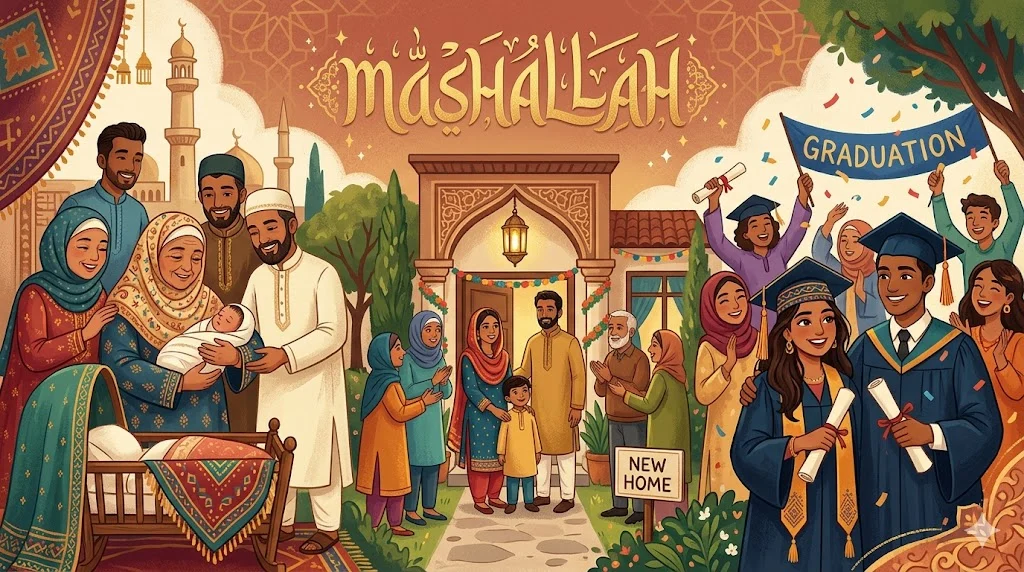
Mashallah (ما شاء الله) means “what God has willed” in Arabic. It is used to express admiration, appreciation, and gratitude for something good, while acknowledging it happened by God’s will. Muslims commonly say Mashallah to celebrate positive events, compliment someone, and protect against envy or the evil eye.
One word. Dozens of emotions. And if you’ve never heard it before, it stops you in your tracks.
Mashallah.
Someone sees a newborn baby and whispers it. A mother hears her son got into university and says it out loud. A friend walks into your new home, looks around, and the first thing out of their mouth is that single, quiet word. No long explanation. No translation offered. Just Mashallah and somehow, everyone in the room understands exactly what it means.
Except maybe you.
If you’ve grown up outside Arab or Muslim culture, this word can feel like a mystery. You hear it constantly in conversations, in comments sections, in TV shows, in everyday life but nobody stops to explain it. And it’s too layered to just Google and move on.
Because Mashallah isn’t just a word. It’s a feeling, a protection, a prayer, and a cultural reflex all compressed into four syllables. Understanding it doesn’t just teach you Arabic it gives you a window into how millions of people see beauty, gratitude, and the world itself.
This article breaks it all down the meaning, the origin, the right way to use it, and why once you truly understand it, you’ll never hear it the same way again.
Origin of Mashallah
Mashallah originates from classical Arabic and literally translates to “What God has willed.” It comes from the root word ‘sha’a’ (شاء), which means “to will” or “to desire.”
- Arabic Script: ما شاء الله
- Transliteration: Mashallah
- Literal Meaning: “As God has willed”
- Spiritual Connotation: Recognition that all good things happen by God’s will, encouraging gratitude and humility.
Historically, it has been used by Arabs and Muslims to praise someone or something without invoking jealousy or the evil eye. This practice emphasizes that positive outcomes are not solely due to personal effort but also divine blessing.
Popularity and Cultural Significance
Mashallah is widely recognized in Muslim-majority countries, as well as among Muslim communities worldwide. Its popularity is not limited to Arabic-speaking populations — it is used in Turkish, Persian, Urdu, and other Islamic cultural contexts.
Why People Say Mashallah
- Protection from envy: Saying Mashallah prevents the evil eye.
- Acknowledgment of blessings: Recognizes that success or beauty comes from God.
- Polite admiration: Compliments someone respectfully without sounding boastful.
For example, if you see a child achieving something impressive, instead of saying “Wow, they’re talented!” you can say:
“Mashallah! That’s amazing.”
This adds a spiritual blessing to your praise.
How to Use Mashallah in Daily Life
Mashallah can be used in multiple contexts, from casual to formal settings. It is versatile and expresses positivity, respect, and appreciation.
1. Friendly or Neutral Praise
- Situation: Complimenting someone’s new car
- Example: “Mashallah, your car looks fantastic! 🚗”
- Situation: Seeing a beautiful house
- Example: “Mashallah, this is such a cozy home! 🏡”
2. Admiration for Achievements
- Situation: A friend’s promotion or graduation
- Example: “Mashallah, congratulations on your success! 🎓”
3. Reacting to Physical Appearance or Traits
- Situation: Complimenting a baby or child
- Example: “Mashallah, what a beautiful baby! 👶”
4. Avoiding Negative or Jealousy-Tinged Comments
- Situation: Someone’s skill or talent
- Example: “Mashallah, your singing is incredible! 🎤”
- Tone Note: Using Mashallah conveys genuine appreciation without implying envy.
Comparison With Related Terms
| Term | Meaning | Usage Context | Tone |
| Mashallah (ما شاء الله) | What God has willed | Admiration, appreciation | Positive, respectful |
| Inshallah (إن شاء الله) | If God wills | Future intentions or plans | Hopeful, conditional |
| Alhamdulillah (الحمد لله) | Praise be to God | Gratitude for blessings | Thankful, content |
| Subhanallah (سبحان الله) | Glory be to God | Astonishment or wonder | Awe, admiration |
Key Difference: Mashallah focuses on appreciating something good in the present or past, while Inshallah refers to hopes for the future.
Alternate Meanings and Interpretations
While Mashallah is primarily used as praise or admiration, it can also subtly indicate:
- Gratitude for divine blessing: Recognizing God’s will in everyday life.
- Protection against envy: In some cultures, it is believed that voicing admiration without Mashallah could invite negative energy.
- Polite acknowledgment: In social settings, saying Mashallah demonstrates humility and respect.
Polite or Professional Alternatives
If you prefer a more formal or secular alternative in professional settings, consider:
- “Congratulations!”
- “Well done!”
- “That’s impressive!”
- “I appreciate your effort.”
These alternatives are suitable in workplaces where religious expressions might not be appropriate.
Examples Table: Mashallah in Different Contexts
| Scenario | What to Say | Tone | Emoji Usage |
| Baby | “Mashallah, such a cute baby!” | Friendly, admiring | 👶❤️ |
| Achievement | “Mashallah, your project turned out great!” | Professional, respectful | 📈👏 |
| Appearance | “Mashallah, your outfit looks amazing!” | Casual, friendly | 👗✨ |
| Property | “Mashallah, this house is beautiful.” | Neutral, polite | 🏡👌 |
| Talent | “Mashallah, your painting is wonderful!” | Admirative, positive | 🎨🌟 |
Tips for Using Mashallah Correctly
- Pronounce it correctly: /maʃaːʔ allaːh/
- Use it sincerely: Avoid overusing or saying it sarcastically.
- Pair with appropriate emoji or tone: Makes it more engaging in texts or social media.
- Understand cultural context: In some cultures, failing to say Mashallah might seem insensitive.
- Use for protection from envy: Especially when complimenting children, achievements, or possessions.
Practical Tips for Everyday Use
- Pair it with genuine compliments: “Mashallah, you did a fantastic job on your presentation!”
- Use sparingly in professional settings unless culturally appropriate.
- Encourage friends or children by acknowledging their achievements with Mashallah.
- In social media captions, it adds a cultural and spiritual touch: “New car, Mashallah! 🚗✨”
FAQs
- What does Mashallah mean in English?
- It means “What God has willed” and is used to express admiration, appreciation, or gratitude.
- Is Mashallah only used by Muslims?
- Primarily yes, but non-Muslims in Arab or Muslim communities may also use it out of cultural familiarity.
- When should I say Mashallah?
- Use it when you admire someone’s achievements, beauty, blessings, or anything positive.
- Can Mashallah be used sarcastically?
- While technically possible, it is culturally inappropriate and can offend people.
- How is Mashallah different from Inshallah?
- Mashallah is for present or past admiration, Inshallah refers to future intentions or plans.
- Can I use Mashallah in text messages?
- Absolutely! It’s very common in text, social media, and WhatsApp chats, often with emojis.
- Are there negative uses of Mashallah?
- Typically no, but saying it insincerely or sarcastically can be perceived as disrespectful.
- What are similar Islamic expressions?
- Alhamdulillah (gratitude), Subhanallah (awe), Inshallah (hope for future) are closely related phrases.
Conclusion
Mashallah is more than just a phrase — it’s a cultural and spiritual expression that reflects admiration, gratitude, and recognition of God’s will. Using it appropriately can enrich conversations, protect against envy, and foster a sense of positivity and respect. Whether you’re complimenting someone’s appearance, achievements, or possessions, Mashallah conveys appreciation in a warm and meaningful way.
- Mashallah = “What God has willed”
- Express admiration, gratitude, and protection against envy
- Use in casual, friendly, or formal settings with sincerity
- Combine with emojis or polite tone for modern communication
- Related expressions include Inshallah, Alhamdulillah, Subhanallah
By understanding the meaning, usage, and context of Mashallah, you can communicate more effectively and respectfully in Arabic and Muslim cultural environments.

Alex Ferguson is a word enthusiast at ValneTix.com who turns the meanings of everyday words into fascinating discoveries. His articles make learning language easy, enjoyable and practical for all readers.