
Last Updated on April 3, 2026
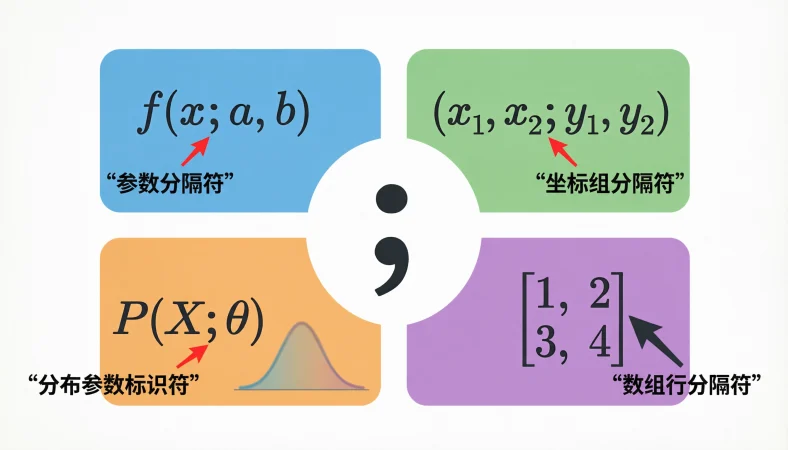
In mathematics, the semicolon (;) is used to separate elements in certain contexts, such as function arguments, coordinates in multi-dimensional spaces, or variables in formal expressions. Its meaning depends on the mathematical framework, often serving as a clear delimiter to distinguish distinct components.
Mathematics is full of symbols that can baffle even the most seasoned students. One symbol that often sparks curiosity is the semicolon (;). You might have seen it in textbooks, programming scripts, or statistical formulas and wondered: “What does this mean in math?” Unlike more common symbols like +, -, or =, the semicolon has a subtle but powerful role in organizing mathematical information. Let’s explore its meaning, origins, applications, and examples in everyday math and advanced studies.
Origins of the Semicolon in Mathematics
The semicolon originates from written language, first introduced by Aldus Manutius in the 15th century as a punctuation mark to separate ideas more subtly than a period. Its adoption in mathematics is more modern and practical, serving as a delimiter in complex expressions.
- Purpose: To separate distinct elements in a compact, readable way.
- Popularity: Primarily used in advanced mathematics, statistics, computer science, and engineering.
- Why it matters: It reduces ambiguity when multiple variables, vectors, or function arguments are involved.
Think of it as a mathematical “pause” that tells the reader: “These are separate entities, but they belong together in this structure.”
Common Contexts Where “;” Appears in Math
The meaning of the semicolon can vary depending on the field. Below are the most common contexts:
1. Function Arguments in Multivariable Calculus
In advanced calculus, you might encounter a function written like this:
f(x;y)=x2+y2f(x; y) = x^2 + y^2f(x;y)=x2+y2
Here, the semicolon separates variables into different categories:
- Before the semicolon: Variables treated as the main input.
- After the semicolon: Parameters held constant or secondary variables.
✅ Example: In physics, F(x;t)F(x; t)F(x;t) might represent a force FFF as a function of position xxx with time ttt as a fixed parameter.
2. Coordinate Systems in Higher Dimensions
In multi-dimensional geometry, semicolons help separate groups of coordinates.
(x1,x2;y1,y2)(x_1, x_2; y_1, y_2)(x1,x2;y1,y2)
- This notation is especially useful in phase space analysis or matrix representations, where grouping variables enhances clarity.
3. Statistics and Probability
Some statistical software or textbooks use semicolons to separate observations from parameters in probability distributions.
- Example:
P(X=x;θ)P(X=x; \theta)P(X=x;θ)
Here, XXX is the random variable, and θ\thetaθ represents a parameter of the distribution.
4. Programming and Mathematical Software
In tools like MATLAB, R, or Mathematica, the semicolon often acts as a delimiter or line separator, which is mathematically significant:
- MATLAB Example:
A = [1 2 3; 4 5 6; 7 8 9];
Here, semicolons separate rows in a matrix.
- Effect: Improves readability and ensures operations are applied correctly.
5. Differential Equations and Control Theory
In control theory, semicolons may be used to separate state variables from control variables:
x˙=f(x;u)\dot{x} = f(x; u)x˙=f(x;u)
- xxx = state variables
- uuu = control inputs
The semicolon clarifies which variables are being differentiated and which are considered constants during analysis.
Example Table of Semicolon Usage in Math
| Context | Example | Meaning of ; |
| Function with parameters | f(x;y)=x2+y2f(x; y) = x^2 + y^2f(x;y)=x2+y2 | Separates main variable from parameter |
| Multidimensional coordinates | (x1,x2;y1,y2)(x_1, x_2; y_1, y_2)(x1,x2;y1,y2) | Separates groups of coordinates |
| Probability / Statistics | P(X=x;θ)P(X=x; \theta)P(X=x;θ) | Separates variable from distribution parameter |
| Programming (MATLAB) | [1 2 3; 4 5 6] | Separates rows in a matrix |
| Control Theory | x˙=f(x;u)\dot{x} = f(x; u)x˙=f(x;u) | Distinguishes state variables from inputs |
Comparison With Related Symbols
Mathematical notation has several separators, and understanding their subtle differences is key:
| Symbol | Common Use | Comparison to ; |
| , | Separates items in a list or vector | Often separates components within the same group; semicolon can separate groups |
| : | Denotes “such that” or a ratio | More logical or ratio-oriented, not used for grouping variables |
| ` | ` | Conditional or divides vectors |
| ; | Separates parameters or groups | Useful for clarity in multi-variable contexts |
💡 Tip: If you’re unsure, look at whether the items on either side of the semicolon are different categories. If yes, semicolon is appropriate; if they’re similar items in a list, a comma is usually better.
Alternate Meanings in Math and Computing
While our focus is mathematics, it’s worth noting that ; may appear in related domains:
- Programming: Ends a statement (x = 5;)
- Spreadsheet formulas: Separates arguments in functions in some locales (SUM(A1;B1))
- LaTeX / Typesetting: Often used for spacing in matrix or array environments
These usages, while not purely mathematical, highlight the semicolon’s versatility as a separator and organizer.
Real-World Examples With Context
- Friendly / Educational Tone:
f(x;y)=x2+y2f(x; y) = x^2 + y^2f(x;y)=x2+y2
Here, the semicolon is a simple “pause” to show: x is the main star, y is along for the ride.
- Neutral / Practical Tone:
(x1,x2;y1,y2)(x_1, x_2; y_1, y_2)(x1,x2;y1,y2)
This is just a clear way to show two coordinate pairs without confusion.
- Negative / Dismissive Tone (for students struggling):
“Ugh, why so many symbols? Well, the semicolon is just saying: don’t mix these variables together!”
Tips for Using the Semicolon Correctly in Math
- Always check the context: function definition, coordinates, matrices, or software.
- Use commas for items in the same group; use semicolons for separate groups.
- In programming, the semicolon may also suppress output (MATLAB, for instance).
- In statistics, keep parameters and variables distinct using semicolons.
- When in doubt, refer to the notation guide in textbooks or software documentation.
FAQs
- Q: Is ; the same as a comma in math?
A: Not exactly. A comma separates items in the same group, while a semicolon separates different groups or categories. - Q: Why do some functions use semicolons instead of commas?
A: To distinguish between main variables and parameters, or between different categories of inputs. - Q: Can I replace a semicolon with a comma in equations?
A: Usually not. Semicolons indicate grouping that commas cannot convey clearly. - Q: Is semicolon usage universal in math?
A: No. It’s common in higher math, programming, and statistics, but not in all contexts. - Q: How is ; used in MATLAB?
A: It separates rows in matrices and can suppress output after a command. - Q: What does ; mean in probability notation?
A: It separates the random variable from the distribution parameters (e.g., P(X=x;θ)P(X=x; \theta)P(X=x;θ)). - Q: Is there a historical reason for using ; in math?
A: Yes, it comes from punctuation practices in the 15th century, adapted to organize mathematical expressions. - Q: Are there alternatives to using semicolons?
A: Sometimes, parentheses or explicit labels can replace semicolons for clarity, especially in text-heavy explanations.
Conclusion
- The semicolon (;) in mathematics acts as a separator of distinct elements, especially in functions, coordinates, matrices, and probability formulas.
- Its purpose is clarity and organization, ensuring multi-variable expressions remain readable and unambiguous.
- Semicolons are common in advanced mathematics, statistics, and programming, but not universal.
- Understanding the context function arguments, groups of variables, or software syntax is crucial.
- When writing math, follow conventions carefully and consider whether commas, colons, or parentheses might be more appropriate.
By mastering semicolon usage, you’ll gain a subtle but powerful tool to make complex mathematics more digestible both for yourself and for anyone reading your work.

Ryan Holloway is an experienced content strategist with a deep interest in etymology and word origins. He enjoys digging into the history behind words and presenting them in a straightforward, engaging way.