
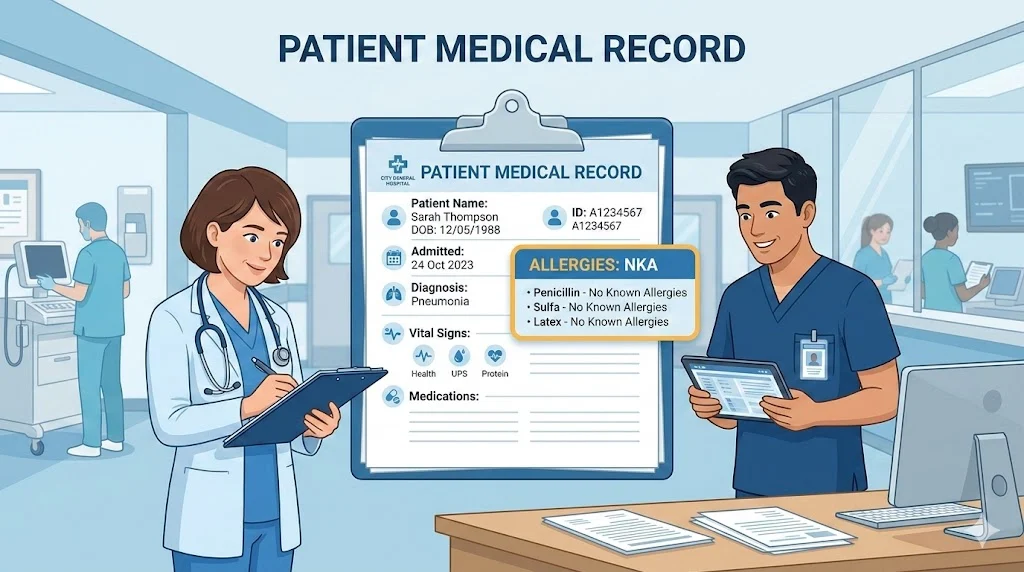
NKA Meaning in Medical Terms:
NKA stands for No Known Allergies, a medical abbreviation used in healthcare records to indicate that a patient has no known allergic reactions.
Medical charts and clinical notes are packed with abbreviations that can feel intimidating even confusing if you’re not trained to read them. One of the most common abbreviations patients and students notice is NKA. It’s short, simple, and often written near a patient’s name, yet it carries serious importance for safety and care.
So, what does NKA mean in medical terms?
Let’s break it down clearly, professionally, and in plain English without losing the clinical accuracy that makes it matter.
Why “NKA” Matters More Than It Looks
At first glance, NKA might seem like a harmless checkbox. In reality, it’s a critical safety marker used in:
- Prescriptions
- Emergency care
- Surgical planning
- Hospital admissions
- Electronic health records (EHRs)
When documented correctly, NKA helps clinicians safely prescribe medications and avoid allergic reactions. When documented incorrectly or assumed it can lead to serious complications.
That’s why this tiny abbreviation carries big responsibility.
Origin of NKA in Medical Documentation
Where Did “NKA” Come From?
Medical abbreviations evolved out of necessity. Clinicians needed:
- Faster charting
- Less repetition
- Clear, standardized communication
NKA emerged alongside other shorthand terms like:
- NKDA (No Known Drug Allergies)
- PMH (Past Medical History)
- ROS (Review of Systems)
It became especially popular with the rise of:
- Paper charts
- Emergency medicine
- Nursing handoff notes
Later, it was fully integrated into electronic health record systems, where allergy status is often a mandatory field.
Popularity and Real-World Usage
How Common Is NKA?
Extremely common. You’ll find NKA documented in:
- Hospitals
- Clinics
- Emergency departments
- Dental offices
- Pre-operative assessments
- Pharmacy records
In fact, allergy status (including NKA) is one of the first things checked before administering medications.
What Exactly Does NKA Include?
When a chart says NKA, it generally means:
- No known drug allergies
- No known food allergies
- No known environmental allergies
However, interpretation can vary slightly by setting, which is why clarification matters.
NKA vs NKDA: A Common Source of Confusion
One of the most frequent misunderstandings is between NKA and NKDA.
Comparison Table: NKA vs NKDA
| Abbreviation | Full Meaning | What It Covers |
| NKA | No Known Allergies | Drugs, food, environmental |
| NKDA | No Known Drug Allergies | Medications only |
🔹 Key difference:
A patient can be NKDA but not NKA (for example, allergic to peanuts but not medications).
Examples of NKA in Medical Context
1. Neutral / Clinical Tone
Allergies: NKA
This is the most common and straightforward usage in charts.
2. Emergency Room Setting
Patient presents with chest pain. Allergies: NKA.
This reassures providers they can administer emergency medications quickly—but still cautiously.
3. Nursing Handoff Note
Vitals stable. Pain controlled. NKA.
Short, efficient, and standard.
4. Electronic Health Record Entry
Allergy Status: NKA
Last Verified: 02/12/2026
Verification date matters more than many people realize.
Example Table: NKA in Different Clinical Settings
| Setting | How NKA Is Used | Why It Matters |
| Emergency Department | Rapid medication decisions | Prevents delays |
| Surgery | Pre-op clearance | Avoids anesthesia reactions |
| Pharmacy | Prescription review | Medication safety |
| Primary Care | Patient history | Long-term accuracy |
| Dentistry | Local anesthetics | Allergy prevention |
Important Clinical Caution: NKA ≠ No Risk
This is crucial.
NKA does NOT mean:
- The patient will never have an allergy
- The patient has been tested for all allergens
- The patient cannot develop an allergy later
It only means:
No allergies are known at the time of assessment.
This is why clinicians often say:
“No known allergies reported.”
How NKA Is Verified (And Re-Verified)
Healthcare professionals don’t just assume NKA. They typically:
- Ask the patient directly
- Review prior medical records
- Confirm during admissions
- Re-check before medication administration
Common Questions Asked
- “Are you allergic to any medications?”
- “Any food allergies?”
- “Have you ever had a reaction to antibiotics or anesthesia?”
If the patient is unsure, providers may document:
- NKA per patient
- Allergies unknown
Tone & Usage: Why NKA Is Always Neutral
Unlike slang or casual abbreviations, NKA is strictly neutral and professional.
- No friendly tone
- No dismissive tone
- No emotional context
It’s purely factual—yet still subject to human error.
Comparison with Related Medical Abbreviations
NKA vs Allergies Unknown (A/U)
| Term | Meaning | Risk Level |
| NKA | No known allergies | Moderate |
| A/U | Allergy status unknown | Higher |
Providers are often more cautious with A/U patients.
NKA vs “Denies Allergies”
- NKA: Standardized shorthand
- Denies allergies: Narrative documentation
Both mean similar things, but NKA is preferred in structured records.
Alternate Meanings of NKA (Outside Medicine)
While NKA is widely recognized in healthcare, it can mean other things in different fields:
- NKA – National Knowledge Association (rare)
- NKA – Abbreviation in business or organizations
- NKA – Internet usernames or brand initials
⚠️ Important:
In medical settings, NKA almost always means No Known Allergies.
Professional Alternatives to NKA in Documentation
In some clinical environments, professionals may prefer clearer wording.
Polite / Professional Alternatives
- No known allergies reported
- Patient reports no known allergies
- Allergy history negative
- No documented allergies
These are especially useful in:
- Legal documentation
- Discharge summaries
- Research reports
Common Mistakes Involving NKA
1. Assuming NKA Means “Tested and Cleared”
False. It only reflects known history.
2. Failing to Update Allergy Status
Patients can develop allergies later in life.
3. Confusing NKA with NKDA
This can lead to overlooking food or latex allergies.
4. Not Verifying with the Patient
Old records may be outdated.
Why NKA Is Critical for Patient Safety
Incorrect allergy documentation is a known cause of:
- Medication reactions
- Anaphylaxis
- Legal liability
- Adverse drug events (ADEs)
That’s why many hospitals require:
- Allergy verification at every visit
- Electronic alerts for discrepancies
FAQs
1. What does NKA stand for in medical records?
It stands for No Known Allergies.
2. Is NKA the same as NKDA?
No. NKDA refers only to drug allergies.
3. Can a patient with NKA still develop allergies?
Yes. Allergies can develop at any time.
4. Is NKA safe to rely on in emergencies?
It helps, but providers still monitor closely.
5. Who documents NKA?
Doctors, nurses, pharmacists, and medical assistants.
6. Does NKA include food allergies?
Yes—unless specified otherwise.
7. Can NKA be wrong?
Yes, especially if not recently verified.
8. Why do doctors keep asking about allergies if NKA is on file?
To ensure accuracy and patient safety.
Conclusion
Let’s summarize the essentials.
- NKA means No Known Allergies
- It’s a standard medical abbreviation
- It plays a critical role in patient safety
- It must be verified regularly
- It does not guarantee zero risk
- It differs from NKDA
- Clear documentation saves lives
Practical tip for patients:
Always tell your healthcare provider about any reaction, even mild ones you might turn an NKA into important life-saving information.
Practical tip for students and professionals:
Never assume. Always verify.

Tom Holland is a language enthusiast at ValneTix.com passionate about unraveling the meanings behind words and phrases. His clear, insightful and engaging explanations help readers expand their vocabulary and communicate with confidence.