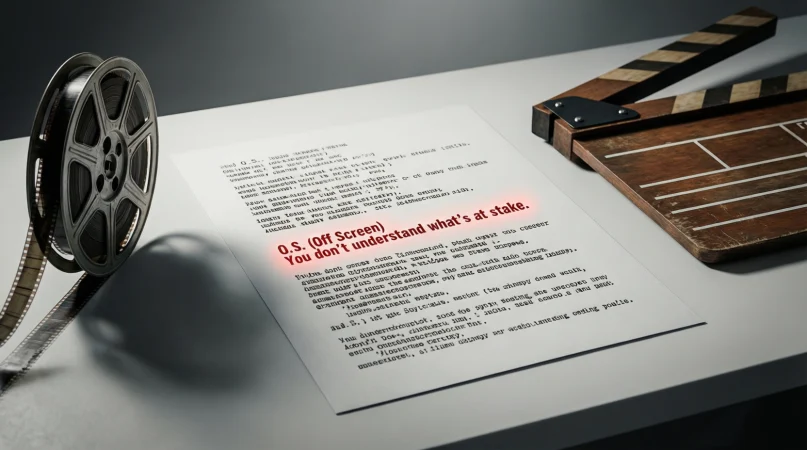
O.S. in a script means “Off Screen.” It’s a screenplay direction used to indicate that a character is speaking, but they are not visible on screen at that moment. The audience hears the dialogue, but the speaker remains outside the camera’s frame.
If you’ve ever read a screenplay or watched a movie where a voice speaks before a character appears, chances are you’ve encountered O.S. even if you didn’t realize it.
Imagine watching a film where you hear a voice yelling from another room, a phone conversation happening off-camera, or a mysterious voice calling out before the character enters the scene. That moment of curiosity, tension, or realism? That’s often powered by O.S. (Off Screen) dialogue.
For aspiring screenwriters, film students, directors, or even curious fans reading scripts, understanding what O.S. means in a script is essential. It’s a small abbreviation, but it plays a big role in storytelling, pacing, and cinematic realism.
In this comprehensive guide, we’ll break down:
- What O.S. means in a script
- Where it comes from and why it’s used
- How it differs from similar screenplay terms
- Real-world examples with tone variations
- Common mistakes to avoid
- FAQs people actually search for
- Professional tips to use it correctly
Let’s dive in 🎬
What Does O.S. Mean in a Script?
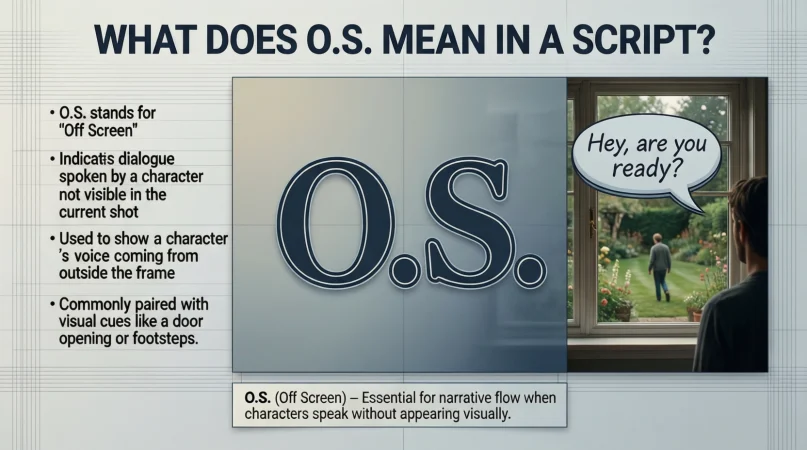
In screenwriting, O.S. stands for Off Screen. It tells the director, actors, and production team that:
- The character is physically present in the scene’s location
- But not visible within the camera frame
- Their dialogue is heard by the audience
Key Characteristics of O.S.
- The speaker is nearby (same general location)
- The voice is live and natural (not a recording)
- The audience knows where the voice is coming from, even if they can’t see the speaker
📌 Important: O.S. is different from narration or voiceover (we’ll compare those later).
Origin and Industry Background of O.S.
The term O.S. (Off Screen) comes from early film and television production practices. As scripts evolved from stage plays into visual storytelling tools, writers needed a concise way to indicate dialogue that wasn’t tied to a visible character.
Why It Became Popular
- Saves space in scripts (short, standardized notation)
- Improves clarity for directors and editors
- Matches the visual language of cinema
- Became a screenwriting industry standard
Today, O.S. is used in:
- Hollywood screenplays
- TV scripts
- Short films
- Web series
- Commercial scripts
It’s universally recognized in professional scriptwriting software like Final Draft, Celtx, and WriterDuet.
How O.S. Is Written in a Script
In a screenplay, O.S. appears next to the character’s name.
Basic Format Example
SARAH (O.S.)
Dinner’s ready!
This tells us Sarah is speaking, but we don’t see her.
Real-World Usage of O.S. in Scripts
O.S. is commonly used in situations such as:
- A character calling from another room
- Someone shouting from outside the frame
- Dialogue before a character enters the shot
- Conversations happening just off-camera
- Action scenes with chaotic movement
Why Writers Use O.S.
- Builds suspense or anticipation
- Keeps scenes visually clean
- Makes dialogue feel natural and realistic
- Helps control pacing and blocking
Examples of O.S. in Context
1. Friendly / Casual Tone 😊
MOM (O.S.)
Don’t forget your jacket!
Context: A warm, everyday moment from another room.
2. Neutral / Informational Tone
ANNOUNCER (O.S.)
Flight 209 is now boarding.
Context: Public announcements or background information.
3. Urgent or Dramatic Tone 😮
JACK (O.S.)
Get down! Now!
Context: Action scenes, danger, tension.
4. Negative or Dismissive Tone 😒
BOSS (O.S.)
You’re late. Again.
Context: Authority, criticism, or conflict without direct visual confrontation.
Labeled Example Table: O.S. Usage in Scripts
| Scene Situation | How O.S. Is Used | Effect on Audience |
|---|---|---|
| Character in another room | Dialogue marked (O.S.) | Realism |
| Voice before entrance | Builds anticipation | Suspense |
| Crowded action scene | Keeps focus visual | Clarity |
| Authority figure unseen | Adds tension | Power dynamic |
O.S. vs Similar Script Terms
Understanding O.S. becomes easier when you compare it to related screenplay abbreviations.
O.S. vs V.O. (Voice Over)
| Speaker location | Physically present | Not present |
| Live dialogue | Yes | Often recorded |
| Used for | Nearby dialogue | Narration, thoughts |
| Example | Shouting from kitchen | Inner monologue |
Example Difference:
JOHN (O.S.)
I’m in the garage!
vs
JOHN (V.O.)
I never trusted him.
O.S. vs O.C. (Off Camera)
- O.S. = American screenplay standard
- O.C. = Sometimes used in TV or UK scripts
They usually mean the same thing, but O.S. is more widely accepted in modern screenwriting.
Alternate Meanings of O.S.
Outside of screenwriting, O.S. can mean different things depending on context:
- Operating System (tech)
- Out of Stock (retail)
- Off Side (sports)
- Left eye (oculus sinister) in medical terms
📌 In scripts, however, O.S. almost always means Off Screen.
Professional & Polite Alternatives to O.S.
In most professional scripts, O.S. is perfectly acceptable. However, some writers choose alternatives for clarity or stylistic reasons.
Possible Alternatives
- Writing an action line: Sarah calls from the kitchen.
- Explicit direction: We hear Sarah’s voice from another room.
- Using O.C. (less common)
💡 Tip: Stick with O.S. unless the production specifically asks otherwise.
Common Mistakes Writers Make With O.S.
Even experienced writers slip up sometimes. Here are mistakes to avoid:
❌ Using O.S. for narration
O.S. is not for inner thoughts.
❌ Overusing O.S.
Too much off-screen dialogue can feel lazy or confusing.
❌ Confusing O.S. with V.O.
If the character isn’t physically there, it’s probably V.O., not O.S.
❌ Inconsistent usage
Switching between O.S. and O.C. without reason looks unprofessional.
Usage Tips for Screenwriters
- Use O.S. sparingly and intentionally
- Ask: Is the character physically nearby?
- Visualize the camera frame
- Think like a director, not just a writer
- Read professional scripts to see real usage
🎥 Pro Tip: If the camera could pan and reveal the speaker instantly, O.S. is usually correct.
FAQs
1. What does O.S. stand for in a script?
O.S. stands for Off Screen, meaning the character is speaking but not visible on camera.
2. Is O.S. the same as voice over?
No. O.S. is spoken live by a nearby character, while voice over is usually narration or thoughts.
3. When should I use O.S. in a screenplay?
Use it when a character is physically present but outside the camera’s frame.
4. Can O.S. be used in TV scripts?
Yes, it’s commonly used in both film and television scripts.
5. Is O.S. still used in modern screenwriting?
Absolutely. It remains an industry standard.
6. What’s the difference between O.S. and O.C.?
They mean almost the same thing, but O.S. is more common in U.S. scripts.
7. Can multiple characters speak O.S. in one scene?
Yes, as long as it’s clear who is speaking and why they’re off screen.
8. Should beginners use O.S. or write full descriptions instead?
Beginners should learn and use O.S. correctly it’s professional and efficient.
Conclusion
- O.S. means Off Screen
- It’s used when a character speaks but isn’t visible
- It adds realism, tension, and clarity
- It’s different from voice over (V.O.)
- Proper usage makes your script look professional
If you’re serious about screenwriting, mastering small details like O.S. can make a big difference. It shows you understand the visual language of film and that’s what separates amateur scripts from industry-ready ones.
🎬 Write visually. Think cinematically. Use O.S. with purpose.

Madison Lee is a skilled writer at ValneTix.com dedicated to making word meanings clear, relatable and actionable. She empowers readers to understand language deeply and use words with confidence in daily life.