
Last Updated on February 19, 2026
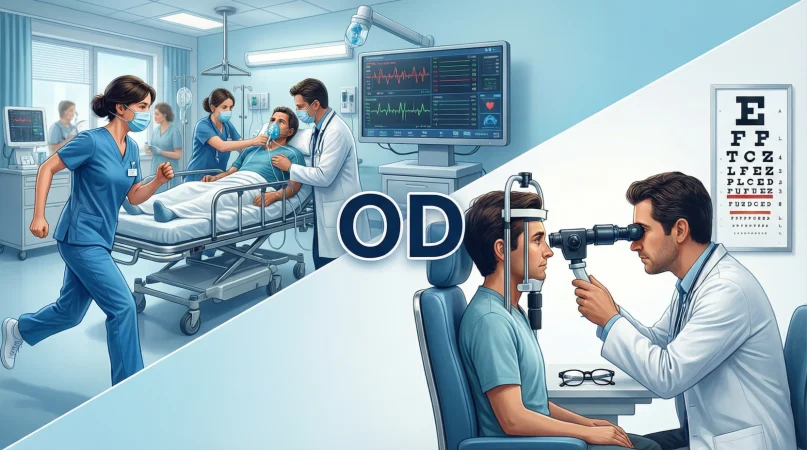
OD in medical terms most commonly means “overdose,” referring to the intake of a drug or substance in a quantity greater than recommended or safe.
Depending on context, OD can also stand for “oculus dexter” (right eye) in medical prescriptions and clinical documentation.
If you’ve ever looked at a medical chart, prescription, or emergency report and paused at the letters OD, you’re not alone.
This tiny abbreviation carries huge importance sometimes meaning a life-threatening overdose, and other times something as routine as which eye needs treatment. Understanding what OD means in medical terms isn’t just useful for healthcare professionals it’s essential for patients, caregivers, students, and anyone trying to make sense of medical paperwork.
In this guide, we’ll break it all down in plain, human language:
- What OD means in different medical contexts
- How doctors and nurses actually use it
- How to tell which meaning applies
- Common misunderstandings (and how to avoid them)
Let’s decode it together 🩺
What Does OD Mean in Medical Terms?
The Two Main Meanings of OD
| Context | Meaning of OD |
| Emergency medicine, toxicology | Overdose |
| Ophthalmology, prescriptions | Oculus Dexter (Right Eye) |
Understanding context is everything. The same abbreviation can mean very different things depending on where and how it’s used.
OD as “Overdose”
What Is an Overdose?
In medicine, OD (overdose) refers to taking more than the safe or prescribed amount of a drug, medication, or substance whether accidentally or intentionally.
An overdose can involve:
- Prescription medications
- Over-the-counter drugs
- Illegal substances
- Alcohol
- A dangerous combination of substances
⚠️ Important: An overdose is considered a medical emergency and requires immediate attention.
Real-World Examples of OD (Overdose)
Neutral / Clinical Tone
“The patient was admitted to the ER following a suspected OD of acetaminophen.”
Urgent / Emergency Context
“EMS responded to a possible opioid OD at the residence.”
Medical Documentation
“History includes prior OD with benzodiazepines.”
Types of Overdose
- Accidental OD – Taking too much unintentionally
- Intentional OD – Often associated with self-harm
- Chronic OD – Gradual buildup over time
- Acute OD – Sudden intake of a large amount
Common Symptoms of an Overdose
Symptoms vary by substance, but may include:
- Nausea or vomiting
- Confusion or disorientation
- Difficulty breathing
- Loss of consciousness
- Seizures
- Irregular heartbeat
🚑 If you suspect an OD, seek emergency help immediately.
OD as “Oculus Dexter” (Right Eye)
What Does Oculus Dexter Mean?
In medical Latin:
- Oculus = eye
- Dexter = right
So OD means the right eye.
This usage is extremely common in:
- Eye exams
- Prescriptions
- Ophthalmology records
Example of OD in Eye Care
“Instill one drop in OD twice daily.”
Translation:
➡️ Put one drop in the right eye, two times a day.
Eye-Related Abbreviation Comparison
| Abbreviation | Meaning |
| OD | Right eye (oculus dexter) |
| OS | Left eye (oculus sinister) |
| OU | Both eyes (oculus uterque) |
How to Tell Which Meaning of OD Applies
Use Context Clues
Ask yourself:
- Is this in an ER report or toxicology note? → Likely overdose
- Is this in an eye prescription or vision test? → Likely right eye
Quick Tip 💡
If OD appears next to dosage instructions for eye drops, it almost never means overdose.
Origin and History of OD in Medicine
OD (Overdose)
- Originated from early toxicology and pharmacology
- Became widely used in hospitals and emergency documentation
- Shortened for speed and clarity in critical situations
OD (Oculus Dexter)
- Comes from Latin medical terminology
- Used for centuries in anatomy and prescriptions
- Still standard in modern healthcare
Why OD Is Still Widely Used Today
Despite the push for clearer medical language, OD remains popular because:
- It saves time in urgent care settings
- It’s universally recognized by medical professionals
- It’s standardized across healthcare systems
However, many providers now spell out “overdose” in patient-facing documents to reduce confusion.
Alternate Meanings of OD
Outside medicine, OD can mean:
- Out of Date
- Optical Density
- On Demand
- Off Duty
These meanings do not apply in clinical contexts unless clearly stated.
Polite and Professional Alternatives to OD
In patient-friendly communication, healthcare providers may prefer:
| Instead of | Use |
| OD | Overdose |
| Suspected OD | Possible medication overdose |
| Prior OD | History of medication overdose |
These alternatives improve clarity and reduce anxiety.
Example Table: OD in Medical Contexts
Labeled Example Table
| Scenario | Meaning of OD | Example Sentence |
| ER report | Overdose | “Patient treated for opioid OD.” |
| Eye prescription | Right eye | “Apply drops to OD daily.” |
| Vision exam | Right eye | “OD visual acuity: 20/20.” |
| Toxicology note | Overdose | “Blood tests confirm OD.” |
Common Misunderstandings About OD
- ❌ Assuming OD always means overdose
- ❌ Confusing OD with daily dosage instructions
- ❌ Misreading eye prescriptions
✔️ Always check context and ask your provider if unsure.
FAQs
1. What does OD mean in medical terms?
OD usually means overdose, but in eye care it means right eye (oculus dexter).
2. Does OD always mean overdose?
No. In ophthalmology, OD refers to the right eye.
3. What does OD mean on a prescription?
If it’s an eye medication, OD means apply to the right eye.
4. What is the difference between OD and OS?
OD = right eye, OS = left eye.
5. Is OD a medical emergency?
If OD refers to overdose, yes—it is a medical emergency.
6. Why do doctors still use OD?
It’s a standard medical abbreviation that saves time and space.
7. Can OD mean both things in one document?
Rarely, but context usually makes the meaning clear.
8. Should patients ask for clarification?
Absolutely. Healthcare providers encourage questions.
Conclusion
So, what does OD mean in medical terms?
Most often, it refers to an overdose, a serious and sometimes life-threatening condition. But in eye care and prescriptions, OD simply means the right eye. The difference lies entirely in context, which is why understanding this abbreviation matters so much.
Knowing how to interpret OD empowers you to:
- Read medical documents with confidence
- Follow prescriptions correctly
- Respond appropriately in emergencies
Small letters. Big meaning. Now you’re in the know. ✅

Sophia Lane is a passionate wordsmith and lifestyle writer who covers everything from Spanish phrases to biblical terms. She believes that understanding language helps people connect better with the world around them