
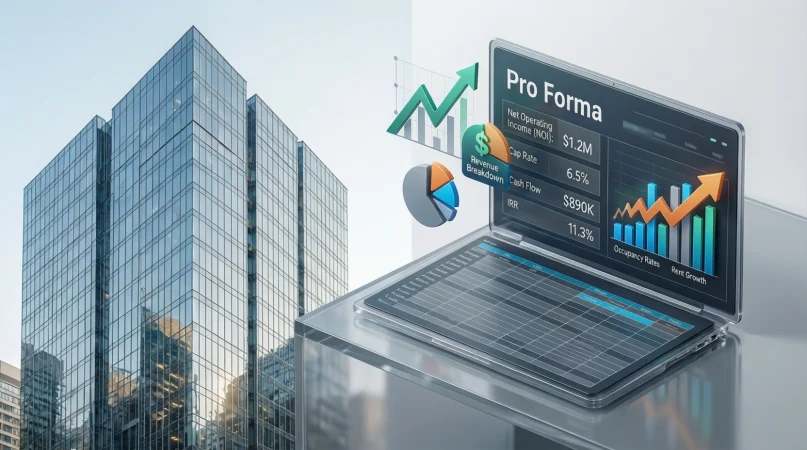
Thinking about investing in real estate or reviewing a property deal? You’ve probably heard the term pro forma thrown around by agents, investors, or lenders. It sounds technical but once you understand it, pro forma becomes one of the most powerful tools in real estate decision-making.
Whether you’re a beginner investor, a real estate student, or a seasoned professional brushing up on fundamentals, this guide will walk you through exactly what pro forma means in real estate, how it’s used, why it matters, and how to read it without getting misled.
Definition
What does pro forma mean in real estate?
In real estate, pro forma refers to a financial projection that estimates a property’s future income, expenses, and profitability based on assumptions rather than historical performance. It is commonly used to evaluate potential investments, development projects, or property improvements.
Why “Pro Forma” Matters So Much in Real Estate
Real estate is forward looking by nature. Investors don’t buy properties based on the past; they buy based on what the property can become.
That’s where pro forma comes in.
A pro forma helps you answer questions like:
- How much money could this property make?
- What will cash flow look like after renovations?
- Is this deal worth the risk?
- Will lenders approve financing based on projections?
In short, a pro forma turns a real estate idea into a financial story one that investors, partners, and banks can understand.
📚 Origin and Meaning of “Pro Forma”
The term pro forma comes from Latin, meaning “for the sake of form.”
Original Meaning
Historically, pro forma documents were created:
- To show hypothetical financial outcomes
- To demonstrate compliance or planning
- Without guaranteeing actual results
How It Entered Real Estate
As real estate investing became more data-driven, pro forma statements became standard tools for:
- Property underwriting
- Investment analysis
- Development feasibility studies
- Loan applications
Today, pro forma financials are essential in commercial real estate, including multifamily, office, retail, and mixed-use properties.
🏘️ What Is a Pro Forma in Real Estate
In simple terms:
A real estate pro forma is an educated financial guess about a property’s future performance.
It estimates:
- Rental income
- Operating expenses
- Net operating income (NOI)
- Cash flow
- Return on investment (ROI)
These estimates are based on:
- Market rents
- Vacancy assumptions
- Planned improvements
- Financing terms
- Comparable properties
🧾 What’s Included in a Real Estate Pro Forma?
A typical real estate pro forma includes several key components.
1. Projected Rental Income
This is what the property should earn once stabilized.
Includes:
- Gross rental income
- Other income (parking, laundry, storage, etc.)
2. Vacancy & Credit Loss
No property is rented 100% of the time.
Common assumptions:
- 5%–10% vacancy for residential
- Higher for commercial or new developments
3. Operating Expenses
These are the costs to run the property (excluding mortgage).
Examples:
- Property taxes
- Insurance
- Maintenance & repairs
- Property management fees
- Utilities (if owner-paid)
4. Net Operating Income
NOI = Income – Operating Expenses
This is one of the most important metrics in real estate valuation.
5. Financing Assumptions
If debt is involved, the pro forma may include:
- Loan amount
- Interest rate
- Debt service
- Cash flow after financing
6. Return Metrics
Pro formas often calculate:
- Cash-on-cash return
- Cap rate
- Internal rate of return (IRR)
- Equity multiple
📊 Example: Simple Real Estate Pro Forma Table
Labeled Example: Small Multifamily Property Pro Forma
| Category | Annual Amount (USD) |
|---|---|
| Gross Rental Income | $120,000 |
| Vacancy (7%) | -$8,400 |
| Effective Gross Income | $111,600 |
| Operating Expenses | -$45,000 |
| Net Operating Income (NOI) | $66,600 |
| Annual Debt Service | -$40,000 |
| Cash Flow Before Taxes | $26,600 |
✅ This table shows how pro forma projections guide investment decisions.
🧠 Real-World Usage of Pro Forma in Real Estate
1. Property Acquisition
Buyers use pro formas to decide:
- What price makes sense
- Whether future income justifies the purchase
2. Value-Add Investments
For properties needing upgrades:
- Pro forma shows income after renovations
- Helps justify higher valuations
3. Development Projects
Developers rely heavily on pro formas to:
- Estimate lease-up timelines
- Forecast stabilization income
- Secure financing
4. Loan Applications
Lenders use pro formas to assess:
- Debt coverage ratios (DSCR)
- Borrower risk
- Feasibility of repayment
🎭 Tone & Context Examples of “Pro Forma” Usage
Friendly / Neutral Tone
“Let’s review the pro forma to see how the property performs after renovations.”
Professional / Investor Tone
“The acquisition decision is based on a five-year stabilized pro forma.”
Cautious / Skeptical Tone
“The pro forma assumes aggressive rent growth, which may not be realistic.”
⚠️ Key Insight: Pro formas are only as good as their assumptions.
⚠️ The Risk of Overly Optimistic Pro Formas
One of the biggest dangers in real estate investing is blindly trusting pro forma numbers.
Common Red Flags
- Unrealistically low vacancy rates
- Underestimated expenses
- Aggressive rent growth assumptions
- Ignoring market downturns
- Excluding capital expenditures
💡 Pro Tip: Always compare the pro forma to actual historical financials (T-12 statements) when available.
🔍 Pro Forma vs Actual Financials
| Feature | Pro Forma | Actual Financials |
|---|---|---|
| Basis | Assumptions | Real performance |
| Timeframe | Future | Past |
| Accuracy | Estimated | Verified |
| Risk | Higher | Lower |
| Use Case | Planning & analysis | Validation |
🆚 Pro Forma vs Related Real Estate Terms
Pro Forma vs T-12
- Pro Forma: Future projection
- T-12: Trailing 12 months of actual income & expenses
Pro Forma vs Budget
- Pro Forma: Investment-focused projection
- Budget: Operational spending plan
Pro Forma vs Underwriting
- Pro Forma: Output document
- Underwriting: Analytical process behind it
🌍 Alternate Meanings of “Pro Forma”
While common in real estate and finance, pro forma can also mean:
- Pro forma invoice: A preliminary bill in trade
- Pro forma financial statement: Adjusted accounting reports
- Pro forma meeting: A formality with little debate
In real estate, however, it almost always refers to financial projections.
🤝 Polite or Professional Alternatives to “Pro Forma”
Depending on context, you may hear or use:
- Financial projection
- Income forecast
- Investment model
- Projected operating statement
- Estimated cash flow analysis
Each serves a similar purpose but may sound more accessible to beginners.
🧩 Practical Tips for Using Pro Forma Like a Pro
- Always stress-test assumptions
- Compare projections to comparable properties
- Include realistic vacancy and expense buffers
- Separate “best case” from “base case” scenarios
- Review with experienced investors or advisors
✅ Conclusion
Understanding what pro forma means in real estate is essential for making informed investment decisions.
- A pro forma is a forward-looking financial projection
- It estimates income, expenses, and returns
- It’s widely used in investing, development, and lending
- It’s powerful but not foolproof
- Smart investors question assumptions, not just numbers
If you treat pro forma as a planning tool rather than a promise, it can guide you toward smarter, more profitable real estate decisions.
❓FAQs
What does pro forma mean in real estate investing?
It means a financial projection estimating a property’s future income, expenses, and returns based on assumptions.
Is a pro forma the same as actual income?
No. A pro forma is estimated; actual income is based on real operating data.
Are pro forma numbers guaranteed?
No. They are hypothetical and depend heavily on assumptions.
Who prepares a real estate pro forma?
Investors, brokers, developers, analysts, or property managers.
Why do sellers present pro forma statements?
To show a property’s potential performance and justify pricing.
Should beginners trust pro forma projections?
They should review them carefully and verify assumptions with market data.
How accurate are real estate pro formas?
Accuracy varies. Conservative assumptions increase reliability.
Can a lender reject a deal based on the pro forma?
Yes. If projections seem unrealistic or risky, financing may be denied.

Olivia Brooks is a skilled writer at ValneTix.com dedicated to making word meanings simple, practical and relatable. Her clear explanations empower readers to use language effectively and confidently.