
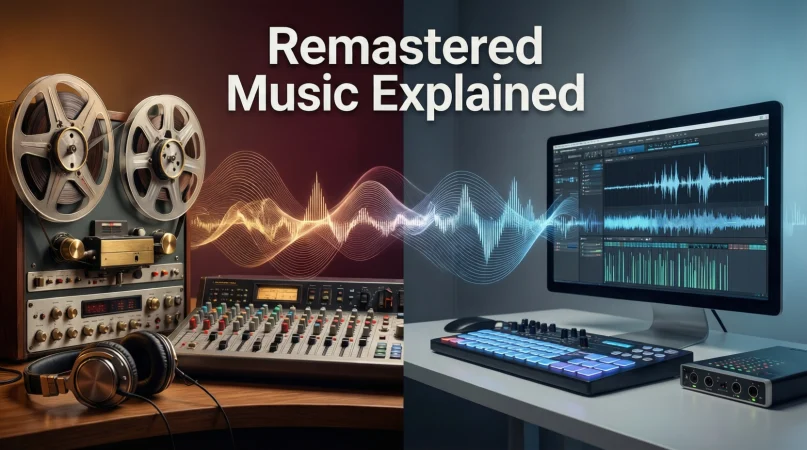
A remastered song is an improved version of an original audio recording. Audio engineers apply modern technology to enhance clarity, balance, and volume without re-recording any instruments or vocals. The original performance stays identical; only the sound quality is upgraded.
Why Do So Many Songs Say “Remastered”?
You’re scrolling through Spotify or Apple Music and notice it everywhere:
- “Bohemian Rhapsody (2011 Remastered)”
- “Hotel California – 40th Anniversary Remaster”
- “Back in Black (Remastered)”
Naturally, you wonder:
What does remastered mean in songs and is it actually different from the original?
This question comes up because remastered tracks dominate playlists, reissues, vinyl releases, and anniversary editions. Sometimes they sound amazing. Other times, fans complain they sound “too loud” or “not the same.”
In this comprehensive guide, we’ll break it all down in simple, friendly terms what remastered really means, how it works, why artists do it, and whether it’s worth listening to over the original.
What Does Remastered Mean in Songs?
When a song is remastered, it means:
- The original final mix is taken
- Engineers use newer audio tools and technology
- The sound is enhanced, cleaned, and optimized
- No instruments are re-recorded
- No performances are changed
Think of remastering like restoring an old photograph.
The people in the photo don’t change but the colors, clarity, and sharpness improve.
Key Goals of Remastering
- Improve clarity and detail
- Balance frequencies (bass, mids, treble)
- Increase loudness without distortion
- Reduce noise or hiss
- Optimize sound for modern speakers, headphones, and streaming platforms
Remastered vs Original: What Actually Changes?
Here’s what can change in a remastered song:
- Overall volume (usually louder)
- Bass depth and punch
- Vocal clarity
- Stereo width
- Reduction of tape hiss or background noise
What does not change:
- Lyrics
- Tempo
- Melody
- Instruments played
- Vocal takes
- Song structure
Origin of Remastering in Music
Where Did Remastering Come From?
Remastering became popular during major format shifts, especially:
- Vinyl → Cassette
- Cassette → CD (1980s–1990s)
- CD → Digital & Streaming (2000s–present)
Early recordings were mastered specifically for vinyl limitations. When CDs arrived, engineers realized older masters didn’t sound optimal on digital formats.
So they went back to the original master tapes and created improved versions—thus, remastered songs were born.
Why Are Songs Remastered?
Artists, labels, and engineers remaster songs for several reasons:
1. New Technology
Modern audio tools can extract clarity and balance that wasn’t possible decades ago.
2. Anniversary Releases
Albums are often remastered for:
- 10th, 20th, 30th, or 50th anniversaries
- Deluxe or collector editions
3. Streaming Optimization
Spotify, Apple Music, and YouTube all have loudness standards. Remastering ensures songs sound consistent across platforms.
4. Commercial Reasons
Remastered albums reintroduce classic music to new generations—and yes, they sell well.
How Remastering Works
Here’s a step-by-step look at the remastering process:
- Source the Original Master
Engineers use the highest-quality version available. - Digital Transfer
Analog tapes are digitized at high resolution. - Audio Enhancement
- EQ adjustments (bass, mids, highs)
- Compression for loudness control
- Noise reduction
- Stereo imaging tweaks
- Final Quality Checks
The song is tested on multiple systems:- Headphones
- Car speakers
- Phones
- Studio monitors
Remastered vs Remixed vs Re-recorded
Many people confuse these terms. Here’s a clear comparison:
Comparison Table: Music Production Terms
| Term | Meaning | Performance Changed? | Common Use |
|---|---|---|---|
| Original | First released version | ❌ No | Initial release |
| Remastered | Improved sound quality | ❌ No | Reissues, anniversaries |
| Remixed | Individual tracks rebalanced | ❌ Usually no | Alternate versions |
| Re-recorded | Song performed again | ✅ Yes | Ownership or artistic updates |
| Live Version | Recorded in concert | ✅ Yes | Tours, special releases |
Real-World Examples of Remastered Songs
Friendly / Positive Tone
“The remastered version sounds so clean—those vocals really shine now 🎧”
Neutral Tone
“This album was remastered for digital streaming platforms.”
Negative or Dismissive Tone
“The remaster is way too loud. I prefer the original mix.”
Yes—remastering is subjective. Some listeners love the clarity. Others miss the warmth of older versions.
Does Remastered Always Mean Better?
Short answer: No.
Pros of Remastered Songs
- Clearer sound
- Better bass response
- Reduced noise
- Optimized for modern devices
Cons of Remastered Songs
- Can be overly loud (compression)
- Loss of dynamic range
- Alters the “feel” of the original
- Audiophiles may prefer original pressings
This debate is especially intense among fans of classic rock, jazz, and early hip-hop.
Remastered Albums vs Remastered Songs
- Remastered Song: A single track improved
- Remastered Album: Entire album remastered consistently
Albums are usually remastered as a complete project to preserve balance between tracks.
Alternate Meanings of “Remastered”
Outside music, remastered can also mean:
- Video Games: Updated graphics and audio
- Movies: Improved resolution and sound
- TV Shows: Digitally restored versions
The core idea remains the same:
Modern improvement without changing the original content.
Professional or Polite Alternatives to “Remastered”
Depending on context, you may see or use:
- Digitally enhanced
- Restored audio
- Updated master
- High-resolution remaster
- Anniversary edition
These terms are often used in marketing or formal descriptions.
When to Choose a Remastered Version
Choose remastered if:
- You use modern headphones or speakers
- You stream music digitally
- You want cleaner sound
Choose original if:
- You prefer vintage warmth
- You’re an audiophile
- You enjoy historical authenticity
Pro tip: Try both versions back-to-back and decide with your ears.
Conclusion
It means taking an existing recording and refining its sound for today’s listeners without changing the music itself. Remastering preserves history while improving clarity, loudness, and balance.
- Remastered ≠ re-recorded
- Sound quality improves, performances stay the same
- Not all remasters are better it’s subjective
- Ideal for modern listening platforms
Whether you love the polish of remastered tracks or the raw charm of originals, the best version is the one that sounds right to you.
FAQs
Does remastered mean the song was re-recorded?
No. The original performance remains the same.
Is remastered better than original?
Not always. It depends on personal taste and mastering quality.
Why do remastered songs sound louder?
Modern mastering uses compression to increase loudness.
Are remastered songs edited?
They are enhanced, not edited. No lyrics or notes change.
Can remastered songs sound worse?
Yes. Over-compression can reduce dynamics.
What does “digitally remastered” mean?
It means digital tools were used during the remastering process.
Should I replace my old music with remastered versions?
Only if you prefer the sound. There’s no rule.
Are remastered songs the same length as originals?
Almost always, yes.

Michael Jordan is a writer at ValneTix.com who explains word meanings in a clear and easy to understand style, helping readers expand their vocabulary and language skills.