
Last Updated on February 19, 2026
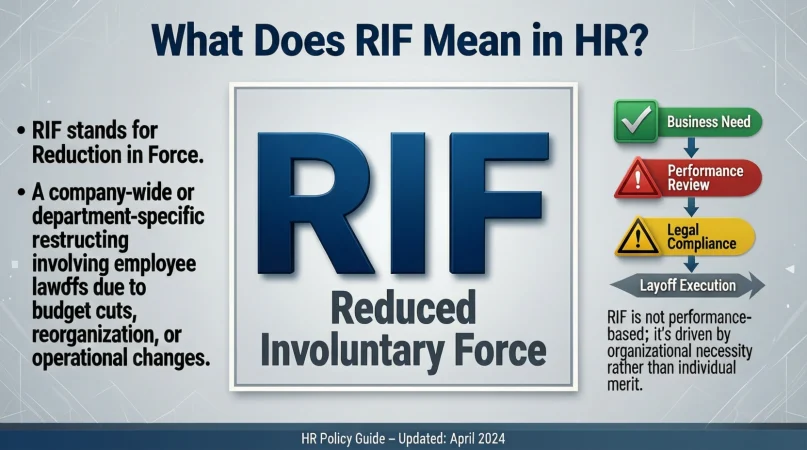
RIF in HR stands for “Reduction in Force.”
It refers to an employer-initiated workforce reduction, usually driven by business reasons such as restructuring, cost cutting, mergers, automation, or economic downturns not individual employee performance.
If you’ve ever seen the term “RIF” in an HR email, policy document, or company announcement and felt a knot in your stomach you’re not alone. RIF is one of those short HR abbreviations that carries big implications for employees and organizations alike.
In this in-depth guide, we’ll break down what RIF means in HR, where it comes from, how it’s used in real workplaces, and how it compares to similar terms like layoffs or furloughs. We’ll also explore tone, examples, alternatives, FAQs, and best practices so you fully understand the concept from both an employer and employee perspective.
Why “RIF” Matters in Today’s Workplace
In modern organizations, especially during uncertain economic times, companies need flexibility to adapt. Unfortunately, that sometimes means reducing staff. Instead of saying “mass firing” or “termination,” HR departments often use RIF as a more formal and neutral term.
Understanding RIF helps employees:
- Interpret HR communications correctly
- Know their rights and benefits
- Prepare emotionally and financially
And it helps employers:
- Communicate professionally and legally
- Reduce reputational risk
- Maintain transparency and trust
What Does RIF Mean in HR?
In simple terms:
A RIF happens when a company permanently eliminates positions due to business needs, not because employees did something wrong.
Key characteristics of a RIF:
- Positions are removed, not just people
- Usually affects multiple employees
- Often planned and documented
- May include severance, notice periods, or redeployment options
Origin of the Term “RIF”
The phrase Reduction in Force originated in government and military contexts, where large-scale workforce adjustments needed a standardized, non-emotional label.
How it evolved:
- 1950s–1970s: Used heavily in U.S. federal employment
- 1980s–1990s: Adopted by corporate HR during restructurings
- Today: Common in global HR policies, legal documents, and internal memos
The term gained popularity because it sounds:
- Objective
- Procedural
- Less personal than “layoff” or “job cuts”
How Is RIF Used in Real-World HR Settings?
RIF is mostly used in formal or internal communication, such as:
- HR policy manuals
- Legal documents
- Internal announcements
- Board-level discussions
Example contexts:
- Company mergers or acquisitions
- Automation replacing roles
- Budget shortfalls
- Department shutdowns
- Strategic realignments
Common RIF Usage Examples With Tone
Let’s look at how “RIF” appears in real HR language, with tone explained 👇
1. Neutral / Professional Tone
“Due to organizational restructuring, the company will implement a Reduction in Force affecting several departments.”
🟢 Tone: Formal, neutral, corporate
🟢 Used in: Official notices, press releases
2. Employee-Facing (Careful & Polite)
“As part of a RIF initiative, impacted employees will receive severance packages and career transition support.”
🟢 Tone: Sensitive, supportive
🟢 Used in: HR meetings, emails
3. Internal HR or Legal Context
“Employees separated as part of the RIF are eligible for benefits continuation under company policy.”
🟢 Tone: Technical, factual
🟢 Used in: Legal/HR documentation
4. Cold or Dismissive (Not Recommended)
“Your position has been eliminated due to the RIF.”
🔴 Tone: Abrupt, impersonal
🔴 Risk: Can damage morale and employer brand
RIF vs Similar HR Terms Comparison Table
Here’s a clear comparison to avoid confusion:
| Term | Meaning | Performance-Based? | Temporary or Permanent? |
| RIF (Reduction in Force) | Elimination of roles due to business needs | ❌ No | ✅ Permanent |
| Layoff | Job loss due to lack of work/funds | ❌ No | ❌ Often temporary |
| Termination | Ending employment | ✅ Often yes | ✅ Permanent |
| Furlough | Unpaid leave | ❌ No | ❌ Temporary |
| Downsizing | Broad workforce reduction | ❌ No | ✅ Usually permanent |
| Restructuring | Reorganizing roles/teams | ❌ No | 🔄 Mixed |
Is RIF the Same as a Layoff?
Not exactly.
While both involve job loss:
- RIF is more formal and strategic
- Layoffs can be temporary and reversible
Many companies prefer “RIF” because it sounds more deliberate and less reactive.
Alternate Meanings of “RIF”
Outside HR, RIF can mean different things:
- Risk Intelligence Framework (cybersecurity)
- Repetitive Instruction Format (education/tech)
- Relief in Place (military term)
⚠️ Context matters. In HR and corporate settings, RIF almost always means Reduction in Force.
Polite & Professional Alternatives to “RIF”
Sometimes HR teams choose softer or clearer language:
Common Alternatives:
- Workforce reduction
- Organizational realignment
- Position elimination
- Role consolidation
- Strategic restructuring
Example (More Human-Friendly):
“Your role has been eliminated as part of a company-wide restructuring.”
✔️ Clear
✔️ Less jargon
✔️ More empathetic
HR Best Practices When Communicating a RIF
If you’re in HR or management, tone matters as much as accuracy.
Recommended tips:
- Avoid excessive jargon
- Explain why the RIF is happening
- Clarify that it’s not performance-related
- Provide next steps (severance, benefits, support)
- Use empathetic language
Example RIF Communication Table
| Audience | Example Language | Tone |
| Employees | “This decision is not a reflection of your performance.” | Supportive |
| Managers | “Please follow the RIF communication guidelines.” | Instructional |
| Legal | “RIF actions comply with labor regulations.” | Technical |
| Public | “The company is restructuring to remain competitive.” | Neutral |
FAQs
1. What does RIF stand for in HR?
RIF stands for Reduction in Force, meaning job eliminations due to business needs.
2. Is RIF a layoff or termination?
It’s closer to a layoff, but usually permanent and more structured.
3. Is RIF related to employee performance?
No. RIF decisions are based on organizational needs, not individual performance.
4. Do employees get severance in a RIF?
Often yes, but it depends on company policy and local labor laws.
5. Why do companies say RIF instead of layoffs?
Because it sounds more formal, neutral, and legally precise.
6. Can a RIF be challenged legally?
Sometimes, especially if it violates labor laws or shows discrimination.
7. Is RIF a negative term?
It’s neutral in HR language but emotionally difficult for employees.
8. How should employees respond to a RIF notice?
Stay calm, ask about benefits and support, and seek legal or career advice if needed.
Conclusion
It’s a formal term for workforce reduction driven by business strategy not employee fault.
- RIF = Reduction in Force
- Used in professional HR contexts
- Usually permanent
- Not performance-based
- Requires careful, empathetic communication
💡 Practical tip: If you encounter “RIF” in workplace communication, read the full context carefully and don’t hesitate to ask HR for clarification or support options.

Ethan Ware is a digital writer and internet culture enthusiast who stays on top of the latest slang, trends and viral phrases. He specializes in making modern language easy to understand for readers of all ages.