Last Updated on February 16, 2026
What does slop mean? Slop is low-quality, AI-generated content flooding the internet with zero originality or human insight. In January 2026, Merriam-Webster named it Word of the Year after it went viral on TikTok, capturing global frustration with artificial intelligence replacing authentic creativity online.
What Slop Actually Means (No BS)
Forget the dictionary definition for a second. Here’s what “slop” really means when your friend texts you about it or you see it trending on TikTok.
Slop = AI garbage that looks real but feels empty.
It’s that blog post about “10 Best Restaurants in Tokyo” written by someone who’s never been to Japan. It’s those weird AI-generated Facebook images of Jesus made of shrimp that your aunt keeps sharing.
The word perfectly captures what we’re all feeling in 2026: drowning in content that nobody actually made with care.
Here’s the thing slop isn’t just “bad content.” We’ve always had bad content. Slop is different because it’s industrialized bad content. Someone (or something) pressed a button and generated 500 articles in an hour.
What makes slop so insidious is that it often looks legitimate at first glance. The grammar is perfect. The images are high-resolution. The formatting is clean. But when you actually read it or look closer, there’s nothing there. It’s like biting into a beautiful apple only to discover it’s made of wax.
The slop era started quietly in 2024 when AI tools became mainstream, but by 2025, it reached critical mass. Suddenly, every Google search returned ten AI-generated articles before you found a real human’s advice. Every social media feed filled with bot-generated memes. Every recipe blog became an AI-written novel before giving you the ingredients.
And that’s when people started fighting back with a single word: slop.
Where This Word Came From
“Slop” isn’t new—it’s just been reborn for the AI age.
The word comes from Old English “sloppe,” which meant muddy ground or spilled liquid. For centuries, farmers used it for the bucket of kitchen scraps they’d feed to pigs. Your grandmother probably said “don’t slop your drink” when you spilled juice as a kid.
But here’s where it gets interesting.
Around 2010-2015, “slop” occasionally popped up online as British slang for bad food or terrible media. Someone might say “that movie was complete slop” or “the cafeteria is serving slop again.” But this usage was rare and mostly UK-based.
The Modern Origin Story (2024-2025)
The current meaning specifically referring to AI-generated content emerged in late 2024 on Reddit and Hacker News. Programmers and tech workers noticed something disturbing: their Google searches were returning dozens of obviously AI-written articles that technically answered questions but provided zero actual value.
In early 2025, a Reddit post in r/SEO titled “The Internet is Drowning in AI Slop” went viral with 45,000 upvotes. The post showed examples of recipe blogs, tech tutorials, and news sites that had switched to pure AI generation. Someone commented: “It’s like they’re slopping AI garbage into the internet trough and expecting us to eat it.”
That metaphor stuck.
By March 2025, “AI slop” was the standard term in tech Twitter threads. By August 2025, your parents were saying it. And in January 2026, Merriam-Webster made it official: Slop was the Word of the Year.
The agricultural metaphor is perfect. Just like farm slop is cheap, mass-produced waste meant to fill bellies without nutrition, AI slop is cheap, mass-produced content meant to fill feeds without providing real value.
How Slop Exploded on TikTok & Twitter
The transformation from tech jargon to mainstream slang happened faster than almost any word in internet history. Here’s the exact timeline of how slop took over 2025-2026.
Phase 1: Tech Twitter (January-March 2025)
It started with frustrated developers and content creators. @webdevantoine posted a thread in February 2025: “I just searched ‘how to center a div’ and got 8 pages of AI slop before finding a real human answer.” The thread got 156K likes and introduced thousands to the term.
Tech journalists picked it up immediately. Casey Newton’s Platformer newsletter ran a piece called “The Slop Economy” in March 2025, documenting how content farms were using AI to generate 10,000+ articles daily with zero human oversight.
Phase 2: TikTok Explosion (April-July 2025)
April 12, 2025: @sarahcodes posts a 45-second TikTok showing how to identify slop. She points at generic AI food photos with impossible lighting and captions it “POV: You’re looking for a real recipe but it’s all slop.” 18.4 million views.
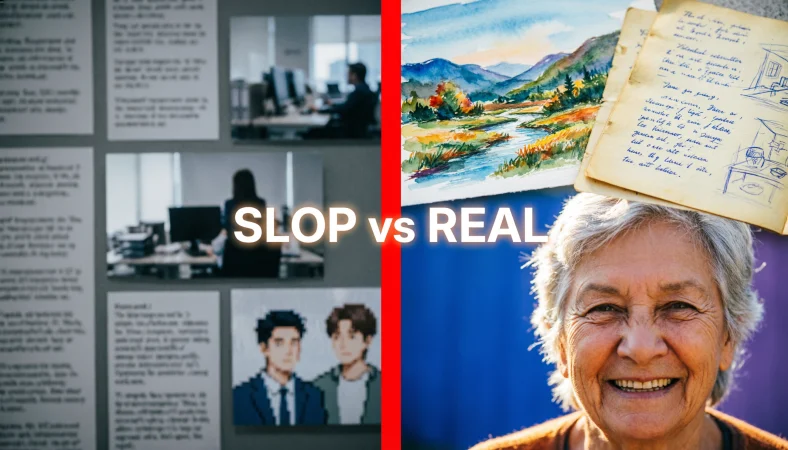
May 2025: The hashtag #AIslop accumulates over 800 million views as creators compete to find the most absurd examples. A viral trend emerges: “Slop or Real?” where people show images or text and viewers guess if it’s AI-generated.
June 2025: @memearchaeologist posts a compilation of the weirdest AI-generated Facebook content with Subway Surfers gameplay underneath (because of course). The video—showing Jesus made of shrimp, impossible AI cats, and gibberish inspirational quotes—hits 34 million views and gets reposted across every platform.
July 2025: TikTok’s algorithm starts promoting “anti-slop” content. Videos teaching people how to find authentic human creators, spot AI artifacts, and demand better content quality trend consistently. The phrase “don’t feed me slop” becomes a meme format with 2.3 billion views on the hashtag.
Phase 3: Mainstream Takeover (August-December 2025)
August 2025: Major influencers adopt the term. MrBeast tweets: “If I catch AI slop in my video scripts, someone’s getting fired.” 4.2 million likes. The tweet sparks conversations about authenticity in content creation across YouTube and Instagram.
September 2025: Hasan Piker uses “slop” constantly on his Twitch streams, particularly when reacting to AI-generated news articles. Clips from his streams get millions of views on TikTok and Twitter. “Chat, this is slop” becomes a catchphrase.
October 2025: Traditional media discovers slop. The New York Times runs “The Year the Internet Drowned in Slop.” The Washington Post publishes “How AI Slop Is Killing Quality Journalism.” CNN does a segment. Your parents start using the word.
November 2025: Neil Gaiman tweets a thread about writing that goes mega-viral: “There’s no shortcut to good writing. AI can help you think, but if you’re just generating slop and hitting publish, you’re not a writer. You’re a slop distributor.” 2.8 million likes.
December 2025: The anti-slop movement peaks. LinkedIn is flooded with posts about “authentic content.” Instagram influencers add “Human-Made ✨” to their bios. Even brands start using anti-slop messaging in their marketing.
Phase 4: Official Recognition (January 2026)
January 6, 2026: Merriam-Webster announces “slop” as the 2026 Word of the Year, defining it as “low-quality or unwanted AI-generated content, especially text or images that flood digital platforms.”
The announcement breaks the internet. News coverage spans every major outlet. Late-night shows joke about it. The term officially enters mainstream vocabulary. Within 48 hours, “slop” trends #1 worldwide on Twitter with 4.7 million tweets.
Right now (February 2026): Slop is everywhere. It’s in corporate emails. Political debates. Family group chats. The word has transcended its origins to become shorthand for the entire cultural anxiety about AI replacing human creativity and authenticity.
Real Life Example inevitably Identify
Here’s how people are actually using “slop” in 2026, pulled from real conversations, tweets, and TikToks:
- “I asked ChatGPT for workout advice and it gave me slop. Like, technically correct information but completely generic and useless.”
- “My boss wants us to post on LinkedIn three times a week but won’t give us time to do it properly. So now our company page is just… slop.”
- “That ‘travel blogger’ has never left their basement. Every post is AI slop with stock photos.”
- “Mom, please stop sharing those AI Jesus images on Facebook. It’s slop and also theologically weird.”
- “I spent 20 minutes reading a recipe blog before realizing the entire thing was slop. There was no actual person testing this recipe.”
- “My professor failed me for submitting slop. Apparently she can tell when you just paste AI output without thinking.”
- “TikTok’s algorithm is feeding me pure slop today. Where are the real humans?”
- “That cryptocurrency newsletter I subscribed to turned into slop overnight. Just AI-generated market updates with zero actual analysis.”
- “The entire first page of Google results is slop. Had to add ‘reddit’ to my search to find real people talking about this.”
- “I don’t care if AI wrote it, but if you publish slop without even reading it first, you’re disrespecting your audience.”
- “Every dating app bio now sounds like slop: ‘I’m passionate about adventures and authentic connections and living life to the fullest.'”
- “The magazine I loved growing up just laid off all their writers and replaced them with AI. Now it’s wall-to-wall slop.”
- “That LinkedIn influencer posts 4 times a day. There’s no way he’s not slopping it out with AI.”
- “My kid’s school is teaching them to identify slop in research. It’s a required digital literacy skill now.”
- “I tried to find a genuine product review and got 50 pages of affiliate slop before someone’s real opinion.”
- “The anti-slop extension for Chrome is a lifesaver. It flags AI-generated content automatically.”
- “Companies are putting ‘Human-Written’ badges on articles now. That’s how bad the slop problem has gotten.”
- “I respect the hustle but I’m not reading your newsletter if it’s AI slop. I can generate my own slop for free.”
Slop vs Spam vs Clickbait (What’s Different?)
People constantly confuse slop with other types of bad content. Here’s the crucial breakdown:
| SLOP | SPAM | CLICKBAIT | FAKE NEWS |
|---|---|---|---|
| AI-generated, generic, hollow | Bulk promotional messages | Misleading headlines | Intentionally false info |
| Looks legitimate, feels empty | Obviously commercial | Sensational but may deliver | Deliberately deceptive |
| Floods feeds with low-effort content | Directly unwanted | Manipulates through curiosity | Manipulates through lies |
| Quality problem | Consent problem | Trust problem | Truth problem |
| “10 tips for productivity” (generic AI list) | “BUY VIAGRA NOW!!!” | “You won’t believe #7!” | “Celebrity secretly alien” |
| 2025-2026 phenomenon | 1990s email issue | 2010s social media tactic | Always existed |
The key distinction:
- Spam tries to sell you something = you know it’s bad
- Clickbait tricks you into clicking = you feel betrayed after
- Fake news lies to you = intentional deception
- Slop wastes your time = looks real, offers nothing
Slop is uniquely frustrating because it passes initial quality checks. The grammar is perfect. The formatting is professional. The images are clean. But there’s no human expertise, no original insight, no actual value. It’s the uncanny valley of content.
Celebrities & Influencers Using “Slop”
The mainstream adoption of slop proves it’s more than just internet slang. Here are notable moments from public figures:
Neil Gaiman (Author) November 2025 Twitter thread with 2.8M likes: “If you’re using AI to write your stories without understanding what you’re creating, you’re making slop, not literature. AI is a tool. Tools require skill.”
MrBeast (YouTuber) August 2025 tweet: “If I catch AI slop in my video scripts, someone’s getting fired. 4.2M likes. Sparked industry-wide conversations about authenticity in content creation.
Hasan Piker (Streamer) Popularized “don’t feed me slop” on Twitch streams throughout late 2025. His reaction videos to AI-generated news became viral TikTok content, introducing millions to the term.
Kendrick Lamar (Rapper) February 2026 single “Authentic” includes lyrics: “They feeding you slop while the real ones starve / Algorithm love when you play your part / But I’m built different, came up from the art.” The song became an anthem for human creativity.
John Green (Author) January 2026 Instagram post: “The slop era is real and it’s damaging our ability to think critically. Please, please seek out human voices and genuine expertise. Your brain deserves better.” 890K likes.
Marques Brownlee (Tech YouTuber) October 2025 video essay “The Slop Problem” explaining how AI content farms are destroying search quality. 18 million views, one of his most-watched non-review videos.
Even politicians started using it. Senator Amy Klobuchar mentioned “AI slop” in a hearing about content regulation in December 2025, making it official government vocabulary.
FAQs
1. What does slop mean in slang?
In 2026 internet slang, slop means AI-generated content that looks legitimate but provides zero real value, insight, or originality. Think of those generic blog posts that use perfect grammar but say nothing useful, or AI-generated social media images with impossible anatomy. The term specifically criticizes mass-produced content where automation completely replaced human thought. It’s not just “bad content” slop refers to industrialized content creation where quantity matters more than quality. The word went viral in 2025 because people needed language to describe this specific phenomenon: perfectly formatted, grammatically correct, search-engine-optimized garbage that floods feeds and wastes everyone’s time. When someone calls content “slop,” they’re saying it’s the digital equivalent of pig feed technically edible, but you deserve better.
2. Is calling something slop offensive?
Yes, it’s intentionally critical, but not offensive like profanity. Calling someone’s work “slop” is definitely insulting you’re saying they put zero effort into creating something and they’re treating their audience like garbage disposals. However, the term has become widely accepted in professional discourse specifically because it serves an important critical function. Most people use “slop” to criticize business practices and content strategies, not to personally attack individual creators. In fact, quality content creators often use the term themselves to call out bad practices in their industries. The word’s agricultural roots give it a blunt, no-nonsense quality that resonates with people tired of corporate spin about “AI enhanced content strategies.” It’s dismissive, yes. But when content truly is mass-produced garbage with no human insight, sometimes dismissiveness is the appropriate response.
3. Who started saying slop?
The modern usage originated in late 2024 on Reddit and Hacker News among programmers and tech workers frustrated with AI generated content flooding search results. A viral Reddit post in r/SEO from early 2025 titled “The Internet is Drowning in AI Slop” helped spread it to wider tech communities. By March 2025, tech Twitter had fully adopted the term. TikTok exploded it into mainstream usage starting April 2025 when @sarahcodes posted a viral video teaching people to identify AI-generated recipes. The hashtag #AIslop accumulated billions of views throughout summer 2025. Major influencers like Mr Beast and Hasan Piker popularized it further in August-September 2025. By October 2025, traditional media outlets were using it regularly. The defining moment came January 2026 when Merriam-Webster crowned it Word of the Year, cementing its place in permanent vocabulary.
4. Can real humans create slop too?
Technically yes, but most people distinguish between human low-effort content and true slop. The term’s power comes specifically from its association with automated, industrialized content creation. When humans write generic, thoughtless content, it’s usually called “lazy,” “phoned-in,” or “low-effort” rather than slop. However, people sometimes use “slop” metaphorically for human content that’s so generic and templated it might as well be AI-generated like those LinkedIn posts with every corporate buzzword but zero actual insight. The debate over this distinction reflects larger questions about authenticity and value. Most agree that even bad human writing contains some individual decision-making and perspective, which pure AI slop lacks. The term works because it identifies a new category: content that exists only because automation made it cheap to produce, not because anyone had something worth saying.
5. How do I spot slop?
Slop has telltale signs once you know what to look for. Text slop features overly generic language that could apply to anything (“leverage synergies,” “best practices”), repetitive sentence structures suggesting templates, perfect grammar but weird logic or contradictions, content that thoroughly covers topics without saying anything insightful, and absence of specific examples or personal experience. Visual slop shows AI artifacts like impossible lighting, weird anatomy (extra fingers, strange proportions), backgrounds that don’t make sense physically, uncanny valley faces, and suspiciously perfect but soulless composition. The biggest tell is the “feels empty” quality grammatically correct but hollow. Many people develop intuition through exposure; slop has an uncanny valley feeling even when you can’t articulate exactly why. Browser extensions now exist to flag AI content automatically, but human judgment remains crucial since sophisticated AI can fool automated detection while obvious patterns remain clear to critical readers.
6. Why is everyone so mad about slop?
Because it’s fundamentally disrespectful to audiences and destructive to information ecosystems. Slop creates cascading problems: it makes finding genuine expertise nearly impossible when search results are flooded with AI-generated nonsense. But the real anger comes from the contempt it shows. When companies replace human writers with AI and hope nobody notices, they’re saying audiences don’t deserve quality. When content farms generate 10,000 articles daily without expertise, they’re treating the internet as a garbage dump. People are mad because slop reveals how little some businesses value their audiences’ time and intelligence.
7. What’s the opposite of slop?
Authentic, thoughtfully created content showing genuine human insight, creativity, and expertise. This includes original research drawing on real experience, creative work with individual artistic vision, expert explanations from people who actually know the subject, personal perspectives reflecting unique viewpoints, and carefully crafted material where attention to quality is obvious. Some people use “human-made,” “handcrafted content,” or “authentic creation” as explicit anti-slop labels. Here’s the crucial point: the opposite of slop isn’t “no AI was used.” Many thoughtful creators use AI tools assistively for research, drafting, or routine tasks while keeping human judgment, creativity, and expertise central. The opposite of slop is content where someone actually cared. You can tell the difference: real content includes specific examples, acknowledges complexity and nuance, has individual voice and style, contains insights that couldn’t be automatically generated, and respects the audience enough to provide genuine value rather than just filling space.
8. Does using AI make my content slop?
No using AI tools doesn’t automatically create slop. What matters is whether you’re using AI thoughtfully or letting automation replace thinking entirely. Thoughtful AI use treats technology as an assistant: helping with research, generating drafts you substantially revise, creating variations you curate, or handling routine tasks that free you for creative work. Many skilled creators use AI this way while maintaining creative control and personal insight throughout. Slop happens when automation replaces thoughtfulness: generating content without human verification, publishing AI output with minimal review, using AI to mass-produce material without quality standards, or prioritizing quantity over substance. The ethical approach requires transparency about AI usage and demonstrating genuine value regardless of tools used. Ask yourself: Does this content reflect my actual expertise and insight? Would I be proud to put my name on this? Does it provide value I’d want if I were the audience? If yes, it’s not slop regardless of whether AI helped create it.
9. Will slop get worse or better?
It’ll likely get worse before it gets better, then bifurcate into distinct quality tiers. As AI becomes more sophisticated, detecting slop becomes harder since output quality improves. However, the fundamental issue isn’t AI capability it’s economic incentives. As long as there’s profit in mass-producing cheap content, slop will exist regardless of AI quality. The likely trajectory: slop continues flooding low-value content farms and social media while simultaneously, high-quality AI assisted content emerges from creators who use tools thoughtfully. This creates a two-tier internet where curation and verification become crucial skills. Platform policies, regulatory frameworks, and cultural values will determine which direction wins. Some predict search engines and social platforms will implement aggressive slop filtering, making quality signals more important. Others worry slop will become so prevalent that finding authentic content requires paid access or exclusive communities. The outcome depends on whether we collectively demand better and support systems that reward quality over quantity.
10. How do I avoid creating slop?
Be intentional about your creative process and commit to providing genuine value. Invest time in original research and thinking rather than just repackaging existing content. Bring your unique perspective and expertise what can you contribute that AI can’t? If using AI tools, treat them as assistants, not replacements for thought; substantially revise anything AI-generated until it reflects your actual insight. Prioritize quality over posting frequency; it’s better to publish one valuable piece monthly than daily slop. Include specific examples and personal experience demonstrating real engagement with your subject. Develop your individual voice and style. Be transparent about your process, including any AI assistance. Focus on serving your audience’s actual needs rather than gaming algorithms. The anti-slop approach means asking: Does this add value or just add noise? Would I want to read this if someone else wrote it? Am I respecting my audience’s time and intelligence? For organizations, it means valuing content quality in hiring and evaluation, setting realistic production expectations, and treating content as craft requiring skill and thought not a checkbox to complete.
Conclusion
The rise of “slop” in 2026 isn’t just about bad content it’s a cultural reckoning with authenticity in the AI age. This viral term gives us language to fight back against mass produced mediocrity flooding our feeds. Whether you’re scrolling TikTok, searching Google, or creating content yourself, recognizing slop matters now more than ever.
The good news? People are demanding better. The anti slop movement proves we still value human creativity, expertise, and genuine insight over algorithmic garbage.
Don’t settle for slop and definitely don’t create it. Your audience deserves authentic content, and the internet needs more real human voices cutting through the noise.
Discover More Related Articles:-
- What Does Forbearance Mean in Student Loans? Complete Guide (2026)
- What Does Mean in JavaScript? Definition, Examples & Usage (2026)
- What Does Defile Mean in the Bible? Definition, Examples & Meaning (2026)

Ryan Holloway is an experienced content strategist with a deep interest in etymology and word origins. He enjoys digging into the history behind words and presenting them in a straightforward, engaging way.