
Standard form in math is one of those phrases students hear early and often but don’t always fully understand at first. If you’ve ever wondered “What exactly does standard form mean?” or “Why does it seem to mean different things in different math topics?”, you’re not alone.
This guide will walk you through everything you need to know about standard form in math in plain, friendly language. We’ll cover definitions, origins, real-world uses, examples across grade levels, comparisons with similar terms, and common questions students and parents search for online.
Definition
Standard form in math is a way of writing numbers, equations, or expressions using an agreed-upon, conventional format that makes them easy to read, compare, and work with.
Depending on the topic—numbers, equations, fractions, or scientific notation standard form can look slightly different, but the goal is always the same: clarity and consistency.
Why “Standard Form” Matters in Math
Math is a universal language. To communicate clearly, mathematicians, teachers, scientists, and students rely on standardized formats.
Standard form helps by:
- Making math easier to read and understand
- Allowing fair comparisons between values
- Reducing confusion in calculations
- Supporting consistency in education worldwide
- Helping computers and calculators process math correctly
Without standard form, math would be messy, inconsistent, and error-prone.
Origin and Popularity of the Term “Standard Form”
The word “standard” comes from the Old French estandart, meaning a flag or established rule. Over time, it came to mean something officially accepted or commonly agreed upon.
In mathematics, “standard form” emerged as education systems needed uniform ways to write:
- Large numbers
- Algebraic equations
- Scientific measurements
Today, the term is widely used in:
- Elementary and secondary education
- College-level math and science
- Engineering, physics, economics, and computer science
- Standardized tests (SAT, ACT, GCSE, IB, etc.)
Different Meanings of Standard Form in Math
One reason standard form confuses students is that it does not have only one meaning. Its definition depends on the math topic.
Let’s break down the most common uses.
Standard Form of Numbers
1. Standard Form of Whole Numbers
In everyday math, standard form simply means writing a number normally, using digits.
Example:
- Standard form: 4,582
- Not standard form: four thousand five hundred eighty-two
This is the most basic usage, often taught in early grades.
2. Standard Form Scientific Notation
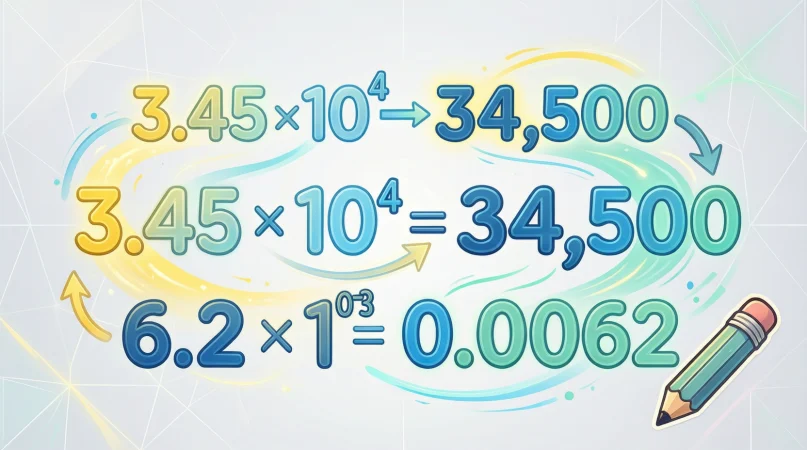
In higher math and science, standard form often means scientific notation, especially when dealing with very large or very small numbers.
Definition:
A number is in standard form (scientific notation) if it is written as:a×10n
Where:
- 1≤a<10
- n is an integer
Examples:
- 5,000 = 5 × 10⁴
- 0.00042 = 4.2 × 10⁻⁴
- 9,800,000 = 9.8 × 10⁶
📌 Friendly tip:
Move the decimal so there’s only one non-zero digit before it—that’s the key rule.
Standard Form of Algebraic Equations
1. Linear Equations Standard Form
For linear equations, standard form is usually written as:Ax+By=C
Where:
- A, B, and C are integers
- A is typically positive
Example:
- 3x + 2y = 12 (standard form)
- y = -1.5x + 6 (slope-intercept form, not standard)
📘 Teachers often prefer standard form because it makes graphing and solving systems easier.
2. Quadratic Equations Standard Form
For quadratic equations, standard form looks like:ax2+bx+c=0
Example:
- x² + 5x + 6 = 0 (standard form)
- (x + 2)(x + 3) = 0 (factored form)
Each form has its use—but standard form is the starting point.
Standard Form of Fractions
For fractions, standard form means the fraction is:
- Fully simplified
- Written with no common factors between numerator and denominator
- Has a positive denominator
Examples:
- 6/8 → 3/4 ✅
- -4/-5 → 4/5 ✅
- 10/20 → 1/2 ✅
🚫 6/8 is not standard form because it can be reduced.
Labeled Example Table: Standard Form Across Math Topics
| Math Topic | Standard Form Format | Example |
|---|---|---|
| Whole numbers | Regular digit format | 2,345 |
| Scientific notation | a × 10ⁿ | 6.2 × 10³ |
| Linear equations | Ax + By = C | 4x + y = 9 |
| Quadratic equations | ax² + bx + c = 0 | x² − 7x + 10 = 0 |
| Fractions | Simplest form | 5/6 |
Standard Form vs Related Math Terms
Understanding what standard form isn’t helps just as much as knowing what it is.
Standard Form vs Expanded Form
| Standard Form | Expanded Form |
|---|---|
| 3,482 | 3,000 + 400 + 80 + 2 |
Expanded form shows place value, while standard form is compact.
Standard Form vs Word Form
- Standard: 1,250
- Word form: One thousand two hundred fifty
Standard Form vs Slope-Intercept Form
- Standard: 2x + y = 7
- Slope-intercept: y = -2x + 7
Each serves a different purpose in algebra.
Real-World Usage of Standard Form
Standard form isn’t just for classrooms—it’s everywhere.
In Science 🧪
- Writing atomic distances
- Expressing speed of light (3 × 10⁸ m/s)
- Measuring microscopic values
In Engineering ⚙️
- Calculating tolerances
- Designing circuits
- Handling massive data values
In Finance 💰
- Large financial projections
- Interest rate modeling
- Economic statistics
In Technology 💻
- Data storage sizes
- Scientific computing
- Programming algorithms
Tone and Context Examples
Although “standard form” itself is neutral, how it’s used can affect tone.
Friendly / Educational
“Let’s rewrite this number in standard form so it’s easier to work with 😊.”
Neutral / Instructional
“Write the equation in standard form before solving.”
Slightly Dismissive
“This isn’t in standard formplease correct it.”
📌 Tip for students:
Teachers use this phrase often, not to criticize, but to encourage clarity and correctness.
Common Mistakes Students Make
- Confusing standard form with expanded form
- Forgetting scientific notation rules
- Leaving fractions unsimplified
- Mixing equation formats
- Using decimals incorrectly
Practice and repetition make standard form second nature.
Polite or Professional Alternatives to “Standard Form”
In formal writing or instruction, you may also see:
- “Conventional notation”
- “Canonical form”
- “Normalized form”
- “Proper mathematical form”
These usually mean the same thing but may vary by subject.
Alternate Meanings of “Standard Form”
Outside math, “standard form” can mean:
- A default legal document format
- A common business template
- A baseline technical specification
However, in math, the meaning is precise and rule-based.
FAQs
1. What does standard form mean in math for kids?
It usually means writing numbers normally using digits, like 345 instead of words.
2. Is standard form the same as scientific notation?
Often yes, especially in middle school, high school, and science but not always.
3. What is standard form of a linear equation?
It’s written as Ax + By = C, where A, B, and C are integers.
4. Why do teachers insist on standard form?
Because it improves clarity, consistency, and makes grading fair and accurate.
5. Can a number have more than one standard form?
No by definition, standard form follows one accepted format.
6. Is 10 × 10³ standard form?
No. Standard form requires the first number to be between 1 and 10.
Correct version: 1 × 10⁴
7. What grade level teaches standard form?
It appears as early as Grade 2–3 and continues through high school and college.
8. How do I know which standard form to use?
Look at the math topic numbers, equations, fractions, or scientific notation and follow the rules for that context.
Key Takeaways and Practical Tips
- Standard form means writing math in an agreed-upon, clear format
- The meaning changes slightly depending on the math topic
- It improves readability, accuracy, and communication
- Mastering it early makes advanced math much easier
- Always check the context before applying the rules
📘 Pro tip:
If you’re unsure, ask: “What form does my teacher or textbook expect?”
Conclusion
Standard form in math is all about clarity, consistency, and communication. Whether you’re writing whole numbers, simplifying fractions, expressing massive values using scientific notation, or organizing equations in algebra, standard form provides a common language that makes math easier to read, compare, and solve.
While the exact rules of standard form vary depending on the math topic, the purpose remains constant: to present information in the most widely accepted and usable format. Recognizing which standard form applies to numbers, equations, or scientific notation can save time, reduce errors, and boost confidence in both classroom and real-world problem-solving.

Olivia Brooks is a skilled writer at ValneTix.com dedicated to making word meanings simple, practical and relatable. Her clear explanations empower readers to use language effectively and confidently.