
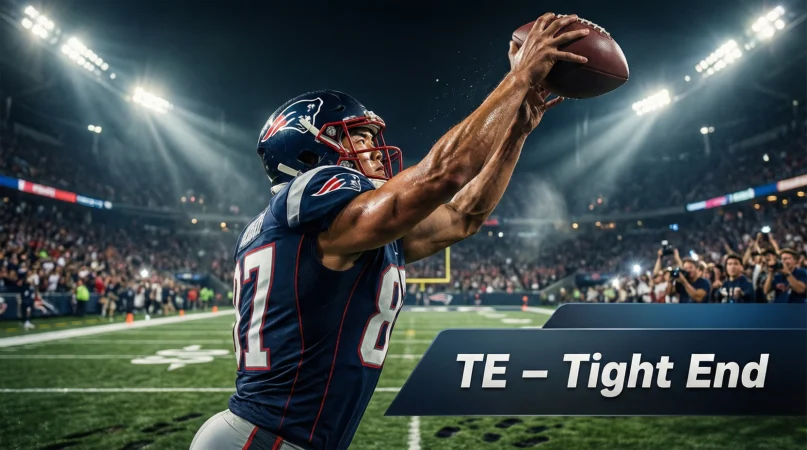
In football, “TE” stands for Tight End a versatile offensive position that combines the skills of an offensive lineman and a wide receiver. Tight ends block to protect the quarterback and run routes to catch passes, making them one of the most dynamic roles on the field.
Football is full of abbreviations that can confuse new fans and even casual viewers. You hear commentators say things like “The TE was wide open in the red zone” or see depth charts listing TE1 and TE2, and suddenly you’re wondering: What does TE mean in football, and why is it so important?
This guide breaks everything down in a clear, friendly, and professional way from the origin of the tight end position to real-game examples, tone usage, comparisons, FAQs, and even alternate meanings. Whether you’re a beginner, fantasy football player, or just brushing up on terminology, you’ll leave with a complete understanding of TE in football.
What Does TE Mean in Football?
In football, TE means Tight End, an offensive player who lines up close (“tight”) to the offensive line, usually next to a tackle.
A tight end’s main responsibilities include:
- Blocking for running plays
- Catching passes on short, medium, or even deep routes
- Providing matchup advantages against defenders
Unlike wide receivers who line up far from the line or linemen who rarely touch the ball, tight ends do both.
Origin of the Tight End Position
Where Did the Term “Tight End” Come From?
The term “tight end” comes from early football formations where players were described by how far they lined up from the offensive line.
- “End” referred to players at the end of the line
- “Tight” meant they lined up close to the tackle
Originally, tight ends were mostly blockers, similar to extra linemen. Passing-heavy offenses later transformed the role.
How the Role Evolved
- Early football: Primarily blocking, minimal receiving
- 1970s–1990s: Balanced blocker–receiver role
- 2000s–present: Elite pass-catching tight ends became offensive weapons
Players like Tony Gonzalez, Rob Gronkowski, Travis Kelce, and George Kittle helped redefine what TE means in modern football.
What Does a Tight End Do in a Game?
Tight ends are often called the “Swiss Army knife” of football offenses.
Core Responsibilities
- 🧱 Blocking defensive linemen or linebackers
- 🏃 Running routes like slants, outs, seams, and curls
- 🏈 Catching passes, especially in the red zone
- 🎭 Disguising plays, making defenses guess run or pass
Why Tight Ends Matter So Much
- Too fast for linebackers
- Too strong for defensive backs
- Create mismatches that defenses struggle to cover
Where Does the TE Line Up?
Most commonly, a tight end lines up:
- Next to the offensive tackle
- On either the left or right side
- Occasionally split wide like a receiver
- Sometimes in the backfield in modern offenses
Common TE Alignments
| Alignment | Description |
|---|---|
| In-line TE | Lined up next to the tackle |
| Slot TE | Positioned between line and receiver |
| Split TE | Lined up wide like a WR |
| H-back | Motion-based hybrid role |
Examples of “TE” Used in Football Context
Here’s how TE is commonly used in real football conversations.
Neutral / Informational Tone
- “The TE ran a perfect seam route for a first down.”
- “He’s listed as the starting TE on the depth chart.”
Positive / Praise Tone
- “That TE is unstoppable in the red zone 🔥”
- “Elite hands for a tight end!”
Critical / Negative Tone
- “The TE missed his blocking assignment.”
- “He’s not physical enough at TE.”
Unlike slang terms, TE itself is neutral — the tone depends on how it’s used.
TE in Different Levels of Football
NFL
- Highly specialized roles
- Pass-catching TEs are stars
- Blocking TEs still essential
College Football
- More variation by scheme
- Spread offenses use athletic TEs
- Some teams barely use traditional TEs
High School Football
- Often used as extra blockers
- Less emphasis on receiving
- Simpler route trees
TE vs Related Football Terms
| Term | Full Form | Main Role | Key Difference |
|---|---|---|---|
| TE | Tight End | Block + Catch | Hybrid role |
| WR | Wide Receiver | Catch passes | Rarely blocks |
| OT | Offensive Tackle | Block | Does not catch |
| FB | Fullback | Block + short runs | Rarely runs routes |
| H-back | Hybrid Back | Motion + block | More flexible alignment |
TE vs WR: What’s the Difference?
While both can catch passes, the differences are clear:
- TEs are bigger and stronger
- WRs are faster and more agile
- TEs block far more often
- WRs run deeper and more complex routes
Some modern offenses blur the line, but the responsibilities still differ.
TE in Fantasy Football
In fantasy football, TE is its own position category.
Why TEs Are Valuable in Fantasy
- Fewer elite options compared to WRs
- Top TEs score like WR1s
- Red-zone targets increase TD potential
Common Fantasy Terms
- TE1: Starting tight end
- TE premium leagues: Extra points for TE receptions
- Streaming TEs: Weekly matchup-based picks
Alternate Meanings of “TE”
While TE in football almost always means Tight End, the abbreviation can have other meanings in different contexts:
- TE (Technical Error) – academic or exam context
- TE (Thermal Energy) – physics
- TE (Text Editor) – computing
👉 Context matters. In football discussions, TE = Tight End nearly 100% of the time.
Polite or Professional Alternatives
If you’re writing formally or explaining to beginners, you can use:
- “Tight end” instead of TE
- “Offensive tight end position”
- “Tight end (TE)” on first reference, then TE afterward
This improves clarity in articles, coaching materials, and broadcasts.
Common Misconceptions About TE
- ❌ “TEs are just blockers”
- ❌ “TEs are slow”
- ❌ “They’re less important than WRs”
✅ Modern football proves tight ends can be offensive focal points.
Labeled Example: TE in a Play
| Play Element | Tight End Role |
|---|---|
| Pre-snap | Lines up next to tackle |
| Snap | Chips defensive end |
| Route | Runs a seam route |
| Result | 15-yard reception |
Conclusion
- TE means Tight End in football
- It’s one of the most versatile offensive positions
- Tight ends block, catch, and create mismatches
- The role has evolved into a game changing weapon
- Understanding TE helps fans, players, and fantasy managers alike
If you want to better understand football strategy, formations, or player roles, mastering what TE means in football is a great place to start.
FAQs
What does TE mean in football positions?
TE stands for Tight End, an offensive position responsible for blocking and receiving.
Is TE offense or defense?
TE is an offensive position.
What is a TE’s main job?
To block defenders and catch passes, depending on the play.
Are tight ends considered receivers?
They are eligible receivers, but not classified as wide receivers.
Why are tight ends important in the red zone?
Their size and strength make them ideal targets near the goal line.
What does TE1 mean?
The starting tight end on a team or fantasy roster.
Can a TE line up as a wide receiver?
Yes, modern offenses often split TEs wide.
Is TE a difficult position to play?
Yes it requires strength, speed, blocking skill, and catching ability.

Alex Ferguson is a word enthusiast at ValneTix.com who turns the meanings of everyday words into fascinating discoveries. His articles make learning language easy, enjoyable and practical for all readers.