
Last Updated on March 5, 2026
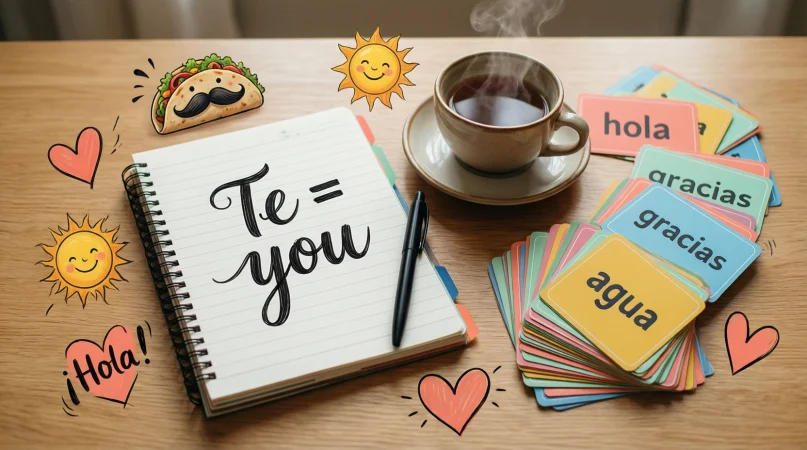
“Te” in Spanish is a pronoun used to refer to the second person singular “you” in informal contexts, functioning as either a direct or indirect object in a sentence. It is commonly used in everyday conversation to indicate actions done to or for someone.”
Spanish learners often stumble when encountering “te”, a small yet essential word that appears in hundreds of everyday sentences. Despite its size, understanding “te” unlocks a huge part of Spanish communication. Whether you’re chatting with friends, texting, or learning grammar, grasping the nuances of “te” is a game-changer.
In this article, we’ll explore the meaning, uses, examples, and related concepts of “te”. By the end, you’ll be confident in understanding, using, and even teaching this tiny word that carries big meaning.
Origin and Meaning of “Te”
“Te” originates from Latin “tibi”, which also meant “to you” or “for you.” Over time, as Latin evolved into Spanish, “tibi” simplified into “te”, keeping its role as a second-person singular pronoun.
In modern Spanish, “te” is primarily used as:
- An indirect object pronoun, e.g., “Te doy un regalo” (I give you a gift).
- A reflexive pronoun, e.g., “Te lavas las manos” (You wash your hands).
- A part of pronominal verbs, e.g., “Te arrepientes” (You regret).
It’s informal, meaning it is used with friends, family, or people of the same age. Formal situations typically use “le” instead.
When to Use “Te” in Spanish
Understanding the situations where “te” appears is crucial for proper usage.
| Function | Example Sentence | English Translation | Tone/Context |
| Indirect object | Te doy las llaves. | I give you the keys. | Friendly, neutral |
| Direct reflexive | Te cepillas el pelo. | You brush your hair. | Neutral, everyday |
| Reciprocal actions | Te abrazas con tu amigo. | You hug your friend. | Friendly, affectionate |
| Part of pronominal verbs | Te arrepientes de la decisión. | You regret the decision. | Neutral, slightly formal |
Key points:
- Always used in informal singular “you”.
- Position: usually before the conjugated verb (Te veo – I see you) or after an infinitive (Voy a verte – I am going to see you).
- Not interchangeable with “ti”, which is used after prepositions (para ti – for you).
“Te” as a Direct and Indirect Object
The difference between direct and indirect objects can be tricky, but here’s a simple breakdown:
- Direct Object → Receives the action directly.
- Te veo todos los días. (I see you every day.)
- Here, “te” is the person being seen.
- Indirect Object → Receives the action indirectly, often benefitting from it.
- Te compro un regalo. (I buy you a gift.)
- Here, “te” is the person receiving the gift.
A helpful tip: if the verb involves giving, showing, telling, or helping, “te” is often an indirect object.
Examples of “Te” in Context
Learning “te” is easier with real-world examples. Notice how it adapts to different tones and situations:
| Spanish Sentence | English Translation | Tone |
| Te quiero mucho. | I love you a lot. | Friendly, affectionate |
| ¿Te acuerdas de mí? | Do you remember me? | Neutral |
| Te dije que no vinieras. | I told you not to come. | Slightly scolding |
| Te vas a enfermar si sales sin abrigo. | You’re going to get sick if you go out without a coat. | Caring, advisory |
| ¡Te olvidaste de tus llaves! | You forgot your keys! | Slightly alarmed, neutral |
Notice how “te” conveys familiarity, intimacy, or casual tone.
Common Expressions with “Te”
Some everyday Spanish expressions use “te” idiomatically:
- Te lo juro – I swear to you.
- Te pasas – You go too far (informal, can be teasing or scolding).
- Te importa – Do you mind?
- Te echamos de menos – We miss you.
- Te va a gustar – You will like it.
Using these phrases naturally signals fluency in informal conversation.
Comparison With Similar Words
| Word | Meaning | When to Use | Example |
| Te | Informal “you” (object/reflexive) | Friendly, singular | Te llamo mañana – I’ll call you tomorrow |
| Le | Formal “you” (object) | Respectful, singular | Le llamo mañana – I’ll call you tomorrow (formal) |
| Ti | After prepositions | “For you”, “to you” | Esto es para ti – This is for you |
| Se | Reflexive pronoun (3rd person or formal 2nd) | He/she/you formal | Se lava las manos – He/She/You (formal) washes their hands |
Tip: Many learners confuse te and ti. Remember: te = before a verb, ti = after a preposition.
Alternate Meanings and Uses
While “te” is primarily a pronoun, it can occasionally appear in other contexts:
- As part of “té” (with accent) → means tea in Spanish: Me gusta el té verde (I like green tea).
- In idiomatic expressions, sometimes it forms reflexive or reciprocal actions: Te va a ir bien – You’re going to do well.
Always check for accents: “te” vs “té” changes the meaning entirely.
Polite Alternatives to “Te”
Since “te” is informal, in professional or formal situations:
- Use “le” as a formal singular object pronoun:
- Informal: Te doy el documento. (I give you the document.)
- Formal: Le doy el documento. (I give you the document.)
- Avoid overusing “te” with strangers or elders to maintain respect.
FAQs
1. What does “te” mean in Spanish texting?
In text messages, “te” retains the same pronoun function and often appears in phrases like “Te quiero” (I love you) or “Te extraño” (I miss you).
2. How do I know when to use “te” or “le”?
Use te for informal singular “you” and le for formal singular “you” (or third person).
3. Can “te” be used for plural “you”?
No, te is singular. For plural, use os in Spain or les in Latin America (formal plural).
4. Is “te” always before the verb?
Generally yes, except with infinitives (Voy a verte) or affirmative commands (¡Lávate!).
5. Can “te” change meaning in different regions?
Mostly, it keeps the same meaning, but Latin American Spanish sometimes prefers certain pronominal verb forms differently than Spain.
6. What’s the difference between “te” and “ti”?
Te = object before the verb.
Ti = after prepositions (para ti, a ti).
7. Can “te” be used for reflexive verbs?
Yes! Many reflexive verbs rely on te for the second person singular: Te despiertas temprano (You wake up early).
8. Is “te” the same as “tú”?
No. Tú is the subject pronoun (you as the doer), te is the object pronoun (you as the receiver).
Conclusion
“Te” may seem small, but it’s mighty in Spanish. From casual chats to reflexive verbs and idiomatic expressions, mastering “te” will help you sound natural and fluent.
- Te = informal singular you
- Before verbs, after infinitives/commands
- Use “le” for formal situations
- Pay attention to “té” with an accent, which means tea
By practicing common phrases and real-world examples, you’ll quickly integrate “te” into your Spanish conversations, making your speech more authentic and engaging.
Discover More Related Articles:-
- What Does High MCV Mean in a Blood Test? (2026 Guide)
- What Does Queer Mean in Sexuality? Clear Guide (2026)

Ethan Ware is a digital writer and internet culture enthusiast who stays on top of the latest slang, trends and viral phrases. He specializes in making modern language easy to understand for readers of all ages.