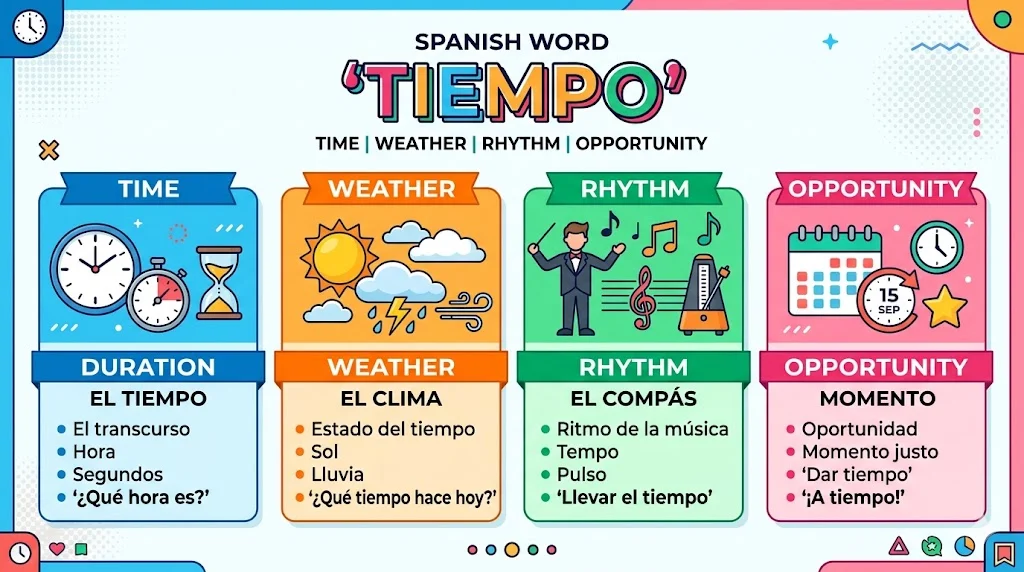
Tiempo in Spanish means “time”, but its meaning shifts depending on context. It can refer to weather, rhythm, or duration in everyday conversation. Tiempo is a versatile word widely used in literature, music, and professional settings, making it one of the most common and important words in the Spanish language.
One Spanish word. Two completely different meanings. And mixing them up can make your conversation go in a very unexpected direction.
Tiempo.
Ask a local in Madrid what the tiempo is like today and they’ll look out the window. Ask a musician about tiempo and they’ll talk about rhythm and beat. Same word, same spelling, same pronunciation but depending on context, you’re either discussing the weather or the flow of music.
That’s the beauty of Spanish. And also the trap.
Tiempo is one of those words that beginner textbooks mention once and move on. But native speakers use it constantly, in ways that go far deeper than any translation app will tell you. Miss the context and you miss the meaning entirely.
Whether you’re learning Spanish for travel, work, relationships, or just pure curiosity truly understanding tiempo is one of those small breakthroughs that suddenly makes real conversations click.
This guide covers everything the full meaning, both uses, real example sentences, pronunciation, and exactly how native speakers use it every single day.
The Origins and Popularity of “Tiempo”
The Spanish word tiempo comes from the Latin tempus, which also means time. Over centuries, it evolved in Spanish to not only refer to chronological time but also to the weather, musical rhythm, and even an opportune moment.
Why is “tiempo” popular?
- It’s one of the first words taught to Spanish learners.
- It appears frequently in idioms and expressions like:
- Tiempo al tiempo – “Time will tell.”
- Perder el tiempo – “To waste time.”
- A tiempo – “On time.”
Fun Fact: In many Spanish-speaking countries, “tiempo” is used more flexibly than its English counterpart, often blending into social and poetic contexts effortlessly.
Primary Meaning: Time ⏳
The most common and literal translation of tiempo is time. This can refer to:
- Clock time:
¿Qué tiempo es? – “What time is it?” - Duration:
Pasé mucho tiempo estudiando. – “I spent a lot of time studying.” - Historical periods:
En tiempos antiguos, la vida era diferente. – “In ancient times, life was different.”
Tips for Usage:
- Use tiempo for general or abstract concepts of time.
- Use hora specifically for a precise hour or moment.
Secondary Meaning: Weather ☀️🌧️
Interestingly, tiempo also means weather in Spanish, especially in daily conversation and news reports.
Examples:
- El tiempo hoy es soleado. – “The weather today is sunny.”
- ¿Qué tiempo hará mañana? – “What will the weather be like tomorrow?”
Tip: In Spanish, weather-focused tiempo is neutral and friendly. It’s frequently used in small talk or planning outdoor activities.
Other Contextual Meanings 🎵💃
Beyond time and weather, tiempo can be used in specialized or idiomatic contexts:
- Music / Rhythm
- Tocar en tiempo – “To play in time.”
- Refers to the tempo or rhythm of music.
- Opportunity / Chance
- Es tiempo de cambiar. – “It’s time to change.”
- Used to indicate the right moment to act.
- Sports / Competition
- In soccer: El árbitro añadió tiempo extra. – “The referee added extra time.”
Usage Examples in Context 📚
Here are examples with tones for better understanding:
| Context | Sentence | Tone |
| Everyday | No tengo tiempo para eso. – “I don’t have time for that.” | Neutral / Friendly |
| Weather | Hoy el tiempo está nublado. – “Today the weather is cloudy.” | Neutral |
| Music | La banda toca en tiempo perfecto. – “The band plays in perfect time.” | Positive / Admiring |
| Idiomatic | Tiempo al tiempo. – “Time will tell.” | Philosophical / Reflective |
| Negative | Perdiste tu tiempo conmigo. – “You wasted your time with me.” | Dismissive |
Comparison With Related Terms 🔍
Understanding subtle differences can help avoid mistakes:
| Term | Meaning | Usage Note |
| Tiempo | Time / Weather / Moment / Rhythm | Flexible; broad use |
| Hora | Hour / Exact Time | Specific clock time |
| Clima | Weather / Climate | Focus on long-term patterns; more formal |
| Ritmo | Rhythm / Beat | Used in music, poetry, dance |
| Momento | Moment / Opportunity | Short, precise, situational |
Key Tip: If in doubt, use tiempo for general references, and hora or clima for more precise meanings.
Professional and Polite Alternatives ✨
Sometimes, you may want a more formal or polite way to express tiempo:
- Duration / Time span → período, lapso
- Example: El proyecto tomó un período de tres meses. – “The project took a three-month period.”
- Opportunity / Right moment → ocasión, momento oportuno
- Example: Aprovecha la ocasión. – “Seize the opportunity.”
- Weather (formal) → condiciones meteorológicas
- Example: Las condiciones meteorológicas son favorables. – “The weather conditions are favorable.”
Common Mistakes Learners Make ❌
- Confusing tiempo with hora
- Incorrect: ¿Qué tiempo es? (for a precise clock hour)
- Correct: ¿Qué hora es?
- Assuming tiempo always means time
- El tiempo está bonito hoy. – “The weather is nice today.” (Not “The time is nice today”)
- Overusing tiempo in idioms
- Stick to common phrases like perder el tiempo or tiempo al tiempo to sound natural.
- Ignoring context in music or sports
- Always pair tiempo with terms like extra, perfecto, or ritmo when referring to music or sports.
Example Table: “Tiempo” in Different Contexts 📝
| Meaning | Sentence in Spanish | Translation | Tone |
| Time | Necesito más tiempo para estudiar. | “I need more time to study.” | Neutral |
| Weather | El tiempo está lluvioso. | “The weather is rainy.” | Neutral |
| Music | Toca en tiempo. | “Play in time.” | Positive |
| Opportunity | Es tiempo de hablar. | “It’s time to speak.” | Neutral / Professional |
| Sports | Se añade tiempo extra. | “Extra time is added.” | Neutral |
FAQs
1. What is the literal translation of tiempo?
Tiempo literally translates to time, but it can also mean weather, moment, or rhythm depending on context.
2. How do I ask for the time in Spanish?
Use ¿Qué hora es? rather than ¿Qué tiempo es?, which is incorrect in this context.
3. Can tiempo mean weather?
Yes! In everyday conversation, tiempo can refer to weather conditions.
4. Is tiempo used in idiomatic expressions?
Absolutely! Common phrases include:
- Perder el tiempo – to waste time
- Tiempo al tiempo – time will tell
5. What is the difference between tiempo and hora?
- Tiempo: general concept of time, duration, or moment
- Hora: specific clock time
6. How is tiempo used in music?
It refers to tempo or rhythm, e.g., tocar en tiempo perfecto.
7. Are there professional alternatives for tiempo?
Yes, depending on context: período (duration), ocasión (opportunity), condiciones meteorológicas (weather).
8. Can tiempo be negative?
Yes, in idioms like perder el tiempo (“to waste time”) it can express frustration or dismissal.
Conclusion
- Tiempo is a versatile Spanish word with primary meanings of time and weather, but also includes rhythm, opportunity, and moments.
- Always consider context to avoid confusion, especially with hora (exact hour) and clima (formal weather).
- Common expressions like perder el tiempo or tiempo al tiempo are essential for conversational fluency.
- For professional writing or formal contexts, alternatives like período, ocasión, or condiciones meteorológicas elevate your language.
- Mastering tiempo will enhance your understanding of Spanish culture, literature, and daily communication.
Remember: Spanish speakers often use tiempo flexibly and poetically embrace the nuances, and your fluency will shine! ✨

Madison Lee is a skilled writer at ValneTix.com dedicated to making word meanings clear, relatable and actionable. She empowers readers to understand language deeply and use words with confidence in daily life.