
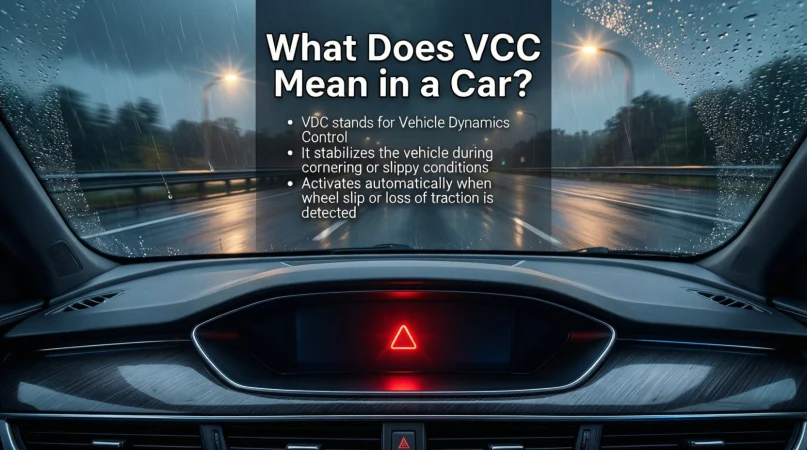
VDC in a car stands for Vehicle Dynamic Control. It is an advanced safety system designed to help drivers maintain control of their vehicle by reducing wheel slip, improving traction, and stabilizing the car during sharp turns, slippery roads, or sudden maneuvers.
If you’ve ever seen a VDC light on your dashboard or wondered what that button labeled VDC OFF actually does, you’re not alone. Many drivers use cars with VDC every day without fully understanding how important it is or when it should (and shouldn’t) be turned off.
This guide explains what VDC means in a car, how it works, why it matters, how it compares to similar systems like traction control and ESC, and what to do if the VDC warning light comes on.
What Is VDC in a Car?
Vehicle Dynamic Control (VDC) is an electronic safety system that helps prevent skidding, loss of traction, and loss of steering control. It works by automatically adjusting engine power and selectively applying brakes to individual wheels when the car senses instability.
In plain terms:
👉 VDC helps keep your car going where you intend it to go.
It is especially useful in:
- Rain 🌧️
- Snow ❄️
- Ice
- Loose gravel
- Emergency swerving situations
VDC is not a substitute for safe driving but it acts as a silent co-driver that steps in when things start to go wrong.
Origin and Evolution of VDC
Where Did VDC Come From?
Vehicle Dynamic Control emerged in the late 1990s as automakers began integrating computer controlled safety systems into vehicles.
- First widely adopted: Late 1990s early 2000s
- Inspired by: Anti-lock Braking Systems (ABS)
- Developed by: Nissan, Infiniti, and other Japanese manufacturers initially
- Global equivalent: Electronic Stability Control (ESC)
Why Did It Become Popular?
VDC gained popularity because:
- It dramatically reduces accident risk
- It improves control during emergency maneuvers
- Insurance and safety agencies strongly support it
- Many countries now require stability control by law
According to global safety studies, stability control systems like VDC can reduce single-vehicle crashes by up to 50%.
How Does VDC Work?
VDC relies on multiple sensors and a central computer to monitor how your car is behaving versus how you’re steering it.
Key Components Involved
- Wheel speed sensors
- Steering angle sensor
- Yaw rate sensor (vehicle rotation)
- Throttle control system
- Brake control module
Step-by-Step Example
Imagine this situation:
- You turn sharply on a wet road
- The car begins to skid outward
- VDC detects the mismatch between steering input and actual movement
- The system:
- Reduces engine power
- Applies brakes to specific wheels
- The car regains stability
You may feel a slight vibration or hear a clicking sound that’s normal.
What Does the VDC Light Mean?
The VDC warning light on your dashboard communicates important information.
Common VDC Light Meanings
| VDC Light Status | Meaning |
|---|---|
| Light flashes briefly | System actively correcting traction |
| Light stays on | VDC system malfunction |
| “VDC OFF” illuminated | System manually disabled |
Is It Safe to Drive with the VDC Light On?
- Short trips: Usually okay in dry conditions
- Rain/snow: Higher risk ⚠️
- Long-term: Get it checked as soon as possible
A steady VDC light means the system is not protecting you.
When Should You Turn VDC Off?
Although VDC is designed to stay on most of the time, there are rare cases where turning it off helps.
Situations Where VDC OFF Makes Sense
- Driving out of deep snow
- Rocking the car out of mud
- Driving on sand
- Performance driving on a closed track
When You Should NOT Turn It Off
- Daily city driving
- Highway driving
- Rainy or icy roads
- Emergency maneuvers
👉 For 99% of drivers, VDC should remain ON.
Real-World Usage Examples
Neutral / Informative Example
“My car’s VDC system kicked in during a sharp turn on a wet road, and I felt the brakes adjust automatically.”
Friendly Example 😊
“I didn’t even realize how slippery the road was until the VDC light flashed—saved me from spinning out!”
Negative / Dismissive Example 😬
“I turned off VDC because I thought I didn’t need it… big mistake on icy pavement.”
VDC vs Related Systems
Many drivers confuse VDC with similar safety technologies. Here’s how they compare.
VDC vs Traction Control vs ESC
| Feature | VDC | Traction Control (TCS) | ESC |
|---|---|---|---|
| Prevents wheel spin | ✅ | ✅ | ✅ |
| Controls skidding | ✅ | ❌ | ✅ |
| Applies brakes individually | ✅ | Limited | ✅ |
| Reduces engine power | ✅ | ✅ | ✅ |
| Brand-specific term | Nissan/Infiniti | Generic | Global standard |
Key Takeaway
- VDC = a type of ESC
- Different name, same goal: stability and control
Why Is VDC Important for Safety?
VDC plays a major role in accident prevention.
Benefits of Vehicle Dynamic Control
- Reduces skidding
- Improves cornering stability
- Helps maintain steering control
- Enhances traction on slippery roads
- Reduces rollover risk (especially SUVs)
It doesn’t make you invincible—but it buys you precious seconds to react.
Does VDC Affect Fuel Economy or Performance?
Fuel Economy
- Minimal impact
- Only engages when needed
- Not active during normal cruising
Performance
- May slightly reduce engine power during activation
- Performance-oriented drivers may feel it’s restrictive
- Everyday drivers benefit from smoother control
Which Cars Use VDC?
VDC is most commonly found in:
- Nissan vehicles
- Infiniti models
- Some Subaru and Mitsubishi vehicles
Other manufacturers may use different names:
- Toyota: VSC
- Honda: VSA
- BMW: DSC
- Mercedes-Benz: ESP
Alternate Meanings of VDC
Although rare in automotive contexts, VDC can also mean:
- Volts DC (electronics)
- Virtual Data Center (IT)
- Voltage Direct Current
⚠️ In cars, VDC almost always means Vehicle Dynamic Control.
Professional or Polite Alternatives in Writing
If you’re writing professionally or explaining VDC formally, you may use:
- Electronic Stability Control
- Vehicle Stability System
- Dynamic Stability Control
Example:
“This vehicle is equipped with electronic stability control (VDC) to enhance driving safety.”
Practical Tips for Drivers Using VDC
- Keep tires properly inflated
- Replace worn tires promptly
- Don’t ignore warning lights
- Avoid disabling VDC unnecessarily
- Drive cautiously in bad weather even with VDC
Conclusion
VDC (Vehicle Dynamic Control) is one of the most valuable safety technologies in modern vehicles. It quietly works behind the scenes to keep your car stable, reduce skidding, and help you stay in control during challenging driving conditions.
FAQs
What does VDC mean on my dashboard?
It means Vehicle Dynamic Control, a system that helps stabilize your car when traction is lost.
Is VDC the same as traction control?
No. Traction control prevents wheel spin, while VDC also manages skidding and steering stability.
Should I drive with VDC off?
Only in special situations like deep snow. Otherwise, keep it on.
Why is my VDC light on?
It may indicate a system fault or that VDC has been turned off manually.
Does VDC work at highway speeds?
Yes. It operates at all speeds when instability is detected.
Can VDC prevent accidents?
It significantly reduces risk but cannot overcome unsafe driving.
Is VDC mandatory in cars?
In many countries, stability control systems are legally required in new vehicles.
Does VDC replace good tires?
No. Good tires are essential for VDC to work effectively.

Olivia Brooks is a skilled writer at ValneTix.com dedicated to making word meanings simple, practical and relatable. Her clear explanations empower readers to use language effectively and confidently.