
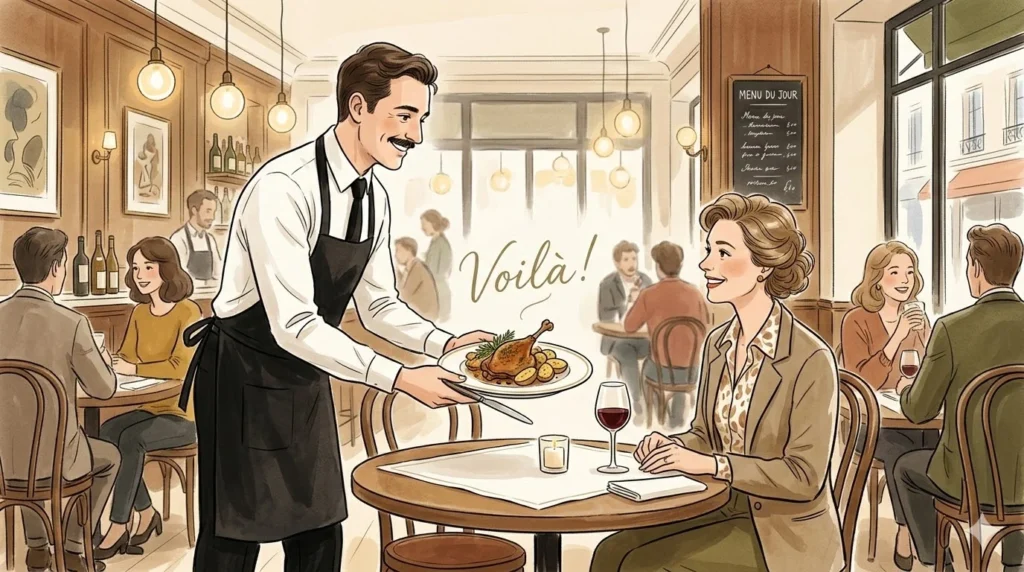
“Voilà” in French means “there it is,” “there you go,” or “here it is.” It’s used to present, point out, conclude, or emphasize something and can convey completion, explanation, or satisfaction depending on context and tone.
You’ve probably heard voilà in movies, cooking shows, magic tricks, or even everyday conversation sometimes said with a flourish, sometimes casually slipped into a sentence. It feels elegant. A little dramatic. Almost magical.
But what does voilà actually mean in French? And why do French speakers use it so often, sometimes in ways that don’t seem to translate neatly into English?
This guide breaks down the true meaning of voilà from its literal definition to its emotional tone, cultural usage, real-life examples, and common misunderstandings. By the end, you’ll not only understand voilà, you’ll know how and when to use it naturally.
Why Voilà Is More Than Just a Word
At first glance, voilà seems simple. But in real French, it’s one of the most versatile and expressive words you’ll hear.
French speakers use voilà to:
- Present something
- Signal completion
- Emphasize a point
- Transition between ideas
- Wrap up a conversation
It’s not just vocabulary it’s communication glue.
Breaking Down the Word: Literal Meaning of Voilà
The word voilà comes from two parts:
- Vois (from voir) = “see”
- Là = “there”
Put together, voilà literally means:
“See there!”
Over time, this evolved into:
- “There it is”
- “Here it is”
- “That’s it”
The Origin of Voilà
Historical Roots
Voilà dates back to Old French, where it functioned as a demonstrative expression—used to point something out physically.
Originally:
- Used in face-to-face interaction
- Accompanied by gestures
- Strongly tied to the act of showing
As spoken French evolved, voilà expanded beyond physical objects into ideas, explanations, and conclusions.
How Popular Is Voilà in Modern French?
Extremely popular.
In fact, voilà is:
- One of the most frequently spoken words in conversational French
- Used across all age groups
- Common in formal and informal speech
French speakers may say voilà dozens of times a day—often without even noticing.
Core Meanings of Voilà in French
1. “There It Is” / “Here It Is”
Used when presenting something.
Example:
Voilà ton café.
(Here’s your coffee.)
Tone: Neutral, friendly ☕
2. “There You Go”
Used when handing something to someone or completing a task.
Example:
Voilà, c’est fait.
(There you go, it’s done.)
Tone: Helpful, reassuring 😊
3. “That’s It” / “That’s Exactly It”
Used to confirm or emphasize a point.
Example:
Voilà le problème.
(That’s the problem.)
Tone: Explanatory, confident
4. A Conversational Filler or Transition
Used to structure speech.
Example:
Voilà, je voulais te dire ça.
(So, that’s what I wanted to tell you.)
Tone: Natural, conversational
Tone Matters: How Voilà Feels in Different Situations
Friendly Tone
Voilà ! 🎉
Feels cheerful, encouraging, or celebratory.
Neutral Tone
Voilà.
Matter-of-fact, explanatory.
Dismissive or Final Tone
Voilà, point final.
Signals closure or impatience.
Tone changes everything.
Examples of Voilà in Real-Life Context
Example 1: In a Restaurant
Voilà votre commande.
(Here is your order.)
Professional and polite.
Example 2: Teaching or Explaining
Voilà pourquoi c’est important.
(That’s why it’s important.)
Clear and instructive.
Example 3: Ending a Conversation
Voilà, à bientôt.
(That’s it, see you soon.)
Warm and conclusive.
Example Table: Common Uses of Voilà
| Situation | Meaning | Example |
| Presenting | Here it is | Voilà le document. |
| Completing | There you go | Voilà, terminé. |
| Explaining | That’s it | Voilà le point clé. |
| Transitioning | So / Well | Voilà, passons à autre chose. |
Voilà vs Related French Expressions
Voilà vs Voici
This confuses many learners.
| Word | Meaning | Usage |
| Voilà | There it is | Distant, general |
| Voici | Here it is | Close, immediate |
In modern French, voilà is used far more often than voici.
Voilà vs “Alors”
- Voilà = presentation or conclusion
- Alors = transition or prompting
Does Voilà Have Alternate Meanings?
Yes—especially outside French.
In English
Voilà is often used to mean:
- “And there you have it”
- A moment of reveal or success
Example:
I fixed the code and voilà!
In Pop Culture
Often associated with:
- Magic tricks 🎩
- Cooking shows 🍳
- Artistic flair 🎨
But in French, it’s far more everyday and less dramatic.
Polite or Professional Alternatives to Voilà
In formal writing or professional contexts, alternatives may include:
- Voici (Here is)
- Ainsi (Thus)
- C’est pourquoi (That’s why)
- En conclusion (In conclusion)
However, voilà is still acceptable in spoken professional French.
Common Mistakes Non-Native Speakers Make
- Overusing voilà in English ❌
- Pronouncing it “voil-ah” instead of vwah-lah ❌
- Using it only for dramatic effect ❌
In French, voilà is subtle, frequent, and flexible.
How to Use Voilà Naturally (Usage Tips)
- Use it to present or conclude, not to decorate sentences randomly
- Pair it with gestures when speaking
- Let tone guide meaning
- Listen to native speakers—usage is best learned by ear
FAQs
1. What does voilà mean in French?
It means “there it is,” “here it is,” or “that’s it,” depending on context.
2. Is voilà formal or informal?
It’s neutral used in both casual and professional speech.
3. How do you pronounce voilà?
Vwah-lah (the “à” is stressed).
4. Can voilà end a conversation?
Yes, it often signals closure.
5. Is voilà used in English correctly?
Yes, but usually for emphasis or reveal not as often as in French.
6. What’s the difference between voilà and voici?
Voilà is general or distant; voici is close or immediate.
7. Can voilà sound rude?
Only if tone is sharp or dismissive.
8. Do French people say voilà a lot?
Yes constantly. It’s a core conversational word.
Conclusion
Voilà isn’t flashy it’s functional. It’s the quiet rhythm of French conversation, the verbal equivalent of a nod, a gesture, or a gentle full stop.
When you understand voilà, you understand something deeper about French communication: clarity, flow, and human connection.
And now… voilà. You know exactly what it means.

Alex Ferguson is a word enthusiast at ValneTix.com who turns the meanings of everyday words into fascinating discoveries. His articles make learning language easy, enjoyable and practical for all readers.