
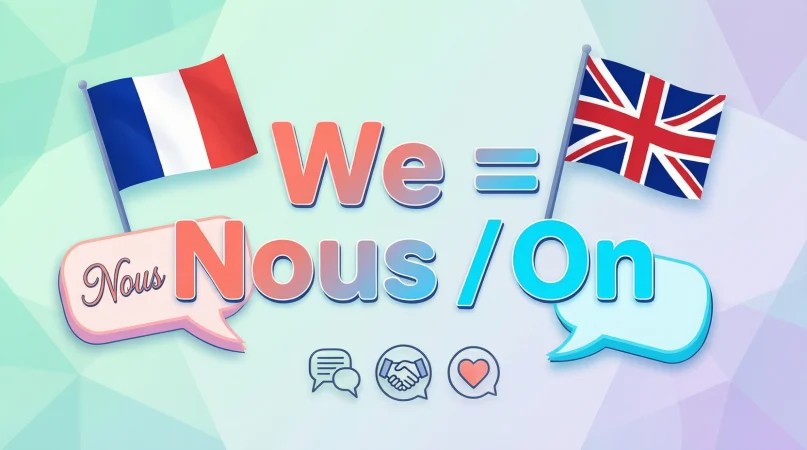
In French, “we” most commonly means nous. In everyday spoken French, however, people often use technically “means” to mean “one” or “people in general.”
If you’ve ever learned French or even just heard it spoken in movies, music, or cafés you’ve probably noticed that the English word “we” doesn’t always translate the same way. Sometimes you hear nous, sometimes on, and occasionally something more nuanced depending on tone, formality, or context.
So what does “we” mean in French, really? And how do you know which form to use?
This comprehensive guide breaks it all down in a friendly, clear, and practical way whether you’re a beginner, a traveler, a student, or just curious about how French actually works in real life.
Understanding “We” in French at a Glance
In English, “we” is simple: one word, one meaning.
In French, “we” has two main translations, plus a few stylistic and contextual twists.
The Two Core Translations of “We” in French
- Nous → Formal, written, standard French
- On → Informal, spoken, everyday French
Both can mean we, but they feel different and are used in different situations.
The Main Translation: Nous
What Does Nous Mean?
Nous is the direct and grammatically correct translation of “we” in French.
English: We are ready.
French: Nous sommes prêts.
When to Use Nous
Use nous when:
- Writing formally (essays, emails, reports)
- Speaking in professional or academic settings
- Wanting to sound precise or official
- Learning grammar rules in school
Grammar Basics with Nous
- Nous always uses plural verb conjugations
- Verb endings often include -ons
Examples:
- Nous allons au cinéma.
(We are going to the cinema.) - Nous comprenons la situation.
(We understand the situation.)
The Everyday Favorite: On
What Does On Mean?
Traditionally, on means:
- “one”
- “people”
- “someone”
But in modern spoken French, on is overwhelmingly used to mean “we.”
On va manger ?
“Shall we eat?”
Why Do French Speakers Use On for “We”?
- It sounds more natural and relaxed
- It’s shorter and easier to conjugate
- It feels friendly and conversational
In fact, native speakers use on far more often than nous in daily life.
Important Grammar Note: On Takes Singular Verbs
Even when on means “we,” it uses third-person singular verb forms.
Example:
- On est fatigués.
(We are tired.)
Notice:
- Verb: est (singular)
- Adjective: fatigués (plural, because it refers to “we”)
This mix often confuses learners—but it’s completely normal in French.
Example Table: “We” in French
| English Sentence | French with Nous | French with On | Tone |
|---|---|---|---|
| We are late | Nous sommes en retard | On est en retard | Formal vs casual |
| We understand | Nous comprenons | On comprend | Neutral |
| We’re leaving | Nous partons | On part | Spoken |
| We should go | Nous devrions partir | On devrait partir | Friendly |
| We agree | Nous sommes d’accord | On est d’accord | Everyday |
Tone Differences: Nous vs On
Nous — Formal, Polite, Structured
- Sounds serious or official
- Common in speeches, writing, news
- Less common in casual conversation
On — Friendly, Natural, Conversational 😊
- Dominates spoken French
- Used among friends, family, coworkers
- Makes speech feel relaxed and modern
Real-life tip:
If you use nous in casual conversation, you’ll sound correct—but slightly stiff.
Real-World Usage: What Native Speakers Actually Say
In everyday French:
- 90% spoken conversations use on
- Nous appears mostly in writing
Example conversation:
On se voit ce soir ?
“Are we seeing each other tonight?”
Saying Nous nous voyons ce soir ? would sound overly formal—almost robotic.
Can “On” Have Other Meanings?
Yes! This is where nuance matters.
Alternate Meanings of On
Depending on context, on can mean:
- One (generic)
- People in general
- Someone (unknown subject)
- We (informal)
Examples:
- On dit que ce restaurant est bon.
“They say this restaurant is good.” - En France, on mange tard.
“In France, people eat late.”
Context tells you whether on means we or something more general.
Inclusive vs Exclusive “We” in French
Unlike some languages, French does not formally distinguish between:
- Inclusive “we” (you + me)
- Exclusive “we” (me + others, not you)
Both are expressed with nous or on, and context does the work.
Polite and Professional Alternatives to “We” in French
In professional or diplomatic settings, you might see:
1. Nous (Standard Professional Choice)
Used in:
- Business emails
- Official statements
- Academic writing
2. Impersonal Constructions
Used to sound neutral or diplomatic:
- Il convient de… (It is appropriate to…)
- Il est recommandé de… (It is recommended to…)
These avoid direct “we” altogether.
“We” in Written vs Spoken French
| Context | Preferred Term |
|---|---|
| Casual conversation | On |
| Text messages | On |
| Essays & exams | Nous |
| Business emails | Nous |
| News articles | Nous |
| Speeches | Nous |
Common Mistakes Learners Make
- ❌ Mixing on with plural verb forms
- ❌ Using nous everywhere in speech
- ❌ Forgetting adjective agreement with on
- ❌ Assuming on always means “we”
Correct Example:
On est contents.
Not: On sommes contents.
Conclusion
So, what does “we” mean in French?
The answer is both simple and beautifully nuanced.
At its core, we means nous but in real life, it often becomes on, shaped by tone, context, and modern usage. Mastering both forms will instantly make your French sound more natural, confident, and authentic.
Whether you’re chatting with friends, writing an email, or studying for an exam, knowing when and how to use “we” in French is a small skill that makes a big difference.
FAQs
What is the literal translation of “we” in French?
The literal translation is nous.
Why do French people say on instead of nous?
Because on sounds more natural, friendly, and conversational in spoken French.
Is it grammatically correct to use on for “we”?
Yes. It’s grammatically correct and widely accepted in modern French.
Which should I use as a beginner: nous or on?
Learn both but use on in conversation and nous in writing.
Does on always mean “we”?
No. It can also mean “one,” “people,” or “someone,” depending on context.
Is nous considered old-fashioned?
Not old-fashioned just more formal and written.
How do verbs work with on?
On always takes third-person singular verbs, even when it means “we.”
Can I use on in professional French?
Generally no. In professional or academic writing, nous is preferred.
Discover More Related Articles:-
- What Does Gifted Mean in School? Definition, Programs & Examples 2026 Guide
- What Does Al Mean in Arabic? Definition, Origin, Usage & Examples For 2026
- What Does Remastered Mean in Songs? Definition & Differences For 2026

Madison Lee is a skilled writer at ValneTix.com dedicated to making word meanings clear, relatable and actionable. She empowers readers to understand language deeply and use words with confidence in daily life.