
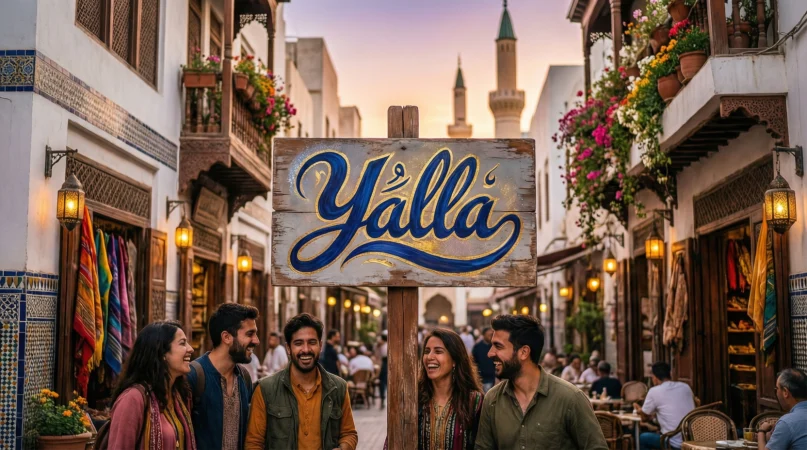
Yalla (يلا) is a common Arabic expression that means “come on,” “let’s go,” “hurry up,” or “okay, let’s do it,” depending on tone and context. It’s used to encourage action, show agreement, or prompt someone to move or decide.
“Yalla” is one of the most widely used and emotionally expressive words in the Arabic language. You’ll hear it in movies, music, social media, streets, homes, and even in offices across the Arab world and far beyond it.
If you’ve ever wondered what does yalla mean in Arabic, why people say it so often, or whether it’s rude or friendly, this guide will walk you through everything you need to know from its origin and cultural depth to real-life examples and polite alternatives.
Why “Yalla” Is Everywhere 🌍
Few words travel as far and as fast as yalla. It’s short, energetic, and incredibly flexible. Non-Arabic speakers pick it up quickly, and many don’t even realize it’s Arabic at all.
You’ll hear yalla used by:
- Friends heading out
- Parents calling kids
- Coaches motivating teams
- Taxi drivers urging passengers
- Colleagues ending a meeting
- Even celebrities and influencers online
In short: if Arabic had a “power word,” yalla would be it.
Origin of the Word “Yalla”
Linguistic Roots
The word yalla (يلا) comes from the Arabic phrase:
يا الله (Ya Allah)
Meaning: “Oh God”
Historically, it was an invocation asking for strength or help before starting something. Over time, it evolved into a secular, everyday expression used to initiate action or movement.
From Sacred to Casual
What’s fascinating is how yalla moved from a religious phrase to a casual, spoken word without losing its emotional energy. Today, it’s mostly informal and widely accepted across cultures.
What Does Yalla Mean in Different Contexts?
The meaning of yalla changes based on:
- Tone
- Situation
- Relationship between speakers
Here’s how it adapts:
Common Meanings of Yalla
- Come on
- Let’s go
- Hurry up
- Okay / Alright
- Let’s do it
- Move it (informal)
Example Table: How “Yalla” Changes Meaning
| Situation | Meaning | Tone |
|---|---|---|
| Friends leaving a café | “Let’s go” | Friendly |
| Parent calling a child | “Hurry up” | Firm |
| Team starting a project | “Let’s do this” | Motivational |
| Someone delaying | “Come on already” | Slightly annoyed |
| Ending a conversation | “Alright then” | Neutral |
Real-Life Examples of “Yalla”
1. Friendly & Casual 😊
Yalla, let’s grab some food!
(Excited, upbeat, social)
2. Motivational 💪
Yalla! You can do it!
(Common in sports and encouragement)
3. Neutral / Practical 😐
Yalla, we should leave now.
(No strong emotion, just action)
4. Impatient or Dismissive 😒
Yalla, yalla… you’re late.
(Slight frustration, not necessarily rude)
Is “Yalla” Rude?
Short answer: Usually no.
Long answer: It depends on tone and context.
When Yalla Is NOT Rude
- Among friends
- In casual conversation
- When encouraging or motivating
- When said with a smile or upbeat tone
When It CAN Feel Rude
- Said sharply or repeatedly
- Used toward elders or strangers
- In formal or professional settings
Tone matters more than the word itself.
How Popular Is Yalla Today?
Yalla is no longer just Arabic—it’s global.
You’ll Find It In:
- Songs and rap lyrics
- TikTok and Instagram captions
- TV shows and movies
- Street slang in Europe
- Everyday speech in multicultural cities
Many non-Arabic speakers use yalla without realizing its origin, especially in places with Arab communities.
Usage Across Arabic Dialects
One of yalla’s strengths is that it works across all Arabic dialects.
| Region | Usage |
|---|---|
| Egypt | Very common |
| Levant (Jordan, Palestine, Lebanon, Syria) | Everyday speech |
| Gulf countries | Frequently used |
| North Africa | Common with slight variations |
| Modern Standard Arabic | Informal only |
No matter where you are in the Arab world, yalla will be understood.
Yalla in Pop Culture & Social Media
You’ll often see:
- “Yalla habibi” (Come on, my dear)
- “Yalla let’s go!”
- “Yalla bye” (Playful way to end chats)
It’s also used humorously, sarcastically, or affectionately online.
Related Words & Comparisons
Yalla vs Similar Arabic Expressions
| Term | Meaning | Tone |
|---|---|---|
| Yalla | Come on / Let’s go | Casual |
| Imshi (امشي) | Move / Go | Can be rude |
| Hayya (هيا) | Let’s go | Slightly formal |
| Tafaddal (تفضل) | Please / Go ahead | Polite |
| Sari‘ (سريع) | Hurry | Direct |
Alternate Meanings of Yalla
While yalla usually signals action, it can also mean:
- “Alright then”
- “Okay, fine”
- “Let’s move on”
These meanings depend heavily on tone and facial expression.
Polite or Professional Alternatives
In professional or respectful settings, avoid yalla. Instead, use:
- Tafaddal – Please / Go ahead
- Min fadlak – If you please
- Hal mumkin… – Is it possible to…
- Hayya bina – Let us begin
These sound more courteous and appropriate in formal contexts.
Usage Tips for Non-Arabic Speakers
If you’re learning Arabic or traveling:
Do:
- Use it with friends
- Match the tone
- Smile when saying it
- Listen to locals first
Don’t:
- Use it with elders unless invited
- Use it in business emails
- Repeat it aggressively
Conclusion
Yalla is more than just a word it’s a cultural expression packed with energy, emotion, and connection. Whether it means let’s go, hurry up, or okay then, its power lies in how it brings people into motion.
FAQs
What does yalla literally mean?
Literally, it comes from “Ya Allah,” but today it means “come on” or “let’s go.”
Is yalla Arabic or slang?
It’s Arabic, but used informally like slang.
Can non-Arabic speakers say yalla?
Yes, it’s widely accepted and commonly used by non Arabic speakers.
Is yalla religious?
Not in modern usage, though it has religious origins.
Is yalla formal or informal?
Informal only.
Can yalla be rude?
Only if used with harsh tone or wrong context.
What language uses yalla besides Arabic?
Hebrew, Turkish slang, and global street language.
What does “yalla habibi” mean?
“Come on, my dear” affectionate and friendly.

Madison Lee is a skilled writer at ValneTix.com dedicated to making word meanings clear, relatable and actionable. She empowers readers to understand language deeply and use words with confidence in daily life.