

Last Updated on April 10, 2026
How to Prove HL Theorem (Complete Guide)
The HL theorem (Hypotenuse-Leg theorem) is one of the easiest ways to prove that two right triangles are congruent. Many students struggle with how to prove HL theorem correctly, but once you understand the steps, it becomes simple.
This guide explains how to prove HL theorem step by step, with examples, diagrams, and common mistakes.
What is the HL Theorem?
The HL theorem states:
If the hypotenuse and one leg of a right triangle are equal to the hypotenuse and one leg of another right triangle, then the triangles are congruent.
In simple words:
- Same hypotenuse
- Same one side
- Both are right triangles
👉 Then triangles are identical (congruent)
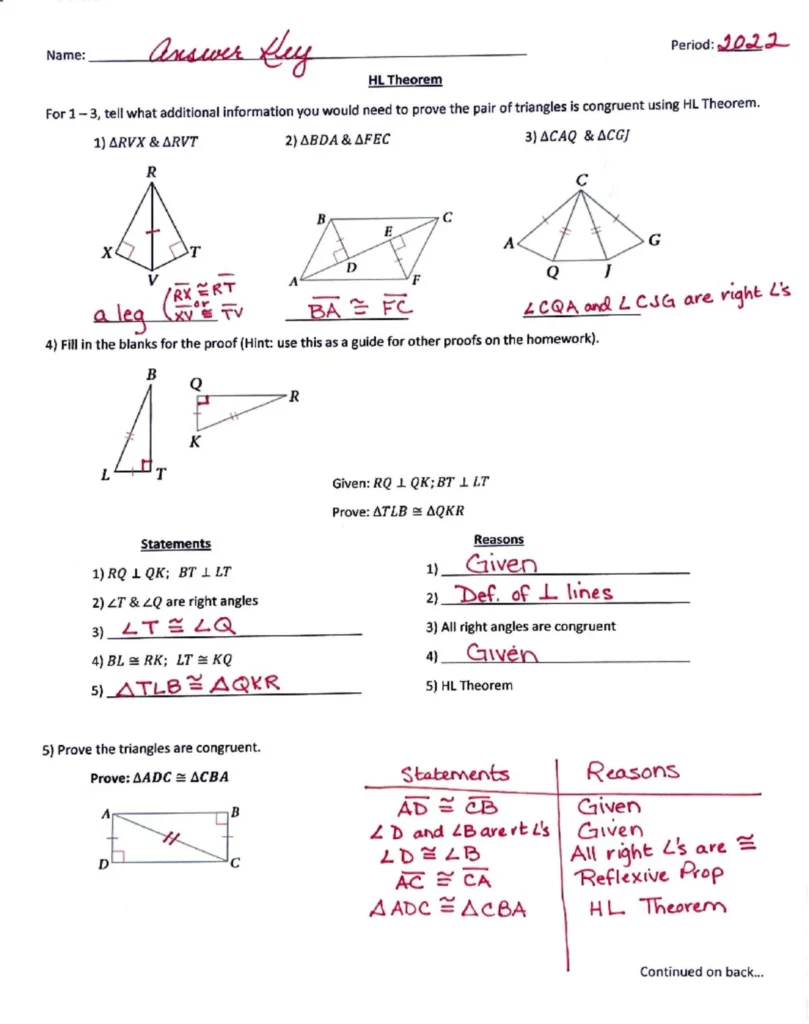
When Can You Use HL Theorem?
You can use the HL congruence rule only when:
- Both triangles are right triangles (90° angle)
- The hypotenuse is equal
- One corresponding leg is equal
Important:
If the triangle is not a right triangle, HL theorem does NOT apply.
HL Theorem Diagram
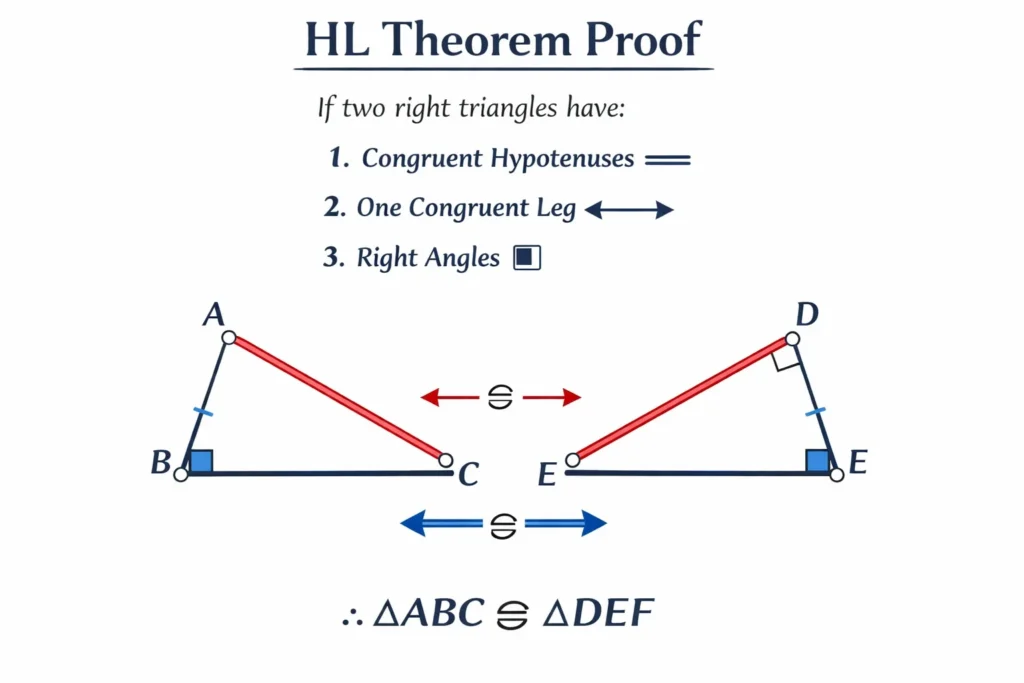
Follow these exact steps in any geometry proof:
Step 1: Prove Both Triangles Are Right Triangles
Show that each triangle has a 90° angle.
Example:
∠A = 90° and ∠D = 90°
Step 2: Identify the Hypotenuse
The hypotenuse is the longest side opposite the right angle.
Example:
AC = DF (hypotenuse)
Step 3: Identify One Equal Leg
Find one pair of equal corresponding sides.
Example:
AB = DE (leg)
Step 4: Apply HL Theorem
Now conclude:
△ABC ≅ △DEF by HL theorem
Example 1: HL Theorem Proof
Given:
- Two right triangles
- AC = DF (hypotenuse)
- AB = DE (leg)
Proof:
- ∠A = ∠D = 90°
- AC = DF
- AB = DE
- Therefore, △ABC ≅ △DEF (HL theorem)
Example 2 (Exam Style Question)
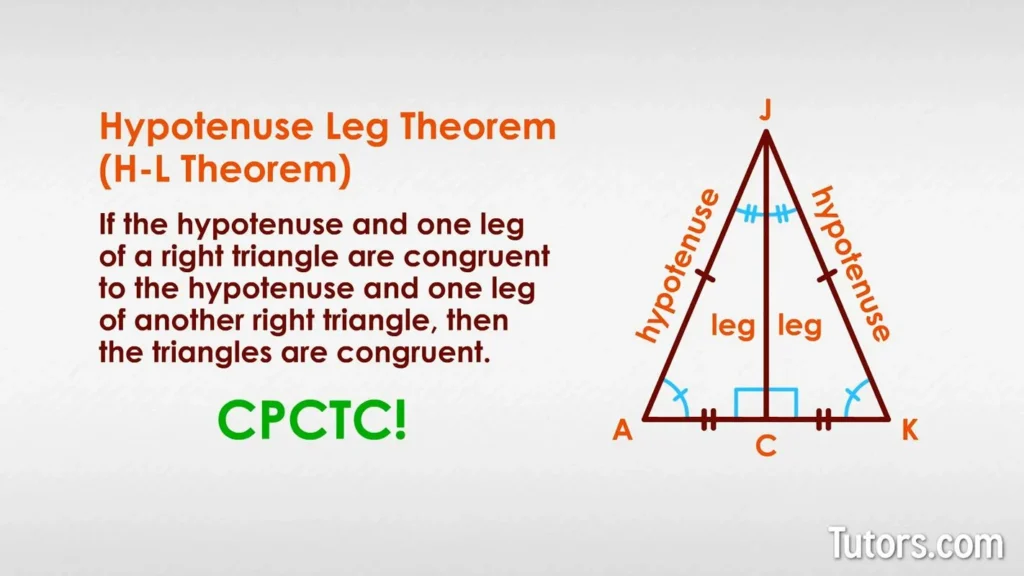
Given:
- ∠X and ∠Y are right angles
- XZ = AC (hypotenuse)
- XY = AB (leg)
Proof:
- Both triangles are right triangles
- Hypotenuse XZ = AC
- Leg XY = AB
- Therefore, triangles are congruent by HL theorem
Why Does HL Theorem Work?
The HL theorem works because a right triangle is uniquely determined by:
- Its hypotenuse
- One leg
This means only one triangle can exist with those measurements, so the triangles must be congruent.
Common Mistakes in HL Theorem
Students often make these mistakes:
- Using HL on non-right triangles
- Confusing the hypotenuse with a leg
- Not proving the right angle first
Always check all three HL conditions before applying the rule.
HL vs Other Triangle Congruence Rules
- HL → Right triangle + hypotenuse + one leg
- SAS → Two sides and included angle
- SSS → All three sides
HL is special because it works only for right triangles.
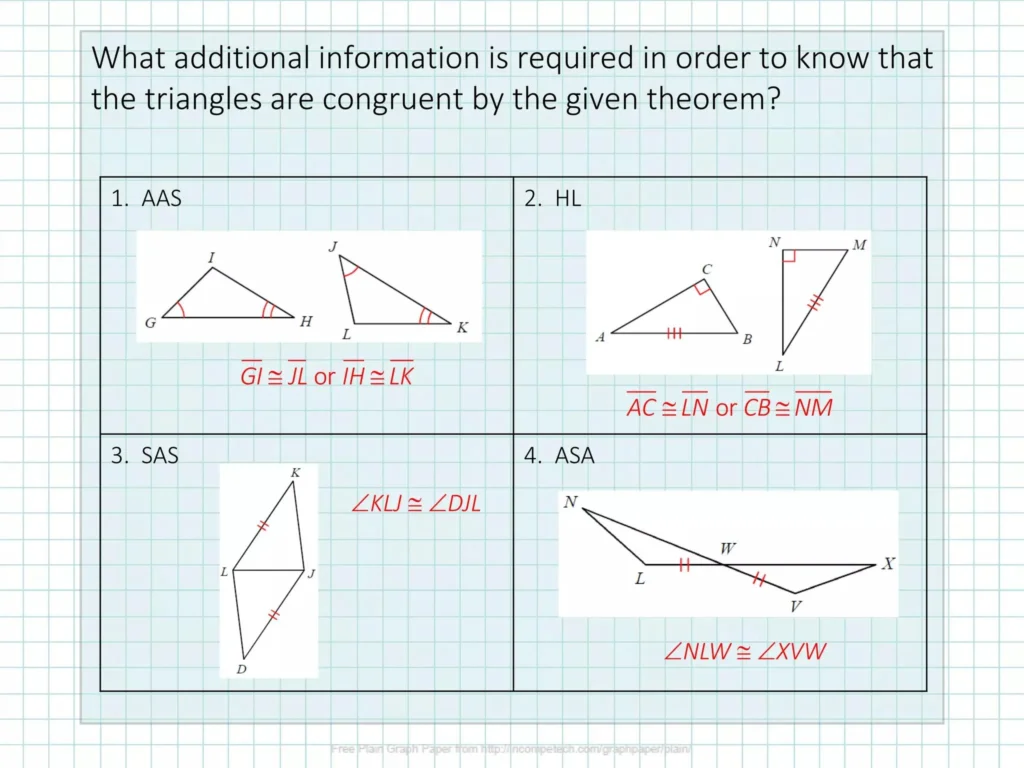
Practice Questions
Question 1:
Two right triangles have hypotenuse = 10 cm and one leg = 6 cm. Are they congruent?
Answer: Yes, by HL theorem
Question 2:
Two triangles have one equal side and one equal angle. Can HL be used?
Answer: No
FAQs
How do you prove HL theorem in geometry?
You prove HL theorem by showing:
- Both triangles are right triangles
- Hypotenuse is equal
- One leg is equal
Is HL the same as RHS?
Yes, HL (Hypotenuse-Leg) is also called RHS (Right angle–Hypotenuse–Side).