
Last Updated on April 26, 2026
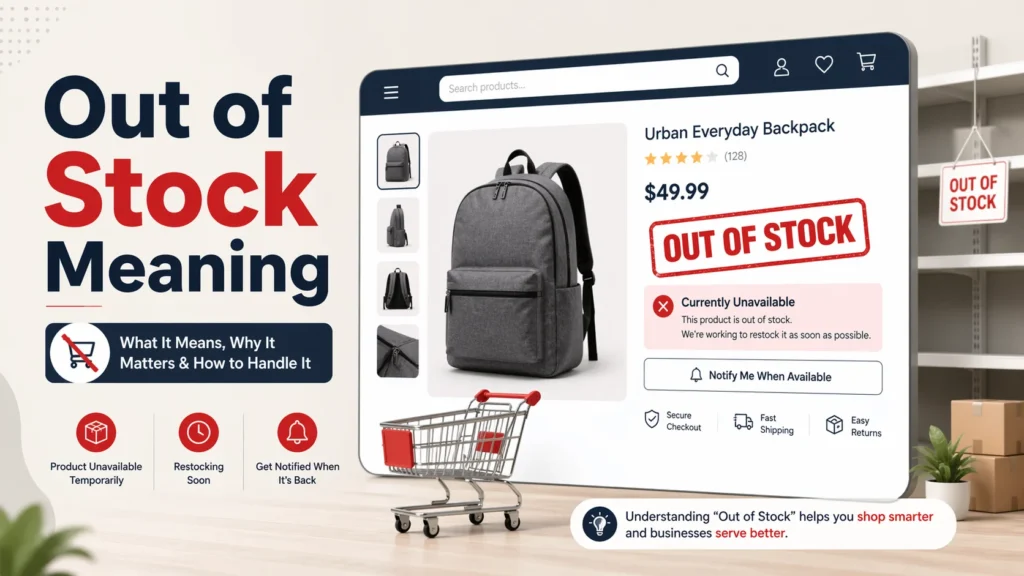
Out of stock means that a product is temporarily unavailable because the seller has no units left to sell. The item may return later when inventory is replenished, unless it is discontinued or permanently unavailable.
Ever clicked “Add to Cart,” only to see the dreaded words “out of stock”? It is a tiny phrase, but it can stop a purchase, delay a plan, or send shoppers looking elsewhere. For businesses, it can mean missed revenue. For customers, it usually means one thing: you cannot buy this product right now.
The phrase out of stock is common in online shopping, retail stores, warehouses, restaurants, pharmacies, and supply chains. It tells customers that demand has exceeded available inventory, or that the seller has not restocked the product yet.
In this guide, you will learn the full out of stock meaning, where the phrase comes from, how it is used in real life, how it compares with similar terms like sold out, backordered, and discontinued, plus polite alternatives and practical examples. 🛒
What Does “Out of Stock” Mean?
Out of stock means a product is not available for sale because the seller currently has no inventory left.
In simple terms:
Out of stock = none available right now.
For example:
- “This phone case is out of stock.”
- “The blue jacket is out of stock in medium.”
- “Sorry, that medicine is currently out of stock.”
- “The item is out of stock online but available in select stores.”
The phrase usually applies to physical goods, such as clothes, electronics, groceries, books, cosmetics, medicine, furniture, or spare parts. It can also apply to digital codes, tickets, or limited-access items, though “unavailable” or “sold out” may be more common there.
Key Meaning
| Term | Meaning |
|---|---|
| Out of stock | The seller has no units available right now |
| May return? | Yes, often after restocking |
| Common in | Retail, e-commerce, inventory, warehouses |
| Customer impact | Cannot buy immediately |
| Business impact | Lost sales, customer frustration, restock pressure |
Origin of “Out of Stock”
The phrase out of stock comes from the business and retail meaning of stock, which refers to goods, supplies, or merchandise kept available for sale.
The word stock has long been used in commerce to describe a store’s supply of items. A shop’s “stock” is everything it has available for customers. When that supply runs out, the item is literally out of stock.
The phrase became especially common as modern retail grew. Physical stores needed clear ways to tell customers when shelves were empty. Later, e-commerce websites made the phrase even more visible by placing labels such as:
- Out of stock
- Currently unavailable
- Notify me when available
- Restocking soon
- Sold out
Today, “out of stock” is one of the most familiar inventory phrases in online shopping.
Why “Out of Stock” Became So Popular
The phrase became popular because it is short, clear, and useful. Customers immediately understand it.
In e-commerce, the phrase is especially important because customers cannot physically check shelves. A website must show inventory status clearly so shoppers know whether they can complete a purchase.
Common places you will see out of stock include:
- Product pages
- Shopping carts
- Store inventory systems
- Warehouse dashboards
- Customer service messages
- Restaurant menus
- Pharmacy listings
- Marketplace platforms
- Order confirmation emails
For example, an online store might display:
Out of stock Join the waitlist to be notified when this item returns.
That sentence does more than explain availability. It also keeps the customer interested.
Real-World Usage of “Out of Stock”
The phrase is used in both casual and professional situations.
In Online Shopping
A customer may see:
“This item is currently out of stock.”
This means the website cannot fulfill an order for that item right now.
In a Physical Store
A shop assistant might say:
“We are out of stock in that size, but we may receive more next week.”
This means the store does not have the requested item available at the moment.
In Customer Service
A support agent might write:
“We apologize, but the product is temporarily out of stock. We expect a restock soon.”
This sounds professional and customer-friendly.
In Inventory Management
A warehouse team might say:
“SKU 4592 is out of stock.”
This means that specific product code has reached zero available units.
Examples of “Out of Stock” With Tone
The phrase itself is neutral, but the surrounding words can make it sound friendly, professional, frustrating, or dismissive.
Example Table: “Out of Stock” in Different Tones
| Tone | Example | How It Feels |
|---|---|---|
| Friendly | “Oops! This item is out of stock, but we’ll let you know when it’s back 😊” | Helpful and warm |
| Neutral | “This product is currently out of stock.” | Clear and factual |
| Professional | “We apologize, but this item is temporarily out of stock.” | Polite and businesslike |
| Urgent | “Out of stock limited restock expected soon!” | Creates demand |
| Negative | “It’s out of stock. Check later.” | Brief and unhelpful |
| Dismissive | “We don’t have it.” | May sound careless |
| Customer-focused | “This size is out of stock, but similar styles are available.” | Useful and solution-oriented |
Punctuation also changes the feeling:
- “Out of stock.” → plain and neutral
- “Out of stock!” → more urgent or dramatic
- “Out of stock 😭” → casual, playful, disappointed
- “Currently out of stock back soon.” → professional and reassuring
For business writing, the best tone is usually clear, polite, and helpful.
“Out of Stock” vs. Similar Terms
Many related terms sound similar, but they do not always mean the same thing.
Comparison Table
| Term | Meaning | Is It Temporary? | Example |
|---|---|---|---|
| Out of stock | No inventory available right now | Usually yes | “The shampoo is out of stock.” |
| Sold out | All available units have been purchased | Often yes | “The concert tickets are sold out.” |
| Backordered | Customers can order now, but delivery happens later | Yes | “The laptop is on backorder.” |
| Unavailable | Cannot be purchased or accessed | Maybe | “This item is unavailable in your region.” |
| Discontinued | No longer produced or sold | Usually no | “This model has been discontinued.” |
| Temporarily unavailable | Not available now, but may return | Yes | “The product is temporarily unavailable.” |
| Low stock | Only a few units remain | Not yet out | “Low stock: only 3 left.” |
| Stockout | Business/inventory term for zero stock | Usually yes | “A stockout occurred during peak demand.” |
Out of Stock vs. Sold Out
Out of stock and sold out are often used interchangeably, but there is a slight difference.
Out of stock focuses on inventory status. It means the seller has no available units.
Sold out focuses on demand. It suggests that customers bought all available units.
Example:
- “The item is out of stock.” → inventory is zero.
- “The item sold out in two hours.” → customers bought everything quickly.
Sold out often feels more exciting or demand-driven. It is common for events, limited editions, and popular launches.
Example:
“Our limited-edition sneakers sold out overnight.”
That sounds more energetic than:
“Our limited-edition sneakers are out of stock.”
Both may be true, but the tone is different.
Out of Stock vs. Backordered
A product that is out of stock cannot usually be purchased immediately. A backordered product can often still be ordered, but it will ship later.
Example:
“This camera is out of stock.”
You cannot buy it now.
“This camera is backordered.”
You can buy it now, but delivery will be delayed.
For customers, backordered is more useful because it gives them a path forward. For businesses, offering backorders can help capture sales even when inventory is temporarily unavailable.
Out of Stock vs. Discontinued
This distinction matters a lot.
Out of stock usually means the item may return.
Discontinued means the item is no longer being produced or sold.
Example:
“The red blender is out of stock.”
It might come back.
“The red blender has been discontinued.”
It probably will not come back.
If you are writing for customers, avoid using out of stock when the product is actually discontinued. That can create false expectations.
Common Reasons Products Go Out of Stock
A product may go out of stock for many reasons. Some are predictable. Others are sudden.
Common Causes
- High demand: More people bought the item than expected.
- Seasonal trends: Holiday, summer, school, or event-related demand increased.
- Supply chain delays: Suppliers, manufacturers, or shipping partners were delayed.
- Production limits: The manufacturer cannot produce enough units.
- Inventory errors: The system showed stock that was not actually available.
- Limited edition release: Only a small quantity was produced.
- Supplier issues: Raw materials or components were unavailable.
- Promotions or discounts: A sale caused faster-than-normal purchases.
Example:
A skincare brand runs a 40% discount on its bestselling serum. The product sells faster than expected and becomes out of stock within one day.
This does not necessarily mean poor planning. Sometimes demand simply exceeds expectations.
How Customers Understand “Out of Stock”
To customers, out of stock can mean several things emotionally:
- “I missed my chance.”
- “I need to wait.”
- “I should look somewhere else.”
- “Maybe this product is popular.”
- “Maybe this store is unreliable.”
That is why wording matters. A plain “out of stock” message gives information, but it does not guide the customer.
Better messaging includes:
- When the item may return
- Whether similar products are available
- Whether the customer can join a waitlist
- Whether another size, color, or location has stock
- Whether the product is discontinued
Compare these:
“Out of stock.”
Better:
“This item is currently out of stock. Join the waitlist and we’ll email you when it returns.”
Even better:
“This item is temporarily out of stock. A restock is expected soon. You can join the waitlist or view similar products below.”
The second and third versions reduce frustration because they offer a next step.
Professional Ways to Say “Out of Stock”
Sometimes “out of stock” is perfectly fine. Other times, a softer or more polished phrase works better.
Polite Alternatives
| Alternative | Best Used For |
|---|---|
| Currently unavailable | General product pages |
| Temporarily unavailable | Products expected to return |
| Restocking soon | Items with planned replenishment |
| Available again soon | Friendly customer-facing copy |
| Not available at the moment | Customer service replies |
| Currently sold out | Popular or limited items |
| On backorder | Items customers can still order |
| Unavailable in this size/color | Variant-specific inventory |
| No longer available | Discontinued products |
Customer Service Examples
Friendly:
“Sorry, this item is currently out of stock. We’re working to bring it back soon.”
Professional:
“We apologize for the inconvenience. This product is temporarily unavailable due to high demand.”
Helpful:
“This size is out of stock, but the same style is available in black and navy.”
Clear and honest:
“This item is no longer available and will not be restocked.”
How to Use “Out of Stock” in a Sentence
Here are common sentence patterns.
Basic Use
- “The product is out of stock.”
- “We are out of stock at the moment.”
- “That size is out of stock.”
- “The item went out of stock yesterday.”
Online Store Use
- “This item is currently out of stock online.”
- “Out of stock notify me when available.”
- “This product is out of stock in your selected location.”
Business Use
- “The warehouse is out of stock on this SKU.”
- “We experienced a stockout due to unexpected demand.”
- “Inventory will be replenished next week.”
Customer Support Use
- “Unfortunately, this item is out of stock right now.”
- “We expect the product to be back in stock soon.”
- “Would you like to be notified when it returns?”
“Out of Stock” in E-Commerce SEO
For online stores, out-of-stock products can affect user experience and search performance. A product page with no stock can still rank, but it should be handled carefully.
Good Practices for Out-of-Stock Product Pages
- Keep the page live if the product will return.
- Add a notify me button.
- Mention expected restock timing if available.
- Recommend similar products.
- Show available variants.
- Avoid misleading “in stock” labels.
- Update structured product information if used.
- Do not delete popular pages too quickly.
A helpful product page might say:
“This item is temporarily out of stock. Sign up for restock alerts or browse similar products.”
That keeps visitors engaged instead of sending them away.
Alternate Meanings of “Out of Stock”
The main meaning of out of stock is commercial: no product inventory is available.
However, people sometimes use it casually or humorously to mean they have run out of something non-physical.
Examples:
- “I’m out of stock on patience today.”
- “My brain cells are out of stock after that meeting.”
- “Motivation is out of stock this Monday.”
These uses are playful and informal. They are not standard business usage, but they can work in jokes, social media posts, or casual conversations.
For professional writing, use the phrase mainly for inventory, products, and supplies.
Related Words and Phrases
Here are useful keyword variations and related terms:
- out of stock meaning
- meaning of out of stock
- currently out of stock
- temporarily out of stock
- out of stock item
- product out of stock
- item unavailable
- sold out meaning
- back in stock
- restock
- stock availability
- inventory shortage
- stockout
- no longer available
- unavailable for purchase
These terms often appear together because they all relate to product availability.
What to Do When an Item Is Out of Stock
For shoppers, an out-of-stock message does not always mean the end of the search.
Practical Tips
- Join the restock alert list.
- Check other sizes, colors, or models.
- Search nearby store availability.
- Contact customer support.
- Ask when restocking is expected.
- Look for similar products.
- Compare other sellers.
- Avoid panic buying from unreliable sources.
For example, if a laptop is out of stock at one retailer, it may still be available from the manufacturer or another authorized seller.
What Businesses Should Do When Products Are Out of Stock
Out-of-stock products are frustrating, but businesses can handle them well with clear communication.
Best Practices
- Be honest
Do not show an item as available if it cannot be shipped. - Give a timeline when possible
“Expected back in stock in early June” is more helpful than “check later.” - Offer restock notifications
Email or SMS alerts help recover sales. - Suggest alternatives
Recommend similar products, colors, or bundles. - Explain briefly
“Due to high demand” can reduce frustration. - Avoid blaming the customer
Keep the tone polite and solution-focused. - Update inventory quickly
Nothing annoys customers more than ordering an item and later learning it was unavailable.
FAQs
1. What does out of stock mean?
Out of stock means a product is currently unavailable because the seller has no units left in inventory. It may become available again after restocking.
2. Does out of stock mean sold out?
Not always. Sold out means all available units were purchased, while out of stock simply means there are no units available right now. In many shopping situations, the terms are used similarly.
3. Will an out-of-stock item come back?
It might. If the item is temporarily out of stock, it may return after restocking. If it is discontinued, it probably will not come back.
4. What does temporarily out of stock mean?
Temporarily out of stock means the product is unavailable right now but is expected to return later. This phrase is more reassuring than simply saying “out of stock.”
5. What is the difference between out of stock and backordered?
An out-of-stock item usually cannot be purchased immediately. A backordered item can often still be ordered, but shipping will happen later when inventory becomes available.
6. Why do products go out of stock?
Products go out of stock because of high demand, supply delays, production issues, inventory mistakes, seasonal trends, promotions, or limited quantities.
7. How do you politely say an item is out of stock?
You can say:
“Unfortunately, this item is currently unavailable. We expect it to be restocked soon and can notify you when it returns.”
8. What does out of stock mean on Amazon or online stores?
On Amazon or other online stores, out of stock means the item is not available for purchase or immediate shipment from that seller at the moment. It may return later, depending on supply.
Conclusion
The meaning of out of stock is simple: a product is not available because there is no inventory left right now. However, the phrase carries important meaning for both shoppers and businesses.
For customers, it means they may need to wait, choose an alternative, or check another seller. For businesses, it signals the need for better inventory planning, clear communication, and helpful next steps.
The most important points are:
- Out of stock means unavailable due to zero inventory.
- It is often temporary, but not always.
- Sold out emphasizes demand.
- Backordered means delayed but still orderable.
- Discontinued means the product likely will not return.
- Clear, polite wording improves customer trust.
- Helpful alternatives and restock alerts can prevent lost sales.
A simple phrase like “out of stock” can either frustrate customers or guide them smoothly to the next best option. The difference is in the wording, timing, and support around it. ✅

Ethan Ware is a digital writer and internet culture enthusiast who stays on top of the latest slang, trends and viral phrases. He specializes in making modern language easy to understand for readers of all ages.