
Last Updated on May 11, 2026
MMO stands for Massively Multiplayer Online. In gaming, it refers to online games where thousands (or even millions) of players can interact, cooperate, and compete in a persistent virtual world at the same time.
Whether you’re a casual gamer, an aspiring streamer, or someone curious about the gaming world, understanding what MMO means is essential. These games have transformed gaming from solo adventures into vast, interconnected experiences. Let’s dive in!
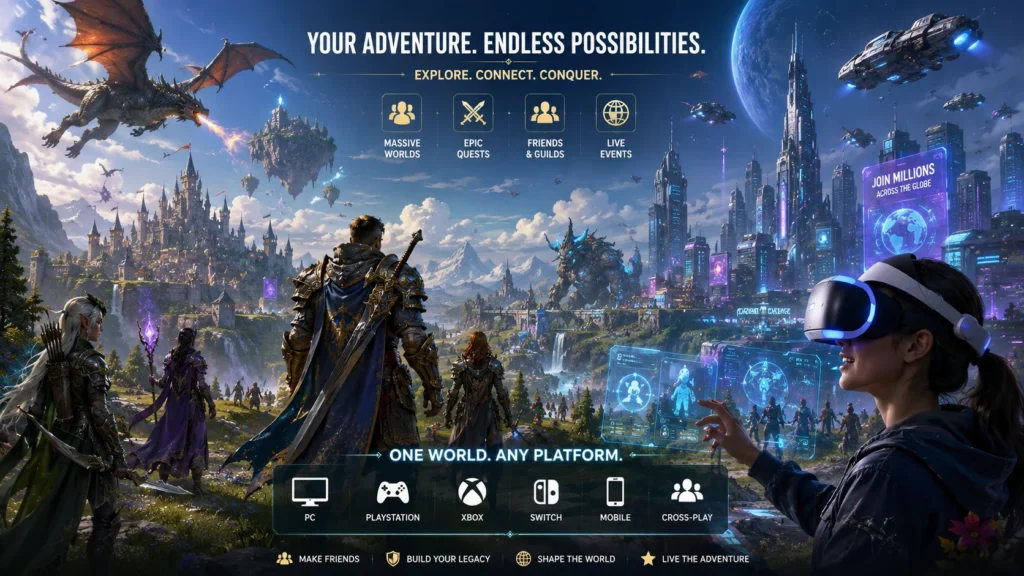
MMOs are not just games; they are social platforms where you can explore, fight, trade, and form alliances with people from all over the world. Imagine stepping into a massive fantasy or sci fi universe where the world never sleeps, and other players can affect your experience. 🛡️✨
Key points about MMOs:
- Persistent Worlds: The game world continues to evolve even when you’re offline.
- Massive Community: Play with thousands of real players at once.
- Social Interaction: Form guilds, chat, trade, or compete.
- Varied Gameplay: PvE (Player vs Environment) and PvP (Player vs Player) modes.
The Origin and History of MMOs
MMO gaming has a rich history dating back to the early days of online connectivity:
| Year | Milestone |
| 1978 | MUD1 – The first text based multi user dungeon, the ancestor of MMOs. |
| 1991 | Neverwinter Nights (AOL) – One of the first graphical MMOs. |
| 1997 | Ultima Online – Popularized MMORPGs, setting the modern standard. |
| 2001 | RuneScape – Accessible browser based MMO, massive global player base. |
| 2004 | World of Warcraft – Revolutionized MMOs with millions of players worldwide. |
The popularity of MMOs surged due to internet accessibility, engaging storylines, and the appeal of interacting with real people in immersive worlds.
Features That Define an MMO
MMOs are more than just online games. Here are the core features that make a game an MMO:
Persistent World
The game world exists and changes even when you’re offline. For example, in World of Warcraft, territories can be contested or events occur while you’re away.
Massive Player Base
Thousands or even millions of players participate simultaneously. You can run into friends, rivals, or strangers in the same space.
Character Progression
Players can level up characters, acquire gear, and develop unique skills over time.
Social Features
Guilds, chat systems, trading markets, and collaborative quests encourage social interaction.
In Game Economy
Many MMOs feature virtual economies where players can trade items, gold, or services, sometimes even with real world money involved.
PvE and PvP Modes
- PvE (Player vs Environment): Players fight AI controlled enemies.
- PvP (Player vs Player): Players compete against each other directly.
Popular MMO Examples
Here’s a list of widely recognized MMOs across different genres:
| Game | Genre | Platform | Notable Features |
| World of Warcraft | MMORPG | PC | Rich lore, raids, guilds, PvP battlegrounds |
| Final Fantasy XIV | MMORPG | PC, Console | Story driven quests, beautiful graphics, large community |
| RuneScape | MMORPG | Browser, PC, Mobile | Accessible, sandbox style gameplay, free to play option |
| EVE Online | Sandbox MMO | PC | Player driven economy, space battles, politics |
| Guild Wars 2 | MMORPG | PC | Dynamic events, flexible class system, no subscription needed |
Tone Insight: Some gamers love MMOs for social interaction, others criticize them for grinding or subscription fees. Both perspectives are valid.
MMO vs Other Game Genres
It’s important to distinguish MMOs from other gaming terms:
| Term | Meaning | MMO Comparison |
| RPG | Role Playing Game | MMOs often include RPG elements like quests and character progression. |
| MMORPG | Massively Multiplayer Online RPG | A subgenre of MMO focused on RPG mechanics. |
| FPS | First Person Shooter | Some MMOs include FPS elements but MMOs are defined by massive online interaction. |
| Battle Royale | Multiplayer survival | Usually smaller scale than MMOs; the world isn’t persistent. |
Understanding these distinctions helps avoid confusion and guides you in choosing the right game.
Alternate Meanings of MMO
While in gaming, MMO always stands for Massively Multiplayer Online, outside gaming, it can occasionally mean:
- Make Money Online – commonly in business or internet marketing contexts.
- Mixed Metal Oxide – in chemistry and materials science.
However, in the gaming community, these alternate meanings are rarely used. 🎮
Pros and Cons of MMOs
Pros
- Social Interaction: Meet players worldwide.
- Continuous Content: Expansions, updates, and events keep gameplay fresh.
- Immersive Worlds: Persistent worlds allow for deeper engagement.
- Collaborative Gameplay: Teamwork in raids, quests, and guilds.
Cons
- Time Consuming: Progression often requires hours of gameplay.
- Subscription Costs: Some MMOs require monthly fees.
- Addictive Potential: Can become a hobby that consumes excessive time.
- Toxic Communities: Not all players are friendly; PvP interactions can be harsh.
FAQs
1. What does MMO stand for in gaming?
It stands for Massively Multiplayer Online, describing games with large numbers of players in a shared virtual world.
2. Are MMOs free to play?
Some are free (e.g., RuneScape), while others require subscriptions (e.g., World of Warcraft). Many offer both free and premium options.
3. How many players can join an MMO?
It varies: small scale servers may host hundreds, while large ones support millions worldwide.
4. What is the difference between MMO and MMORPG?
MMORPGs are MMOs with a focus on role playing game elements, such as quests, character leveling, and storytelling.
5. Can MMOs be played on consoles?
Yes, many MMOs support consoles (e.g., Final Fantasy XIV on PS4/PS5).
6. Are MMOs addictive?
They can be, due to persistent worlds, social interaction, and progression systems. It’s important to manage playtime.
7. Do MMOs have in game economies?
Yes, many MMOs feature player driven markets for trading items, currency, and services.
8. Can I play MMOs solo?
Yes, but social interaction is a core feature. Some content may be challenging without groups or guilds.
Conclusion
MMOs have revolutionized gaming by combining massive communities, persistent worlds, and social interaction. They offer immersive experiences that can be both rewarding and challenging. 🌟
- MMO = Massively Multiplayer Online
- They can be free to play or subscription based
- Core features include persistent worlds, large player bases, and social interaction
- Examples include World of Warcraft, Final Fantasy XIV, and RuneScape
Practical Tips for Beginners:
- Choose the right MMO: Consider genre, platform, and community size.
- Start small: Focus on beginner quests and tutorials.
- Join a guild: Social interaction enhances enjoyment.
- Manage your time: Set limits to avoid burnout.
- Stay safe online: Protect personal information and avoid scams.

James Colton is a language researcher and content writer who loves exploring the deeper meanings behind everyday words. With a background in linguistics, he breaks down complex terms into simple, clear explanations that anyone can understand.