Last Updated on May 11, 2026
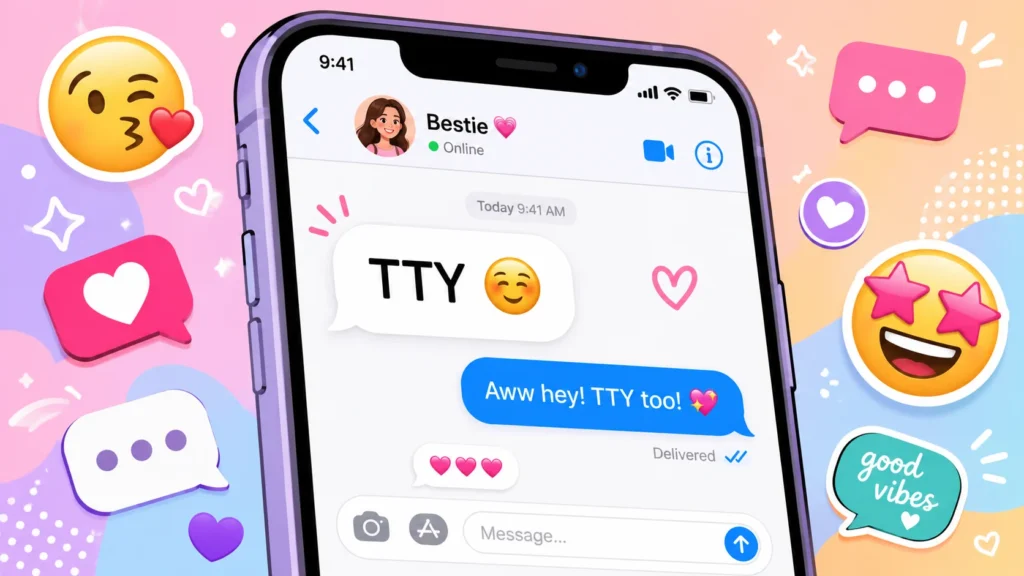
TTY in texting stands for “Talk To You”. It’s an informal abbreviation commonly used in text messages, chats, and online conversations to indicate that the sender will talk to the recipient later, often implying a friendly goodbye or temporary pause in the conversation.
Texting abbreviations are everywhere some are obvious, some require a little decoding. Among these, TTY might seem like just another random combination of letters. But for anyone navigating digital conversations, understanding this abbreviation can save confusion and help you communicate more naturally. In this article, we break down what TTY means, its origins, real world usage, and even some professional alternatives.
The Meaning of TTY in Texting
As mentioned, TTY stands for “Talk To You”. Usually, it’s used in texting or messaging to imply:
- “I’ll talk to you later.”
- “Let’s continue this conversation soon.”
- “Goodbye for now.”
It’s casual, friendly, and typically appears at the end of a text conversation.
💡 Pro Tip: TTY can be paired with other abbreviations like TTYL (Talk To You Later) to clarify timing. While “TTY” is shorter, “TTYL” is more specific and widely recognized.
Origin and Popularity
The abbreviation TTY is derived from early texting and online chat culture, where users preferred shorter forms of words to save typing time.
- Timeline:
- Late 1990s to early 2000s: Abbreviations like “LOL,” “BRB,” and “TTY” gained popularity in MSN Messenger, AIM, and early SMS texting.
- Mid 2000s onward: “TTYL” became more common, though “TTY” persisted in informal chats.
- Why it became popular:
- Shortens typing effort
- Works well for casual conversation
- Easily fits into text messages without clutter
Interestingly, TTY is not as widely used today as it once was, but it still appears in certain circles, especially among people who prefer concise messaging.
How TTY is Used in Text Conversations
Common Usage Patterns
| Situation | Example Text | Tone |
| Ending a casual chat | “Gotta go, TTY!” | Friendly |
| Quick sign off | “Dinner time, tty 😊” | Friendly / Neutral |
| Slightly abrupt goodbye | “I can’t talk now, tty” | Neutral / Slightly dismissive |
| Reassurance | “Busy atm, tty later” | Polite / Friendly |
💬 Tips for using TTY effectively:
- Use it at the end of a conversation, not mid chat.
- Pair with emojis to soften tone.
- Avoid in professional emails or formal messages.
Examples of TTY in Context
Example 1: Friendly Chat
Alex: “Did you watch the new episode last night?”
Jamie: “Not yet 😅 tty, I’ll catch up tomorrow!”
Example 2: Neutral Pause
Sam: “Can we discuss the project now?”
Lee: “Busy at the moment, tty.”
Example 3: Slightly Dismissive Tone
Taylor: “Why didn’t you reply earlier?”
Jordan: “Sorry, tty gotta run.”
Notice how TTY can slightly shift tone based on context and punctuation. Emojis often make it feel warmer, while plain text can feel neutral or abrupt.
Comparison with Similar Abbreviations
Texting is full of abbreviations, and some are close to TTY. Here’s a quick comparison:
| Abbreviation | Meaning | Usage Notes |
| TTY | Talk To You | Casual, friendly, short sign off |
| TTYL | Talk To You Later | More explicit, widely recognized |
| BRB | Be Right Back | Temporary pause, not final goodbye |
| GTG | Got To Go | Urgent or immediate leaving, often neutral |
| CU | See You | Friendly, casual, usually for physical or virtual meet ups |
Key Takeaway: TTY is subtle and versatile, ideal for casual texting, while TTYL is more specific and widely understood.
Alternate Meanings of TTY
While texting culture defines TTY as “Talk To You,” the abbreviation has other meanings in different contexts:
- Technical:
- TTY (Teletypewriter): A device for sending typed messages over the telephone network, often used by deaf or hard of hearing individuals.
- Unix/Linux TTY: Terminal interface in computing.
⚠️ Context matters! Make sure the audience or chat environment makes it clear that TTY means “Talk To You” in casual texting, not the technical definitions.
Professional and Polite Alternatives
In professional or semi formal texting or emails, you may want to avoid TTY. Here are polite alternatives:
- Talk soon – Friendly and versatile
- Chat later – Informal but polite
- Speak with you shortly – Professional tone
- I’ll follow up – Neutral, formal
Tip: Pairing alternatives with emojis in casual work chats can make communication warmer, e.g., “Talk soon! 😊”
FAQs
1. Is TTY the same as TTYL?
- Not exactly. TTY is a shorter form meaning “Talk To You,” while TTYL explicitly implies “Talk To You Later.”
2. Can TTY be used in emails?
- It’s not recommended in professional emails. Use “Talk soon” or “I’ll follow up” instead.
3. Is TTY still popular?
- Less so than TTYL or BRB, but it’s still recognized in casual texting circles.
4. Does TTY have a negative meaning?
- Context matters. Alone, it’s neutral, but plain text usage can sometimes feel abrupt.
5. What does TTY mean with emojis?
- Emojis soften the tone, e.g., “TTY 😊” feels warm, while “TTY” alone can feel neutral.
6. Can TTY be misunderstood?
- Rarely in casual texting, but in professional or technical contexts, it might be confused with “Teletypewriter.”
7. How is TTY different from BRB or GTG?
- BRB and GTG indicate temporary absence. TTY is more of a farewell or pause in conversation.
8. Is TTY gender neutral?
- Yes, TTY is a neutral term suitable for any recipient.
Conclusion
In the ever evolving world of digital communication, abbreviations like TTY offer a quick, friendly way to end a conversation or indicate a pause. While it’s casual and concise, context is key use emojis to soften tone, avoid professional emails, and pair with TTYL when timing needs clarification.
- TTY = “Talk To You” in texting.
- Friendly, casual sign off; tone depends on punctuation and context.
- Not as widely used as TTYL, but still recognized.
- Avoid in professional communication; consider alternatives like “Talk soon” or “Chat later.”
- Understand alternate meanings in technical contexts.
💡 Practical Tip: Keep a mental “texting tone check.” A simple TTY can be friendly, neutral, or abrupt adjust according to the relationship and context.

James Colton is a language researcher and content writer who loves exploring the deeper meanings behind everyday words. With a background in linguistics, he breaks down complex terms into simple, clear explanations that anyone can understand.